
CITIES APPEAL:
Melbourne, VIC
The ICAN Cities Appeal was endorsed unanimously by the City of Melbourne on 16 October, 2018. Melbourne was the first Australian Council to endorse the Appeal.
MOTION
Moved by Cr Leppert and seconded by Cr Oke.
1. That Future Melbourne Committee:
1.1. Notes that the City of Melbourne:
1.1.1. Is a member of Mayors for Peace, the mission of which is to raise international public awareness regarding the need to abolish nuclear weapons and contribute to the realisation of genuine and lasting world peace.
1.1.2. Proudly supports the work of 2017 Nobel Peace Prize Winner the International Campaign to Abolish Nuclear Weapons (ICAN), founded in the City of Melbourne.
1.2. Endorses the ICAN Cities Appeal, that is, that the City of Melbourne “is deeply concerned about the grave threat that nuclear weapons pose to communities throughout the world. We firmly believe that our residents have the right to live in a world free from this threat. Any use of nuclear weapons, whether deliberate or accidental, would have catastrophic, far-reaching and long-lasting consequences for people and the environment. Therefore, we warmly welcome the adoption of the Treaty on the Prohibition of Nuclear Weapons by the United Nations in 2017, and we call on our national government to sign and ratify it without delay.”
Background
The ICAN Cities Appeal is a campaign run by ICAN. ICAN is approaching a large number of Councils and is using responses from Councils to advocate to government.
FURTHER ACTION:
2021: Councillor Roundtable
Councillor Rohan Leppert attended a special Councillors Roundtable hosted by ICAN Australia to celebrate the entry into force of the Treaty on the Prohibition of Nuclear Weapons in March 2021.
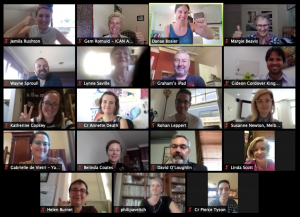
Screenshots of councillors attending an online Councillor Roundtable in March 2021.
2025: Melbourne commemorates 80th anniversaries of Hiroshima and Nagasaki
On Tuesday 5th August 2025, the City of Melbourne (VIC) passed a commemorative motion which acknowedged the 80th anniversaries of the bombings of Hiroshima and Nagasaki, and reaffirmed its support for the UN Treaty on the Prohibition of Nuclear Weapons (TPNW).
Councillor Olivia Ball moved:
1. That the Future Melbourne Committee:
1.1. notes that 6 August is Hiroshima Day and 9 August is Nagasaki Day, this year being the 80th anniversary of the atomic bombing of these Japanese cities in 1945;
1.2. commemorates with profound sorrow the massive loss of life and ongoing inter-generational consequences of radiation exposure and trauma in Japan;
1.3. notes the City of Melbourne:
1.3.1. declared itself a nuclear-free zone in 1983, along with scores of other municipalities across Australia, and hosted the Australian Nuclear-Free Zones Secretariat at Melbourne Town Hall;
1.3.2. reaffirmed its status as a nuclear-free city in 2001;
1.3.3. is a member of Mayors for Peace, which raises international public awareness of the need to abolish nuclear weapons and works for genuine and lasting world peace;
1.3.4. proudly supports the work of 2017 Nobel Peace Prize winner the International Campaign to Abolish Nuclear Weapons (ICAN), founded in the City of Melbourne;
1.3.5. was in 2018 the first of nearly 50 Australian local governments, and among hundreds of municipal governments worldwide, to express “deep concern about the grave threat that nuclear weapons pose to communities throughout the world. We firmly believe that our residents have the right to live in a world free from this threat. Any use of nuclear weapons, whether deliberate or accidental, would have catastrophic, far-reaching and long-lasting consequences for people and the environment.”
1.3.6. in 2018 called on the Australian Government to ratify the 2017 UN Treaty on the Prohibition of Nuclear Weapons;
1.3.7. upholds existing policy, namely City of Melbourne’s Procurement Policy and the principles which underpin council’s Investment Strategies, which discourage procurement or investment in entities engaged in manufacturing armaments, including nuclear weapons; and
1.3.8. will illuminate Melbourne Town Hall on 6 and 9 August 2025 in honour of Hiroshima Day and Nagasaki Day;
1.4. reaffirms our anti-nuclear stance and commitment to nuclear disarmament and peace;
1.5. requests management publicise these recommitments in communications coinciding with Hiroshima Day and Nagasaki Day; and
1.6. requests the Lord Mayor and CEO write to the Prime Minister, Foreign and Defence Ministers and Attorney-General urging them to sign and ratify without further delay the UN Treaty on the Prohibition of Nuclear Weapons.
Carried.
2025: Melbourne Town Hall Illumination
To mark the 80th anniversaries of the atomic bombings of Hiroshima and Nagasaki, the City of Melbourne illuminted the iconic Melbourne Town Hall in red on August 6th and 9th 2025.

2025: Letter to the Prime Minister
In September 2025, following the City of Melbourne’s commemorations of the 80th anniversaries of the US bombings of Hiroshima and Nagasaki, Lord Mayor of Melbourne Nicholas Reece penned a letter to Prime Minister Anthony Albanese, urging him to implement Labor’s long-standing national policy to sign and ratify the UN Treaty on the Prohibition of Nuclear Weapons (TPNW).
The letter cited Melbourne’s proud history of advocacy and leadership on nuclear weapons, highlighted the current dangers of nuclear escalation worldwide, and the unique roles of councils to speak out against these increasing risks.
We believe that the first responsibility of every level of government is the protection of its citizens and that many global challenges, including the climate crisis; and many international obligations, such as respect for and fulfilment of human rights obligations, require action by all levels of government.
Cities like ours are responsible for many of the services that would be catastrophically disrupted in a nuclear attack, rendering any meaningful health and humanitarian emergency response impossible to implement at any effective scale.
This includes maintenance of safely navigable roads, bridges and walkways; managing evacuations and provision of safer places of shelter and refuge; collection and disposal of the vast amounts of debris and waste that would be created; assisting access to food and essential services and supplies; water supply, hygiene and sewage disposal infrastructure; disposal of large numbers of corpses and mass burials; transport and communications infrastructure; disease control measures and maintaining social order, and communicating with the population.
Read the full letter, here.