Media Release: New award-winning documentary exposes unresolved nuclear legacies

Media Release: New award-winning documentary exposes unresolved nuclear legacies

CAMPAIGN NEWS:

Media Release: New award-winning documentary exposes unresolved nuclear legacies

Amidst growing international tension and conflicts involving nuclear weapon states, a new feature documentary highlighting the global legacy of nuclear testing will make its Australian premiere in Adelaide this week. 

Written and directed by award-winning British-Canadian filmmaker, Daniel Everitt-Lock, and made over three years, across five countries, including interviews with over fifty victims, survivors and descendants, ‘Our Planet, The People, My Blood’ (2026, 83 mins) serves as a powerful reminder about the human and environmental consequences of nuclear weapons testing. 

Between 1945 and 1996, more than 2,000 nuclear tests were detonated globally, directly exposing Indigenous people, citizens, and military personnel, and contaminating multiple continents. For decades, the physical, psychological and environmental impact of these tests has remained largely absent from public discourse.

The film connects firsthand testimonies from service personnel, First Nations communities, and civilian populations in the Marshall Islands, Australia, the United States, Japan, the UK and beyond—many of whom continue to suffer from cancers, birth defects and generational health conditions. These personal accounts are framed within a broader investigation into government secrecy, institutional denial and the systematic refusal to acknowledge responsibility or provide compensation.

At the centre of the narrative is a landmark legal battle led by nuclear test descendant, Alan Owen, against the UK Ministry of Defence, seeking recognition and justice for affected veterans and communities. The story expands beyond UK borders, revealing how nuclear testing created a global network of victims linked by shared exposure, silence and injustice. 

As nuclear tensions and weapons rhetoric return to the global agenda, ‘Our Planet, The People, My Blood’ reframes nuclear testing not as Cold War history, but as an unresolved humanitarian crisis with ongoing political, ethical and public health implications.

Brought to Australia by Nobel Peace Prize–winning organisation, the International Campaign to Abolish Nuclear Weapons (ICAN) the film will have its Australian premiere ahead of the ALP National Conference in Adelaide on the 23rd of July (The Mercury Cinema), followed by a screening in Perth on the 1st of August (The Backlot Perth), alongside the Australian premiere of First We Bombed New Mexico, directed by Lois Lipman (US). 

Trailers: 

Screening Details:

Including a live panel discussion with Director Daniel Everitt-Lock in conversation with The Hon Melissa Parke, Executive Director of the International Campaign to Abolish Nuclear Weapons and former Labor Member for Fremantle, Karina Lester, Yankunytjatjara-Anangu woman, second-generation nuclear test survivor, ambassador for ICAN, and an AUKUS commissioner.

With the Australian Premiere of ‘First We Bombed New Mexico’ (2023, 95 min), directed by Lois Lipman, and including a live panel discussion with: filmmaker, Daniel Everitt-Lock, ICAN Ambassador and nuclear veteran descendant, Maxine Goodwin, The Hon Josh Wilson MP, Federal Member for Fremantle, as well as the Hon Melissa Parke, Executive Director of ICAN International.

BACK TO NEWS

Media Release: Across party lines, parliamentarians unite on Nuclear Weapon Ban Treaty

Media Release: Across party lines, parliamentarians unite on Nuclear Weapon Ban Treaty

CAMPAIGN NEWS:

Media Release: Across party lines, parliamentarians unite on Nuclear Weapon Ban Treaty

Ahead of the Australian Labor Party National Conference in Adelaide, a cross-party group of ALP, Greens and Independent federal parliamentarians have united in calling on the Albanese government to sign and ratify the United Nations Treaty on the Prohibition of Nuclear Weapons (TPNW).

In a video released today, members of the Parliamentary Friends of the TPNW highlighted the ongoing environmental and humanitarian devastation inflicted on First Nations, Pacific, and veteran communities by nuclear weapons testing. They stated that Australia has a profound responsibility to stand in solidarity with frontline survivors and ensure that nuclear weapons are never used again.

“In a time of grave conflict and uncertainty around the world, like-minded governments must take concerted action against nuclear proliferation,” stated Helen Haines, Independent member for Indi.

The TPNW is “a landmark agreement that is providing much needed momentum towards the abolition of humanity’s most dangerous invention,” stated Josh Wilson, Labor Member for Fremantle. “We welcome Australia’s active engagement with the TPNW process and we’re proud of Australia’s long-standing and resolute commitment to a world without nuclear weapons.”

“Our work is supported by a majority of federal parliamentarians representing Australia’s rich and diverse communities,” stated Mark Dreyfus, Labor Member for Isaacs.

“The treaty has given countries and citizens hope and a promising new pathway towards the abolition of these weapons,” stated Senator Jordon Steele-John, federal Greens member for Western Australia. 

ICAN Australia welcomed the statements and backed calls for the government to listen to its own parliamentary ranks by signing the TPNW within this parliamentary term.

“Seeing this extraordinary cross-party unity underscores both the urgency of this issue and the clear opportunity the ALP National Conference presents,” said Janet Craven, Director at ICAN Australia. “After eight years of talking about signing and engaging as an observer state, the Albanese Government must honour its own commitment and take decisive steps toward joining the Treaty.” 

About the Parliamentary Friends of TPNW – Parliamentary Friends of the TPNW is a forum for federal parliamentarians to meet and interact with nuclear disarmament and non-proliferation advocates on matters relating to the TPNW and to discuss ways to ensure the Treaty’s success into the future. The group was launched during the 46th Parliament in June 2020, co-chaired by Ged Kearney MP (Australian Labor Party), Ken O’Dowd MP (National Party) and Senator Jordon Steele-John (Australian Greens). Current members included in the video are:


  • Josh Wilson MP (Labor Member for Fremantle and current co-chair)
  • Senator Steph Hodgins-May (Greens Senator for Victoria)
  • Dr Helen Haines MP (Independent Member for Indi and current co-chair)
  • Renee Coffey MP (Labor Member for Griffith)
  • Louise Miller-Frost MP (Labor Member for Boothby)
  • Mark Dreyfus KC, MP (Labor Member for Isaacs)
  • Senator Jordon Steele-John (Greens Senator for Western Australia)
  • Nicolette Boele MP (Independent Member for Bradfield)
  • Tania Lawrence MP (Labor Member for Hasluck)
  • Matt Smith MP (Labor Member for Leichhardt)
  • Senator David Shoebridge (Greens Senator for New South Wales and current co-chair)
  • Senator Lisa Darmanin (Labor Senator for Victoria)
  • Sharon Claydon MP (Labor Member for Newcastle)
  • Alison Byrnes MP (Labor Member for Cunningham)
  • Senator Charlotte Walker (Labor Senator for South Australia)
  • Susan Templeman MP (Labor Member for Macquarie)
  • Dr Andrew Leigh MP (Labor Member for Fenner)

BACK TO NEWS

ICAN Australia welcomes Tonga’s historic step toward a nuclear-free world & calls on Albanese to align with Pacific and also sign the Treaty on the Prohibition of Nuclear Weapons

ICAN Australia welcomes Tonga’s historic step toward a nuclear-free world & calls on Albanese to align with Pacific and also sign the Treaty on the Prohibition of Nuclear Weapons

CAMPAIGN NEWS:

ICAN Australia welcomes Tonga’s historic step toward a nuclear-free world & calls on Albanese to align with Pacific and also sign the Treaty on the Prohibition of Nuclear Weapons

MELBOURNE, AUSTRALIA – The International Campaign to Abolish Nuclear Weapons (ICAN) Australia warmly welcomes the Kingdom of Tonga’s decision to join the Treaty on the Prohibition of Nuclear Weapons (TPNW) and the Comprehensive Nuclear-Test-Ban Treaty (CTBT).

By taking this decisive step, Tonga has reaffirmed the Pacific region’s historic, unwavering leadership in global nuclear disarmament. Tonga joins the overwhelming majority of its Pacific neighbours, including Fiji, Vanuatu, Kiribati, Tuvalu, Samoa, and New Zealand, in creating a region that is ensuring nuclear weapons and testing are comprehensively rejected.

“The Pacific understands the catastrophic consequences of nuclear weapons, having borne the brunt of hundreds of nuclear explosions. By embracing the TPNW, Tonga’s actions send a clear message that real security is achieved through total prohibition and disarmament. We congratulate the government and people of Tonga for joining the TPNW, and call on the Albanese Government to now join the global majority of nations and join the TPNW without any further delay” said Janet Craven, ICAN Australia Director. 

Tonga’s accession to the TPNW places Australia’s ongoing delay in signing the UN nuclear weapon ban treaty under a sharp spotlight. Despite the Albanese Government’s stated commitment to the Pacific, and Labor’s longstanding promise to join the TPNW, Australia remains a glaring gap in a region united against nuclear arms under the TPNW.

In light of Australia’s recently inked regional security treaties and defense pacts including the  Vuvale Union with Fiji earlier this week, the federal government’s continued reliance on nuclear deterrence is at direct odds with the strategic priorities of Pacific allies. If Australia truly wishes to act as vuvale or family with our Pacific neighbours, it must align its security strategy with the region’s long-standing commitment to remaining nuclear free. 

“In a region increasingly militarised through AUKUS and great-power competition, Tonga’s accession is a powerful assertion of Pacific sovereignty. True security in the Pacific is built on a foundation of climate justice and total denuclearisation, not the false promise of extended nuclear deterrence,” stated Reverend James Bhagwan, General Secretary of the Pacific Conference of Churches.

“While our Pacific nations unite to construct a genuine Ocean of Peace, Australia’s continued reliance on nuclear deterrence remains a profound contradiction to its claims of regional family and solidarity.”

The TPNW is the first legally binding international agreement to comprehensively prohibit nuclear weapons, with provisions requiring states to assist victims and remediate environments contaminated by nuclear testing. ICAN urges the Australian government to look beyond traditional defense pacts and support the tangible humanitarian frameworks already championed by Pacific states. 

“The Pacific deserves complete freedom from nuclear weapons and their threat—not simply their management, but their total elimination. For decades, our communities and veterans have carried the severe intergenerational scars of colonial nuclear testing,” added Merewalesi Tuilau, Director of the Fiji Nuclear Veterans and Families Association.

“Australia cannot claim to stand with us in bilateral security pacts while refusing to sign the TPNW. It is time for the Albanese government to listen to the demands of Pacific states and match words with action.”

– ENDS – 

H.E. Viliami Vaʼinga Tōnē, Permanent Representative, Permanent Mission of the Kingdom of Tonga to the United Nations (center) deposits their instrument of accession with David Nanopoulos, Chief of the Treaty Section at the United Nations (right) and Seth Shelden, ICAN (left)

H.E. Viliami Vaʼinga Tōnē, Permanent Representative, Permanent Mission of the Kingdom of Tonga to the United Nations (center) deposits their instrument of accession with David Nanopoulos, Chief of the Treaty Section at the United Nations (right) and Seth Shelden, ICAN (left)

BACK TO NEWS

Pacific Voices call for urgent signature of TPNW in Canberra commemorating 80 years of nuclear harm in the region

Pacific Voices call for urgent signature of TPNW in Canberra commemorating 80 years of nuclear harm in the region

CAMPAIGN NEWS:

Pacific Voices call for urgent signature of TPNW in Canberra commemorating 80 years of nuclear harm in the region

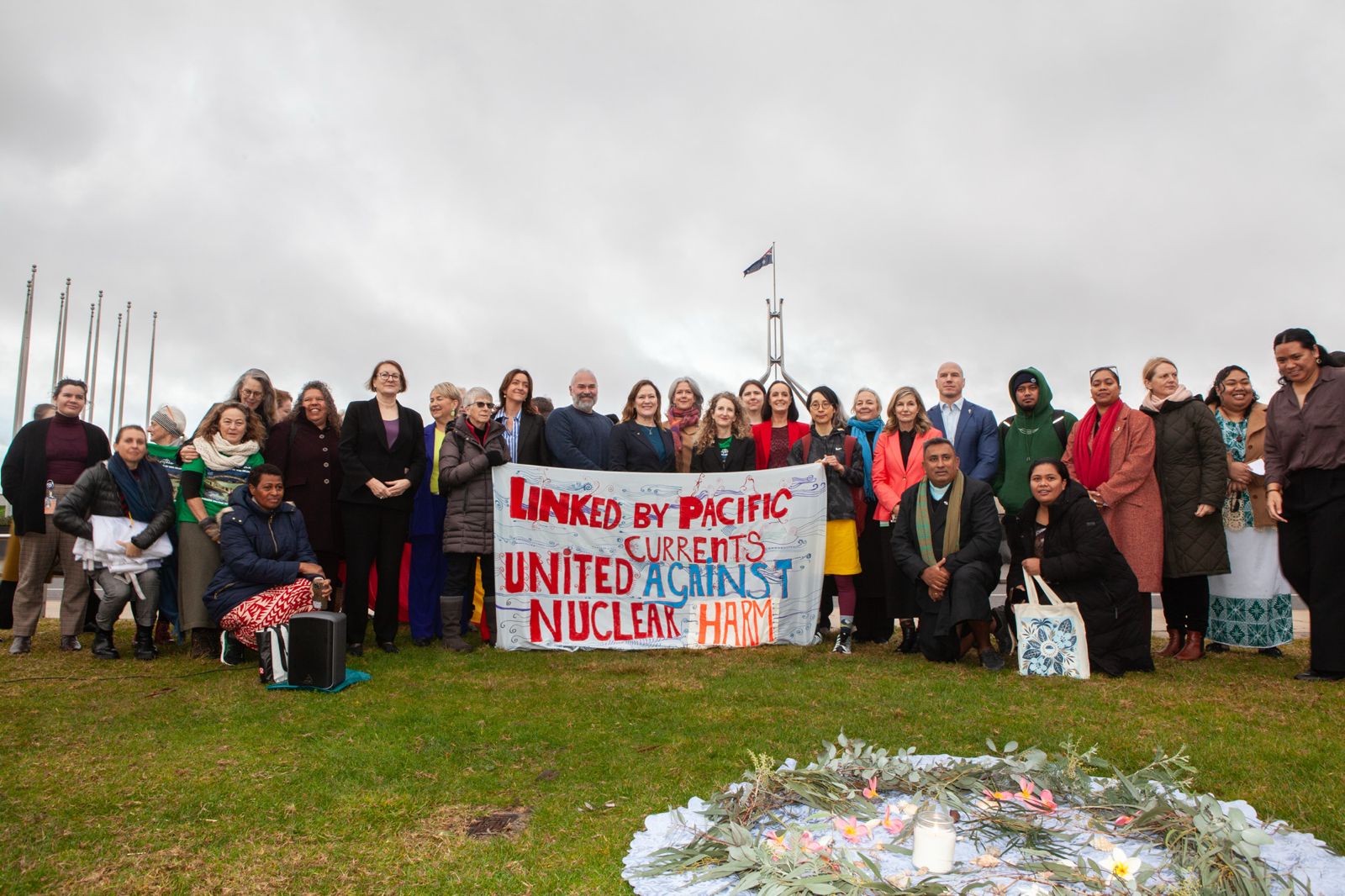
Linked By Pacific Currents, United Against Nuclear Harm


80 years on from the first of some 300 nuclear explosions conducted in the Pacific, the impact on the fragile ecology of the region and the health and mental well-being of its peoples has been profound and long-lasting. The ‘testing’ on First Nations land in Australia at Maralinga, Emu Field and the Monte Bello Islands, and across the Pacific, including in the Marshall Islands, Kiribati and Mā’ohi Nui (French Occupied Polynesia) has left behind radioactive legacies felt far beyond borders.
 

ICAN Australia supported a delegation of Pacific and Australian nuclear survivors and advocates in Canberra, Sydney and Melbourne this week to shine a light on the history and intergenerational impacts of nuclear ‘testing’ in the Pacific region, including here in Australia.

Special thanks to The Pacific Conference of Churches, the Fiji Nuclear Veterans and Families Association, the Marshall Islands Student Association, the Quakers, the Nuclear Truth Project and the Mountain Air Foundation.

Together, we welcomed nuclear-impacted communities from the Pacific and Australia for a series of events which highlighted pathways towards nuclear justice in the region and call for a future that is decolonised, demilitarised, denuclearised and decarbonised.

The delegation shared expert diverse perspectives of the enduring legacy of nuclear weapons in the region, and the iterconnected risks faced by communities due to climate change and a increased militarisation in the region. 


Meet the Delegation:

Samuel Barton is the President of the Marshall Islands Student Association (MISA), at the University of the South Pacific (USP) in Fiji, where he is in his final year studying law. Samuel was a lead organiser of the Nuclear Victims Remembrance Day event at University of the South Pacific this year. 

Merewalesi Tuilau is a rights activist, facilitator and a leader from Fiji. Her advocacy on self-determination, nuclear, and ocean issues comes from over 10 years of engagement with Pacific agencies and governments within regional civil society organisations, movements and International organisations.

Frances Namoumou is a Pacific climate justice advocate, a Methodist, and an Indigenous Fijian (i-taukei) woman whose work bridges faith, gender justice, peacebuilding, and ecological stewardship across local, regional, and global spaces.

Rev. James Bhagwan is an ordained minister, writer, preacher and regional advocate. His work is shaped by the Pacific’s experience of colonialism, militarisation and environmental harm.

Karina Lester is a Yankunytjatjara Anangu woman from the Anangu Pitjantjatjara Yankunytjatjara Lands (APY Lands) in the far northwest of South Australia. Karina is an ICAN Ambassador sharing  the impacts of the British Nuclear Tests in the 1950’s – 1960’s on people and country.

Maxine Goodwin is the daughter of an Australin nuclear veteran. In 1952, Maxine’s father, a Royal Australian Air Force radio technician, was deployed to Onslow, Western Australia, for Operation Hurricane—the first British atomic test in Australia.

Parliamentary Commemorations:

To mark two these two solemn anniversaries of nuclear testing in the Pacific region Susan Templeman MP, Labor Member for Macquarie and member of the Parliamentary Friends of the Treaty on the Prohibition of Nuclear Weapons (TPNW), moved a motion in the Federation Chamber in the House of Representatives.

Speaking to the motion Ms Templeman highlighted the shared histories of nuclear testing in the Pacific region, including in Australia, and the significant leadership of Pacific Island Nations in breathing new life into disarmament endeavours with their early embrace of the TPNW.

The motion was also spoken to by Michael McCormack MP -Nationals Member for Riverina, Matt Smith MP – Labor Member for Leichhardt, Helen Haines – Independent Member for Indi, and Joanne Ryan MP – Labor Member for Lalor.

Nicolette Boele MP, Independent Member for Bradfield also asked a question in Question time from Deputy Prime Minister and Defence Minister Richard Marles asking when Australia will sign the TPNW.

The Parliamentary Friends of the Treaty on the Prohibition of Nuclear Weapons hosted two events at Australian Parliament House: A panel event with Members, Senators and Parliamentary Staff, and a well attended Vigil on the Parliamentary Lawns on the 80th Anniversary of the first US nuclear detonation at Bikini Atoll. 

Pacific and Australian nuclear survivors and nuclear justice advocates at Parliament House alongside Parliamentarians and members of the public. Credit: Jesse Boylan.

    Media Coverage:

    The visit was widely reported in Australian media. From local radio, to a prime time spot on ABC Radio National, the demands for nuclear justice and were also included in a wide array of print and online media across the continent. Some highlights were:

    We also hosted Press conference at Australian Parliament House with Members of the Parliamentary Friends of the Treaty on the Prohibition of Nuclear Weapons Senator David Shoebridge and Andrew Wilkie MP. Watch it below.

    Public Events and Vigils:

    We were supported by ICAN partner organisations and community groups across Canberra, Sydney and Melbourne to organise a series of public events and vigils to commemorate the anniversaries and to share the lived experiences and demands of the delegation with a wide public audience. Continuing to build solidarity across the peace, faith, climate and social justice movements our event supporters throughout the week included:
      

    • Community and Public Sector Union
    • Friends of the Earth Melbourne
    • Greenpeace Australia Pacific
    • Jubilee Australia
    • Maritime Union of Australia
    • Micah Australia
    • Medical Association for the Prevention of War
    • National Council of Churches
    • Nuclear Free & Independent Pacific 
    • Nuclear Justice Project
    • Sydney Peace Foundation
    • Uniting Church in Australia – Vic/Tas 
    • Uniting Church in Australia – NSW/ACT
    • Victorian Council of Churches
    • Victorian Trades Hall Council

    Gallery:

    BACK TO NEWS

    Media Release: Pacific nuclear justice delegation call on PM to sign UN Nuclear Ban Treaty, as 80th and 60th anniversaries of Bikini and Moruroa tests mark a region still seeking justice

    Media Release: Pacific nuclear justice delegation call on PM to sign UN Nuclear Ban Treaty, as 80th and 60th anniversaries of Bikini and Moruroa tests mark a region still seeking justice

    CAMPAIGN NEWS:

    Media Release: Pacific nuclear justice delegation call on PM to sign UN Nuclear Ban Treaty, as 80th and 60th anniversaries of Bikini and Moruroa tests mark a region still seeking justice

    A delegation of Pacific nuclear survivors and advocates is in Canberra today to call on the Australian Prime Minister to sign and ratify the Treaty on the Prohibition of Nuclear Weapons (TPNW). They are joined by Anangu-Yankunytjatjara woman and second-generation nuclear test survivor Karina Lester, and members of the Parliamentary Friends of the TPNW.

    The visit falls during two significant anniversaries: July 1 marks 80 years since the first US test detonation at Bikini Atoll, Marshall Islands; July 2 marks 60 years since the first French test detonation at Moruroa Atoll, Mā’ohi Nui (French Polynesia). The anniversaries were acknowledged in a motion put forward on Monday by Labor member for Macquarie, Susan Templeman, who said: “With the legacy of nuclear testing still felt deeply in Australia, our region and across the world, we want nuclear weapons testing to be relegated to history. […] I will continue to advocate for the importance of sustained international commitment to nuclear non-proliferation, including the Treaty on Nuclear Non-Proliferation and the Treaty on the Prohibition of Nuclear Weapons.”

    “The experiences of the Marshall Islands and other Pacific communities remind us that decisions made by powerful nations can have consequences that last for generations. We ask the world to remember our history, stand with survivors, pursue nuclear disarmament, and place human dignity, justice, and peace at the centre of global decision-making.” — Samuel Barton, Marshall Islands Student Association (MISA)

    “In a region increasingly militarised through AUKUS, the Quad and great-power competition, signing the Treaty on the Prohibition of Nuclear Weapons would be a clear commitment to a nuclear-free Pacific and a genuine Ocean of Peace.” — Rev. James Bhagwan, General Secretary, Pacific Conference of Churches

    “The Pacific demands and deserves complete freedom from nuclear weapons and their threat – not simply management, but total elimination. Australia has shown it can lead. Australia must match its history with urgent new action.” — Merewalesi Tuilau, Fiji Veterans and Families Association

    “Our lands, oceans and bodies carry the nuclear radiation scars and are further at risk to the climate impacts. The Pacific has carried this legacy for 80 years. Now we ask Australia to help carry the responsibility for ensuring it is never repeated.” — Frances Namoumou, Ecumenical Animator, Ecological Stewardship and Climate Justice, Pacific Conference of Churches

    Background notes:

    • The Parliamentary Friends of the TPNW is a cross-party forum, currently made up of 47 federal parliamentarians who meet and interact with nuclear disarmament and non-proliferation advocates on matters relating to the Treaty on the Prohibition of Nuclear Weapons, and to discuss ways to ensure the Treaty’s success into the future.
    • Federal Labor committed to signing the TPNW in 2018 but has yet to do so. The delegation is highlighting the urgent need for signature ahead of the ALP National Conference later this month.The Canberra events are part of a wider lobby and advocacy tour to Canberra, Sydney and Melbourne running Monday 29 June to Friday 3 July, sharing testimony from communities affected by nuclear testing and calling for a Pacific that is decolonised, demilitarised, denuclearised and decarbonised.
    • Articles 6 and 7 of the TPNW on ‘victim assistance, environmental remediation, and international cooperation and assistance’seek to address ongoing and unresolved humanitarian, human rights, and environmental impacts from nuclear weapons.

    BACK TO NEWS

    Press Conference 80th Anniversary of First Pacific Nuclear Detonation

    Press Conference 80th Anniversary of First Pacific Nuclear Detonation

    CAMPAIGN NEWS:

    Press Conference 80th Anniversary of First Pacific Nuclear Detonation

    “An ocean of peace can only exist when the nuclear option is taken off the table.”


    Today in Canberra, a delegation of Pacific nuclear survivors and advocates addressed the press in Canberra as part of a series of Parliamentary Events to call on the Australian Prime Minister to sign and ratify the Treaty on the Prohibition of Nuclear Weapons (TPNW) on the 80th anniversary of the first nuclear test in the region. Speakers in order of appearance:

    • Senator David Shoebridge (Greens) – Co-chair of the Parliamentary Friends of the Treaty on the Prohibition of Nuclear Weapons.
    • Andrew Wilkie MP (Independent) – Member for Clarke, Tasmania.
    • Karina Lester Anangu-Yankunytjatjara woman and second-generation nuclear test survivor.
    • Reverend James Bhagwan, General Secretary, Pacific Conference of Churches.
    • Samuel Barton, President of the Marshall Islands Student Association (MISA).

    Today marks 80 years since the Pacific was marred by the first nuclear test, an atomic test in the Marshall Islands. And what followed was decades and decades of the world treating the Pacific as basically a laboratory for nuclear weapons and nuclear explosives. And the Pacific lives with that legacy. And of course, it’s not just the Pacific Islands. First Nations peoples in this country also saw their land, their country, their water, their air used for atomic experiments by the British government with the strong endorsement of the Australian government. That toxic legacy, that violent toxic legacy carries through to today.

    That is why it is incredibly important that we have First Nations leaders, Pacific leaders coming here today on that 80th anniversary and demanding a peaceful Pacific, demanding First Nations cultures, indigenous cultures, their ways of life and respect for this planet, this extraordinary blue part of the planet is actually embedded into Australian law and international law.

    And a key thing the Albanese government can do to respect that concept of a peaceful Pacific is to finally sign the treaty to prohibit nuclear weapons. The Pacific are telling us, our friends, our neighbors, our First Nations leaders in this country, they are telling us that the toxic legacy of atomic weapons never ends.  Young people continue to inherit the legacy. Justice has never been delivered for veterans in Fiji. here, the Marshall Islands or First Nations peoples in this country. And how do we prevent that injustice happening again? The best and first and best way is for Australia to sign that treaty and for the world to finally ban the bomb. I’ll hand over to my friend. 

    Senator David Shoebridge

    Co - Chair of the Parliamentary Friends of the TPNW, Australian Greens

    Thank you, Senator.


    You know, there’s over 12,000 nuclear warheads still in existence in the world. It’s down from a peak of about 60,000 warheads during the Cold War, but it’s still more than enough nuclear warheads to destroy humanity as we know it many times over. We cannot tolerate that. We can’t accept that as the status quo.

    To accept over 12,000 nuclear warheads in the arsenals of a number of countries. To accept that is to accept that we are comfortable with someone like Vladimir Putin having his finger on a red button. That we’re comfortable with someone like Donald Trump having access to thousands of nuclear warheads. That we’re comfortable with the North Korean leader having his finger on the button, the Israeli prime minister having his finger on the button. In hot spots like Pakistan and India that we’re comfortable with those two countries facing off in a very hostile relationship with between them hundreds of nuclear warheads. We cannot accept that status quo. We cannot accept it because that is to accept the fact that we will live will continue to live permanently on the brink of destruction.

    So we have to keep up the fight. Now, people might say we’re dreamers. You know, you can’t uninvent nuclear weapons. But you know what? We have to keep aspiring for that aim because we can’t accept the status quo. So, I applaud I can I call on the Australian government to do more, to sign international treaties, to to assure people that it will fight for a nuclear free world because only then will we step back from that brink of destruction.


    Andrew Wilkie MP

    Member of the Parliamentary Friends of the TPNW, Independent MP for Clark, TAS

    Thank you. Today’s a very emotional day for many of us. Not only here in Australia, but across the Pacific as we mark the 80th anniversary of the tests that took place on the Marshall Islands. I’m a Anangu woman who comes from the story and the legacy of what happened in 1953 when that dark cloud rolled over our community. Australia has a responsibility not only to us but to our Pacific friends as well

    In 2017 we had started negotiations on the treaty to prohibit nuclear weapons. That 2017 was the same year that the International Campaign to Abolish Nuclear Weapons was awarded the Nobel Peace Prize. In 2018, our prime or not our prime minister, the opposition at the time, Anthony Albanese, made a promise to sign and ratify this treaty in the national portfolio and platform. And so we are now calling again years later in 2026 for our Australian government to sign and ratify this Treaty on the Prohibition of Nuclear Weapons.

    Our Pacific friends have experience. We in First Nations and in our own country of Australia have lived experience. These weapons cause harm not only to our people, not only to our land and our oceans. It cause harm to future generations as well. So I ask the Australian government and I ask the Australian people, you know, what are our plans and why haven’t we yet signed this Treaty on the Prohibition of Nuclear Weapons?

    I want to call on our Pacific friends, Reverend James, to say a few words from the Pacific. Thank you.

    Karina Lester

    ICAN Ambassador, AUKUS Public Inquiry Commissioner

    Thank you, Karina. Good morning. Thank you everyone for being here. I represent the Pacific Conference of Churches, communities of faith from around 20 Pacific Island countries and territories who for over half a decade have been calling to an end of this shadow over our Pacific nuclear weapons. I stand with our young people here who represent affected communities, islands, oceans, people and creatures to ask when will this be signed by Australia.

    We recently last year at the Pacific Islands Forum saw the signing of the Ocean of Peace Declaration. We are calling for peace in this region. Later this year, we sign or we commemorate the 40th anniversary of the Treaty of Raaratonga, which Australia signed, declaring the South Pacific a nuclear-free zone. We commemorate this year the 30th anniversary of the Comprehensive Nuclear Test Ban Treaty, which again Australia took the lead in.

    And so we are asking Australia now to come forward, step up, sign this treaty because an ocean of peace can only exist when the nuclear option is taken off the table. This is a time of huge militarization contestation in our blue Pacific. Australia is signing a security agreements with Pacific island countries, signing treaties. There are calls for an ocean of peace treaty, but that can’t happen until we have this treaty signed. And so we I think I ask the same question that Karina asks to the people of Australia and to the Australian government. When will you sign?

    Thank you. I invite Samuel now to share a story from the Marshall Islands.
    Reverend James Shri Bhagwan

    General Secretary of the Pacific Conference of Churches

    Thank you, Reverend James.

    Hello to everyone in this room and to everyone in all of Australia. My name is Samuel Barton. I am a youth representative representing the Marshall Island Students Association and we run a campaign called the Misa for the Pacific which our work revolves around advocating for anti-nuclear and climate change activism.

    And this this day is the 80th anniversary for our islands because it’s when the initial testings uh first took place where the United States deceived my people into relocating them and erasing their land, their history and their culture and their identity. And we call upon this state to sign this treaty because we know the con what the consequences are and we know that this type of consequence transcends generations.

    Samuel Barton

    President of the Marshall Islands Student Association (MISA)

    BACK TO NEWS