The world is drifting back towards unconstrained nuclear danger – Marianne Hanson

The world is drifting back towards unconstrained nuclear danger – Marianne Hanson

CAMPAIGN NEWS:

The world is drifting back towards unconstrained nuclear danger – Marianne Hanson

The world is drifting back towards unconstrained nuclear danger

With the expiration of the New START treaty and the erosion of arms control agreements, the safeguards that once limited nuclear danger are rapidly disappearing – despite decades of evidence that restraint reduces catastrophic risk.

A number of recent developments on the nuclear weapons radar should concern us all.

On 5 February, we saw the end of the most important nuclear weapons agreement between Washington and Moscow. The NewSTART treaty, an extension of the process initiated between George H W Bush and Mikhail Gorbachev in 1991, the  Strategic Arms Reduction treaties, significantly lowered the number of strategic offensive nuclear weapons between the two states.

The treaty was suspended some years ago amid worsening relations between Washington and Moscow but it always carried the option for renewal. That option is now gone. N ewSTART’s expiration is a further nail in the coffin of attempts to reduce nuclear dangers. It marks a new low in what has been a period of disregard for the carefully achieved arms control measures of the past.

But it is just one development showing how dangerously far the world has drifted away from restraint in nuclear policies.

Most people are unaware that the very first Resolution to be adopted by the United Nations General Assembly (UNGA) on 24 January 1946 called for the establishment of mechanisms to eliminate nuclear weapons and other weapons of mass destruction from national arsenals. Adopted by consensus and supported by the major Allied powers (the United States, the United Kingdom, France, China, and the Soviet Union), Resolution 1 recognised the hugely destructive potential that nuclear weapons held.

Yet despite us knowing of these dangers, Resolution 1 has never been implemented. There are still around 12,200 nuclear weapons in existence today – held by Russia, the US, China, France, the UK, Pakistan, India, Israel, and North Korea. The combined destructive power of this remaining global arsenal is the equivalent of 146,000 Hiroshima bombs, meaning we could drop one Hiroshima-sized bomb every day for the next 400 years, or if you prefer, one every hour for the next 17 years.

All nine nuclear weapon states are modernising their arsenals, and all threaten to use them. Analysts at the Bulletin of the Atomic Scientists’ Doomsday Clock, which measures the likelihood of catastrophic nuclear war and other planetary-destroying scenarios, last month  shifted the clock’s hands from 89 to 85 seconds to midnight – the closest we have ever been to a potential nuclear disaster. This shift is the result of continued sabre-rattling between nuclear-armed states, the dangers of misperception or miscalculation, risks of cyberwarfare and AI use, and the loss of so many treaties.

This gloomy situation wasn’t always the case: at the height of the Cold War,  America and the Soviet Union regularly engaged in talks and risk-reduction measures. But New START is now expired,  and there is no chance now for either party to renew it. The treaty ensured not only that the number of deployed strategic nuclear warheads held by each side would be capped; it also allowed for the exchange of observers, transfer of information and intentions, and the development of trust and transparency between these states. That is all gone. Other treaties, notably the Intermediate Nuclear Forces Treaty, and the Open Skies Treaty, have also fallen by the wayside.

Today, it seems that complying with international law, focusing on active diplomacy and developing international confidence-building measures, have all fallen out of fashion. But it beggars belief to think that the world is safer without the rules and constraints negotiated in the past. Such agreements were seen as hard-headed and necessary. But today there is little left to limit nuclear risks.

International humanitarian law requires that nuclear weapons will never be used. Their continued existence cannot be tolerated. The dangers of accidental or deliberate use remain too high for comfort, and the cost of maintaining them is unacceptable in a world which requires urgent attention to climate change, global inequality, genocide, and other pressing issues. The excuse that these states ‘need’ these weapons for deterrence is increasingly flimsy and risky.

The UN Treaty on the Prohibition of Nuclear Weapons (TPNW) recognises that, like other weapons of mass destruction, nuclear weapons can be stigmatised, outlawed, and eventually abolished. The technology for doing so is there; so too is the will of the people – including in Australia, where the Labor government is yet to fulfil its promise to sign the TPNW.

Eighty years ago, leaders at the UN knew that nuclear weapons posed an existential danger to humanity and the planet; this judgement remains the same today. The collapse of NewSTART and nuclear restraints more generally is no accident. It is the result of political choices and can be restored in the same way. To create a safer future, the US and Russia must act with integrity now. And our government must choose to support the elimination of nuclear weapons.

The views expressed in this article may or may not reflect those of Pearls and Irritations.

BACK TO NEWS

Media Release: End of New START escalates risks for Australia

Media Release: End of New START escalates risks for Australia

CAMPAIGN NEWS:

Media Release: End of New START escalates risks for Australia

The collapse of the New START treaty on 5 February removes the last legally binding limits on the world’s two largest nuclear arsenals at a time of heightened global tension and nuclear threats.

With inspections halted, data exchanges frozen, and no successor agreement in place, the end of New START marks a decisive breakdown of nuclear restraint between Russia and the United States, which together possess 87% of the world’s nuclear weapons.

The treaty’s verification, notification, on-site inspection and dispute resolution mechanisms provided ongoing communication, reduced uncertainty and helped prevent miscalculation. Their loss deepens mistrust and increases the risk of escalation.

The end of New START also exposes a central failure of deterrence and arms control. Arms control can regulate numbers and deployments but does not eliminate nuclear weapons. When restraint collapses or accidents or cyberattack happen, so does the system meant to prevent nuclear catastrophe.

Dr Tilman Ruff, ICAN founding chair, said:

“New START was the last treaty constraint on the most destructive weapons ever built. Its collapse leaves the world more dangerous and less predictable. 

“We are back in a full-scale arms race. Russia and the US could double their deployed nuclear weapons within months of New START’s end unless President Trump takes up President Putin’s offer to continue to respect New START’s limits. He should do this urgently.”

“But this would not be enough. Nuclear-armed states should start negotiations to verifiably eliminate their Doomsday arsenals, as they committed to do more than 50 years ago in the nuclear Non-Proliferation Treaty.”

“The Treaty on the Prohibition of Nuclear Weapons lights the path forward. It draws a clear line—nuclear weapons are illegal, unacceptable, and must be eliminated— and it provides the only internationally agreed, verified, time-bound framework to do so.”

The end of New START has immediate implications for Australia. Close to half the US B52 bombers planned for ongoing deployment at RAAF Tindal in the NT starting this year—which were modified to be unable to carry nuclear weapons under the New START Treaty—can quickly again be made nuclear-capable. That would mean that for the first time in decades nuclear weapons could be brought into and launched from Australia, even without Australia knowing.

Dr Ruff said:

“Australia cannot credibly support nuclear restraint and disarmament while standing outside the global ban, which has been joined by over half the world’s nations. The best way to put sovereign guardrails excluding nuclear weapons around our military cooperation with the United States is to join the ban treaty. The end of New START makes doing that, as Labor’s national policy platform commits, more urgent.”

BACK TO NEWS

The only remaining US‑Russia nuclear treaty expires this week. Could a new arms race soon accelerate? – Tilman Ruff for The Conversation

The only remaining US‑Russia nuclear treaty expires this week. Could a new arms race soon accelerate? – Tilman Ruff for The Conversation

CAMPAIGN NEWS:

The only remaining US‑Russia nuclear treaty expires this week. Could a new arms race soon accelerate? – Tilman Ruff for The Conversation

The only remaining US‑Russia nuclear treaty expires this week. Could a new arms race soon accelerate?

Tilman Ruff, The University of Melbourne

The New START treaty, the last remaining agreement constraining Russian and US nuclear weapons, is due to lapse on February 4.

There are no negotiations to extend the terms of the treaty, either. As US President Donald Trump said dismissively in a recent interview, “if it expires, it expires”.

The importance of the New START treaty is hard to overstate. As other nuclear treaties have been abrogated in recent years, this was the only deal left with notification, inspection, verification and treaty compliance mechanisms between Russia and the US. Between them, they possess 87% of the world’s nuclear weapons.

The demise of the treaty will bring a definitive and alarming end to nuclear restraint between the two powers. It may very well accelerate the global nuclear arms race, too.

What is New START?

The New START or Prague Treaty was signed by then-US President Barack Obama and his Russian counterpart, Dimitri Medvedev, in Prague on April 8, 2010. It entered into force the following year.

It superseded a 2002 treaty that obligated Russia and the United States to reduce their operationally deployed, strategic nuclear warheads to between 1,700 and 2,200 by the end of 2012.

The New START Treaty called for further reductions on long-range nuclear weapons and provided greater specificity about different types of launchers. The new limits were:

  • 700 deployed intercontinental and submarine-launched ballistic missiles (together with heavy bombers)
  • 1,550 nuclear warheads deployed on those platforms, and
  • 800 launchers (both deployed and non-deployed).

These reductions were achieved by February 5, 2018.

The treaty included mechanisms for compliance and verification, which have worked effectively. It provided for twice-yearly exchanges of data and ongoing mutual notification about the movement of strategic nuclear forces, which in practice occurred on a nearly daily basis.

Importantly, the treaty also mandated short-notice, on-site inspections of missiles, warheads and launchers covered by the treaty, providing valuable and stabilising insights into the other’s nuclear deployments.

Lastly, the treaty established a bilateral consultative commission and clear procedures to resolve questions or disputes.

Limitations of the deal

The treaty was criticised at the time for its modest reductions and the limited types of nuclear weapons it covered.

But the most enduring downside was the political price Obama paid to achieve ratification by the US Senate.

To secure sufficient Republican support, he agreed to a long-term program of renewal and modernisation of the entire US nuclear arsenal – in addition to the facilities and programs that produce and maintain nuclear weapons. The overall pricetag was estimated to reach well over US$2 trillion.

This has arguably done more harm by entrenching the United States’ possession of nuclear weapons and thwarting prospects for disarmament.

As the New START treaty was about to expire in 2021, Russia offered to extend it for another five years, as allowed under the terms. US President Donald Trump, however, refused to reciprocate.

After winning the 2020 US presidential election, Joe Biden did agree to extend the treaty on February 3, 2021, just two days before it would have expired. The treaty does not provide for any further extensions.

In February 2023, Russia suspended its implementation of key aspects of the treaty, including stockpile data exchange and on-site inspections. It did not formally withdraw, however, and committed to continue to abide by the treaty’s numerical limits on warheads, missiles and launchers.

What could happen next

With the imminent expiry of the treaty this year, Russian President Vladimir Putin announced in September 2025 that he was prepared to continue observing the numerical limits for one more year if the US acted similarly.

Besides an off-the-cuff comment by Trump – “it sounds like a good idea to me” – the US did not formally respond to the Russian offer.

Trump has further complicated matters by insisting that negotiations on any future nuclear arms control agreements include China. However, China has consistently refused this. There is also no precedent for such trilateral nuclear control or disarmament negotiations, which would no doubt be long and complex. Though growing, China’s arsenal is still less than 12% the size of the US arsenal and less than 11% the size of Russia’s.

The New START treaty now looks set to expire without any agreement to continue to observe its limits until a successor treaty is negotiated.

This means Russia and the US could increase their deployed warheads by 60% and 110%, respectively, within a matter of months. This is because both have the capacity to load a larger number of warheads on their missiles and bombers than they currently do. Both countries also have large numbers of warheads in reserve or slated for dismantlement, but still intact.

If they took these steps, both countries could effectively double their deployed strategic nuclear arsenals.

The end of the treaty’s verification, data exchanges, and compliance and notification processes would also lead to increased uncertainty and distrust. This, in turn, could lead to a further build-up of both countries’ already gargantuan military capabilities.

An ominous warning

The most unsettling part of this development: it means nuclear disarmament, and even more modest arms control, is now moribund.

No new negotiations for disarmament or even reducing nuclear risks are currently under way. None are scheduled to begin.

At a minimum, after New START expires this week, both Russia and the US should agree to stick to its limits until they negotiate further reductions.

And, 56 years after making a binding commitment in the nuclear Non-Proliferation Treaty to achieve nuclear disarmament, both nations should work to implement a verifiable agreement among all nuclear-armed states to eliminate their arsenals.

But Russia, the US and and other nuclear-armed states are moving in the opposite direction.

Trump’s actions since taking office a second time – from bombing Iran to toppling Venezuela’s leader – show his general disdain for international law and treaties. They also affirm his desire to use any instrument of power to assert US (and his personal) interests and supremacy.

Putin, meanwhile, has used of a nuclear-capable intermediate-range ballistic missile to strike Ukraine, made repeated threats to use nuclear weapons against Kyiv and the West, and continued his unprecedented and profoundly dangerous weaponisation of Ukraine’s nuclear power plants.

These moves signal a more aggressive Russian stance that rides roughshod over the UN Charter, as well.

All of this bodes ill for preventing nuclear war and making progress on nuclear disarmament.The Conversation

Tilman Ruff, Honorary Principal Fellow, School of Population and Global Health, The University of Melbourne

This article is republished from The Conversation under a Creative Commons license. Read the original article.

BACK TO NEWS

Media Release: Doomsday Clock warns of rising nuclear danger—Australia can still change course

Media Release: Doomsday Clock warns of rising nuclear danger—Australia can still change course

CAMPAIGN NEWS:

Media Release: Doomsday Clock warns of rising nuclear danger—Australia can still change course

Today, the Bulletin of Atomic Scientists reset the Doomsday Clock from 89 to 85 seconds to midnight, signalling that humanity is moving closer to catastrophe.

The new setting reflects a world facing escalating nuclear dangers and a full-blown new nuclear arms race, widening wars, rapid advances in artificial intelligence, and the accelerating climate crisis. Together, these threats are compounding global instability and increasing the risk of miscalculation and mass harm.

A central driver of this worsening outlook is the collapse of nuclear restraint. The impending end of the New START Treaty will remove the last remaining, binding limits on the world’s two largest nuclear arsenals, stripping away vital guardrails against escalation at a time of heightened tension and mistrust.

The Doomsday Clock has long delivered a consistent message: tweaking nuclear weapons does not make the world safe. As long as these weapons exist, the risk of catastrophic use—by design, accident or miscalculation—remains.

 ICAN co-founder, A/Prof Tilman Ruff AO, said: 

“The Doomsday Clock is telling us what nuclear-armed states refuse to acknowledge: restraint is breaking down, and the danger is growing. They are repudiating international law and cooperation, making threats and using mis- and dis-information campaigns, and ratcheting up nuclear brinkmanship. ”

“With New START ending next week, the last limits on US and Russian nuclear arsenals are disappearing. Deployed nuclear weapons can be expected to rise alongside an arms race in space. Their failure of leadership puts everyone at risk.”

“Wars in Ukraine and Gaza, the integration of artificial intelligence into military systems, and the accelerating climate crisis all intensify instability—but nuclear weapons remain the most immediate existential threat.”

“Decades of arms control have failed to deliver disarmament. Now even those hard-won constraints are in tatters. Nuclear-armed states continue to modernise, expand and threaten to use their arsenals while forcing the rest of the world to live with the consequences.”

“The Treaty on the Prohibition of Nuclear Weapons exists because this approach has failed. It sets a clear international standard that nuclear weapons are illegal for everyone and must be eliminated, and includes the only internationally agreed framework for their elimination.”

Implications for Australia

The new Doomsday Clock setting reinforces the urgency for Australia to move beyond statements of concern and align its security policy with international law by joining the Treaty on the Prohibition of Nuclear Weapons. Dr Ruff said:

“Australia cannot credibly respond to this warning while standing outside the nuclear weapons ban, and providing increasing assistance for the possible use of US nuclear weapons, including by the deployment in Australia this year of B-52 bombers that can now carry nuclear weapons, and in future years, submarines that are likely to again carry nuclear weapons. Joining the treaty is the most meaningful step we can take to help turn the Doomsday Clock back.”

BACK TO NEWS

For a nuclear-free future

For a nuclear-free future

CAMPAIGN NEWS:

For a nuclear-free future

:

A farewell note from Gem Romuld, signing out as ICAN Australia Director. 

Taking on nuclear weapons is one of humanity’s greatest challenges. Not just because of the ruthless industry that develops and builds them but also due to their political status and the imaginative power they wield. It’s as if they are magical creatures, bestowing fear and exerting control wherever they are pointed. For many people, imagining the end of nuclear weapons is like imagining the end of the world as they know it; it’s a fantasy, a noble goal, but not a reasonable prospect. Half the challenge to move the conditions for nuclear disarmament forward is the mental leap; convincing others that nuclear disarmament will make them safer, that nuclear-armed leaders can disarm, that the nuclear world order is not permanent, natural or inevitable. 

It takes courage and a great deal of fierce optimism to demand nuclear abolition. That’s why I love the vision and the work of the International Campaign to Abolish Nuclear Weapons, and why I’ve been honoured to spend 12 years working on the campaign in our corner of the world. We celebrate and push for meaningful steps along the way, but never do we relent on demanding nuclear abolition. This abolitionist orientation is what makes the ICAN campaign unique, bold and powerful. It’s grounding in the humanitarian impacts of nuclear weapons is another core feature, recognising the ongoing damage done by nuclear colonialism on First Nations land and bodies worldwide, and fighting for justice.

The Treaty on the Prohibition of Nuclear Weapons represents the most significant challenge to the global nuclear order in decades. It sets a new common standard and forces every nation to choose, is it for or against nuclear weapons? And here is Australia’s predicament: our government presents itself as vehemently opposed to nuclear weapons, while simultaneously supporting their potential use on our behalf, both politically and practically. The governing Labor Party has committed in policy to sign and ratify the ban, but has thus far refrained from doing so. We can make this signature happen, and we must, before “rotational” AUKUS submarines and “visiting” nuclear-capable bombers entrench Australia more deeply in US nuclear war planning and preparations. We have a window of opportunity, while the man who held ICAN’s Nobel Peace Prize medal aloft, proudly introducing Labor’s national commitment to sign the treaty, is Prime Minister. 

It may be tempting to give up, in a swamp of realpolitik malaise, but that is not the way of the abolitionist. This difficult work is an everyday practice of love for the planet and its people, and is world-changing along the way to the ultimate goal. 

My involvement in ICAN came out of my experience and commitment to countering the nuclear industry in Australia, opposing uranium mines and nuclear waste dumps. I was brought on board by the late great ICAN co-founder Dr Bill Williams, and Tim Wright, both of whom were powerful influences in my development as a professional ratbag. 

If you’ll indulge me, I’ll share a few highlights of my time at ICAN:

Being in the room when the Treaty on the Prohibition of Nuclear Weapons was adopted at the UN in New York on 7 July, 2017, as the conference room erupted in applause, tears and hugs. I wrangled a collection of people present that day into reading out every single line of the Treaty for me to stitch this video together, capturing a moment in time. I saw Hiroshima survivor Setsuko Thurlow and Aunty Sue Coleman-Haseldine, Kokatha elder and nuclear test survivor, speak to the conference floor and celebrate this bittersweet moment: so much has been lost but nuclear weapons were finally banned under international law.

When the TPNW opened for signature on 20 September 2017, and we knew Australia was not going to be there signing on the dotted line, a friend and I climbed up onto the awning in front of the Department of Foreign Affairs in Canberra, holding up a massive banner saying “Sign the nuclear weapons ban treaty”. We stayed there for a few hours while TV cameras swarmed below before the police dramatically abseiled from the top of the building to arrest and remove us. We were released without charge.

Winning the Nobel Peace Prize. I was in a traffic jam in Sumatra, Indonesia, on holiday with friends, when the news came through. Later on we hosted a big party at the Melbourne Town Hall with music, art and speeches, and watched the ceremony live from Oslo.

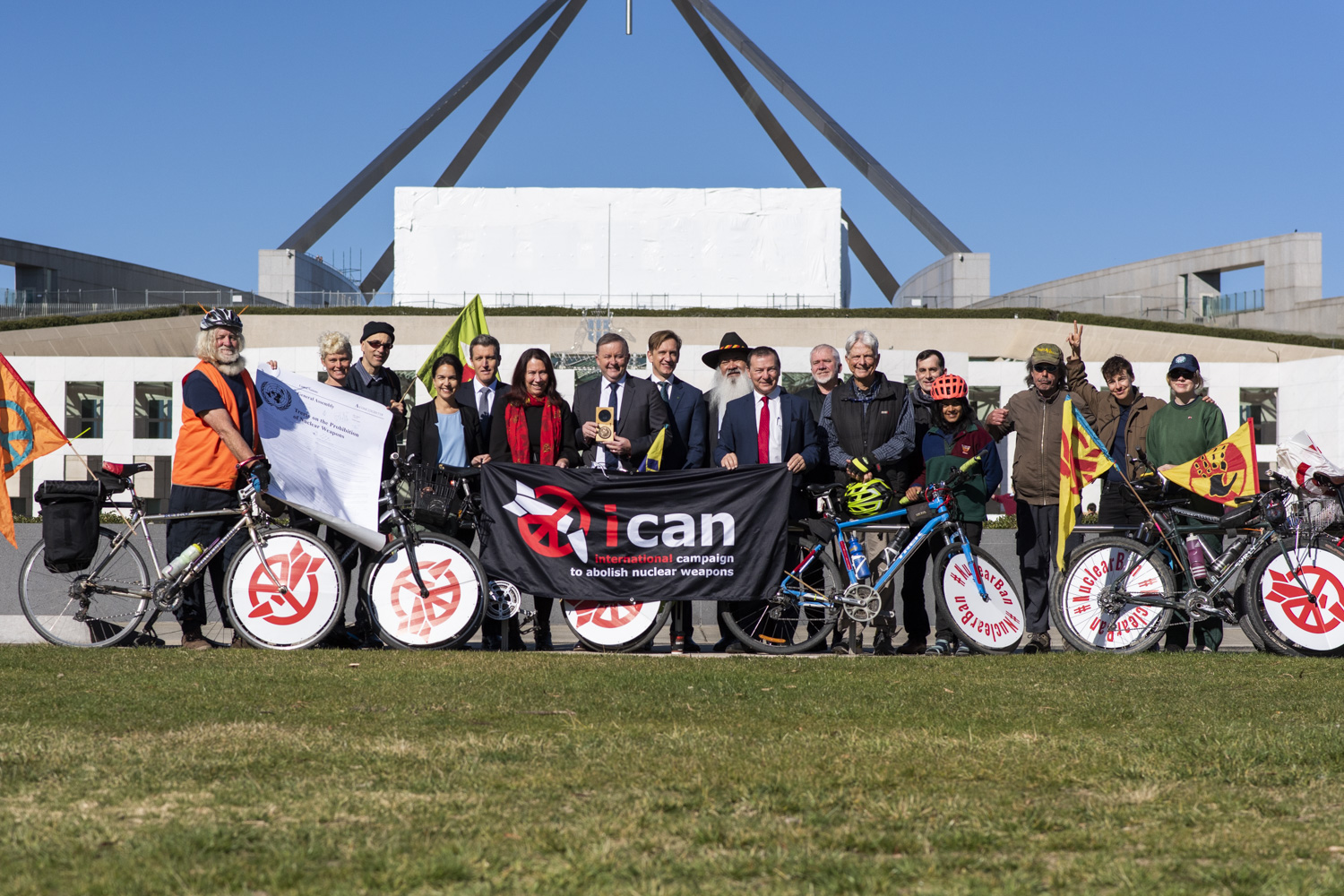
We organised a group of people to cycle from Melbourne to Canberra in 2018, touring the Nobel medal and talking about the ban treaty in small towns along the way. The ride concluded with a protest march escorted by fire trucks, a group of parliamentarians welcoming us to Parliament House and ICAN flags lining the bridge over Lake Burley-Griffin.

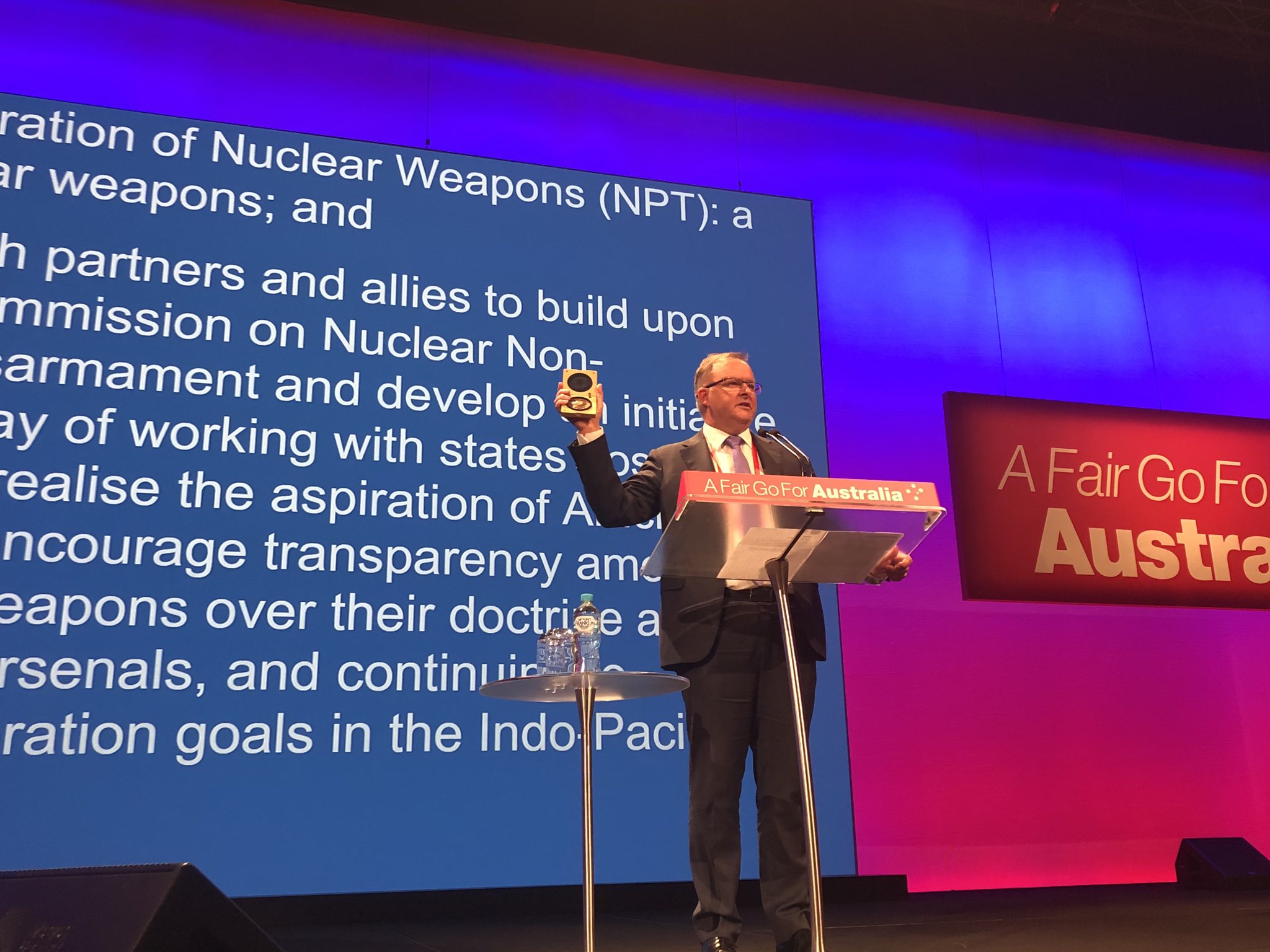
A team of us descended on the December 2018 National Labor Conference in Adelaide and worked the room and the halls while a few good people engaged in tough negotiations behind the scenes to reach Labor’s strong and clear commitment to signing the TPNW. When the future Prime Minister stood on stage to move the resolution, holding our Nobel Peace Prize medal aloft, we knew it was a hugely significant moment. Back at our accommodation, Tim, Marcus and I downed some bubbles, stunned, exhausted, and hopeful. 

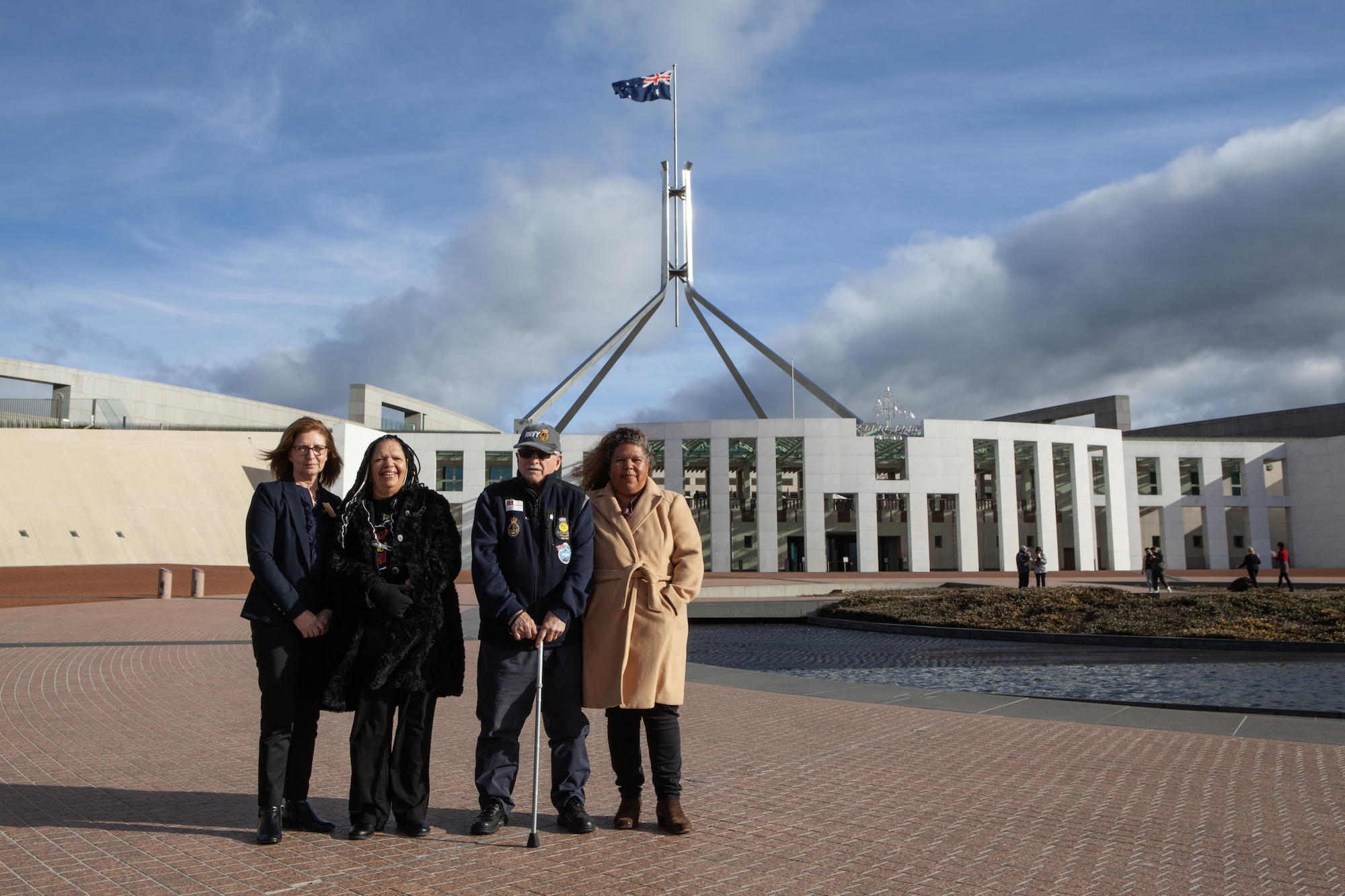
In 2023 we hosted an “Atomic Survivors Delegation”, bringing First Nations nuclear test-impacted women Karina Lester and Aunty June Lennon, as well as nuclear veteran Douglas Brooks and veteran descendent Maxine Goodwin to Canberra. They went from meetings to media spots to events, speaking about how nuclear weapons testing in Australia changed their lives for the worse. Their heart, humanity and commitment was deeply affecting, I hope the Foreign Minister felt it too.

2025 marked the 80th anniversary of the dawn of the nuclear age, with the Trinity nuclear explosion in New Mexico and the devastation of Hiroshima and Nagasaki a few weeks later on 6 and 9 August 1945. This year has seen an impressive rise in nuclear disarmament activism with commemorations, events and mobilisation nationwide to get the TPNW signed now.

Over the years we’ve been a creative team and on occasion have created video clips including the re-worked Rihanna “(Don’t want your) Nuclear Umbrella” and the dismantling of a large missile prop outside the gates of Pine Gap, for a video called “How to dismantle an atomic bomb“. The angle grinder discs were worn down quickly so we had to resort to brute and hilarious force.

In the early years of the TPNW, anything seemed possible, and then the covid-19 pandemic hit, as well as a devastating summer of bushfires. Like so many progressive campaigns, it took time to recover and build momentum again, especially throughout years of Liberal/National government. The nuclear-armed states have made progress more difficult, by continuing to spend billions, showcasing new delivery vehicles and throwing around nuclear threats. Every act of war stalls the possibility for disarmament, as fear reigns and bold action goes on the backburner. We’ve seen nuclear-armed states start wars, and in the case of Israel, two years of genocide on the Palestinian people. We’ve seen the Australian Government doggedly pursue the AUKUS alliance, inviting nuclear dangers, handing over billions of dollars and tying us more deeply to the US military. Militarism is increasingly creeping into Australian civic life, including schools and universities, as the government seeks to expand weapons manufacturing in this country. Countering these forces is difficult and takes a significant mental toll on everyone affected by war and racism at home and worldwide.

We’re also seeing a growing movement of people who have become literate in military supply chains and how exactly Australia is complicit in mass violence elsewhere in the world. War is closer to home when it’s supplied by the factories down the road and facilitated by the Cabinet room in Canberra. Challenging the US alliance has never been more popular with so many Australians revolted by President Trump and everything he stands for. This moment, and the next year or two, hold great possibility for good people to get something back and to win something meaningful. 

I’m stepping down as ICAN Australia Director, making way for someone brilliant to take the campaign forward, and to shift into the climate movement. I take great comfort knowing the brilliant staff team of Jemila, Jesse and Imogen have everything well in hand, and will continue to be an experienced, creative and dedicated team to support the new Director. I also take comfort from my plan to join the ICAN Australia board as a volunteer in 2026 to get Australia’s signature on the Treaty on the Prohibition of Nuclear Weapons. 

My final and favourite highlight is of course the people who’ve inspired, taught, accompliced and accompanied me in this work here in Australia and worldwide. Shout outs to some of my ICAN heroes Aunty Sue, Dave, Dimity, Jemila, Jesse, Karina, Margie, Marianne, Ray, Robert, Scott, Tim, Tilman and the rest of you, too many to name, in all corners of this continent and the world.

Thank you. And let’s keep going.

BACK TO NEWS

ICAN on the Road

ICAN on the Road

CAMPAIGN NEWS:

ICAN on the Road

ICAN’s Roadshows 2025

We’ve just wrapped up our fourth stop, Tasmania, as part of ICAN Australia’s national Roadshows project—a coordinated effort to visit every capital city by July 2026, deepen political and community engagement, and push the Albanese Government to stop delaying and sign the Treaty on the Prohibition of Nuclear Weapons (TPNW).

Across parliament houses, town hall meeting rooms, coffee shops, and Labor conferences, we’re meeting decision-makers, growing our supporter base, and building pressure for Australia to finally step up on nuclear disarmament.

Why Roadshows?

The purpose is simple: shift the national conversation and convert political interest into concrete commitments.

Our goals are to:

  • Brief and motivate parliamentarians across all parties
  • Grow the number of ICAN Parliamentary Pledge signatories
  • Support internal Labor efforts to secure a time-bound commitment to TPNW signature ahead of the July 2026 National Labor Conference
  • Strengthen civil society engagement and advocacy skills
  • Increase public understanding of extended nuclear deterrence—the key obstacle to progress

This is practical groundwork for a safer Australian foreign policy. And the momentum is already building.

Special thanks to the Mountain Air Foundation for supporting the ICAN Australia Roadshows project.

Brisbane: October 2025

 Our first Roadshow stop in Brisbane set the tone: busy, constructive, and energising.

Meetings included Mark Bailey MP, Michael Healy MP, Margie Nightingale MP, Grace Grace MP, Lance McCallum MP, Joan Pease MP, and Melissa McMahon MP, all from the Queensland Labor Party, as well as Michael Berkman MP from the Queensland Greens.

Queensland Labor Conference: November 2025

With support from ICAN partners the Women’s International League for Peace and Freedom (WILPF) and the Quakers, ICAN hosted a popular conference stall that became a hub for conversations with delegates and MPs.

The Electrical Trades Union also secured a strong motion demanding signature of the TPNW in this term of government—a significant signal from the labour movement.

We also secured new ICAN Parliamentary Pledge signatories, including:

  • Ali France MP, Labor Member for Dickson  
  • Peter Russo MP, state Labor member for Toohey 
  • Linus Power MP, state Labor member for Logan 
  • James Martin MP, state Labor member for Stretton 
  • Mark Furner MP, state Labor member for Ferny Grove
  • Joe Kelly MP, state Labor member for Greenslopes

Canberra: November 2025

Our federal Parliament meetings were packed, with two full days of briefings and advocacy, joined by our partners at the Uniting Church in Australia and the Public Health Association of Australia.

Faith-based and public health organisations share a commitment to protecting life and rejecting weapons designed to cause mass death and destruction. They are part of a growing chorus across Australian civil society calling for Australia to join the TPNW.

The Parliamentary Friends of the Treaty on the Prohibition of Nuclear Weapons in the 48th Parliament was also launched—thank you to the Co-Chairs Assistant Minister Josh Wilson, Senator David Shoebridge and Helen Haines MP. Special guest, Navi Pillay, former UN High Commissioner for Human Rights and 2025 Sydney Peace Prize winner, spoke at the launch.

A reflection published by the Uniting Church captured the mood of these meetings. Uniting Church in Australia Policy Advisor Ron Johnson said: Participating in these advocacy meetings … was at once the greatest honour of a lifetime of advocacy work but also the most frightening insight into the state of global militarism and geopolitics that I have ever experienced. 

His words underline why political pressure and public engagement are so vital right now.

Members of the Parliamentary Friends of the TPNW at Ausralian Parliament House Canberra, pictured with Sydeny Peace Prize Winner Navi Pillay

Parliamentarians and staff we met included Senator Fatima Payman (Australia’s Voice), Josh Wilson MP (ALP), Helen Haines MP (IND), Ben Small MP (LNP), staff from the offices of Tania Lawrence MP (ALP), Mary Aldred MP (LNP), Sarah Witty MP (ALP), Susan Templeman MP (ALP), Pat Conroy MP (ALP), Sussan Ley MP (Leader of the Opposition), Dan Tehan MP (LNP), Ged Kearney MP (ALP), Senator Penny Allman-Payne (Greens), Senator Lidia Thorpe (IND), Senator David Shoebridge (Greens), Andrew Leigh MP (ALP), David Smith MP (ALP), Mary Doyle MP (ALP), and senior staff from the Foreign Minister’s Office.

Perth: November 2025

In Perth and Fremantle, our WA delegation—Dave Sweeney, Tara Gutman, Leigh Dix, representatives from the Medical Association for the Prevention of War, and Shayan Rasaratnam from Healthcare Students for the Prevention of War—met with Sophie McNeill MLC (Greens), Amanda Dorn MLC (Animal Justice), Dr Brian Walker MLC (Legalise Cannabis), Dave Kelly MLA (ALP), Frank Paolino MLA (ALP), Karen Beale (staffer to Colleen Egan MLA), David Scaife MLA (ALP), and delegates at the WA Labor Conference.

The United Workers Union secured a powerful motion reaffirming Labor’s commitment to nuclear disarmament and calling on the Federal Parliamentary Labor Party to sign the TPNW in this term of government.

These trips are coordinated with local supporters, faith groups, unions, and civil society organisations—strengthening alliances at every stop.

Hobart: December 2025

Our Tasmanian Roadshow brought together parliamentarians, health professionals, union leaders, and peace advocates for some of the most wide-ranging discussions so far.

We met with Professor George Razay MP, Independent Member for Bass; David O’Byrne MP, Independent Member for Franklin; Peter George MP, Independent Member for Franklin; Ella Haddad MP, Labor Member for Clark; Sarah Lovell MLC, Labor Member for Rumney; Carlo Di Falco MP, Shooters, Fishers and Farmers Member for Lyons; and Margaret Reynolds, National President of WILPF Australia.

We also held a detailed briefing with the Tasmanian Greens, including Leader Rosalie Woodruff MP, Helen Burnet MP, Tabatha Badger MP, Cecily Rosol MP, and discussions with Cassy O’Connor MLC.

A Tasmanian partner roundtable brought together a powerful cross-section of civil society voices, including representatives from ICAN Australia, WILPF, MAPW, Quaker Peace and Justice, Medact, and Unions Tasmania. The discussion focused on shared strategy, the humanitarian and health impacts of nuclear weapons, and how Tasmania can contribute to national momentum for the TPNW.

Key Takeaways So Far

  • Momentum is on our side. Parliamentarians across the political spectrum are increasingly concerned about nuclear risks and open to the TPNW.
  • Labor’s internal landscape is shifting. Conference motions in Queensland and Western Australia show strong grassroots support for signature and ratification.
  • A historic window of opportunity exists. Before Australia becomes more deeply entangled in the nuclear war preparations of AUKUS partners, it must draw a red line on nuclear weapons by joining the TPNW.
  • Civil society engagement is thriving. Partners are eager to host events, join delegations, and help build pressure locally.
  • Personal advocacy works. Delegates—including first-timers—are delivering powerful messages directly to decision-makers, and they are being heard.

The Roadshows are just beginning, but the message is already clear: Australians want leadership on nuclear disarmament. Together, we’re building the pressure needed to ensure the government signs the TPNW and takes a decisive step towards a world without nuclear weapons.

BACK TO NEWS