
ICAN Australia welcomes Tonga’s historic step toward a nuclear-free world & calls on Albanese to align with Pacific and also sign the Treaty on the Prohibition of Nuclear Weapons

ICAN Australia welcomes Tonga’s historic step toward a nuclear-free world & calls on Albanese to align with Pacific and also sign the Treaty on the Prohibition of Nuclear Weapons

CAMPAIGN NEWS:

ICAN Australia welcomes Tonga’s historic step toward a nuclear-free world & calls on Albanese to align with Pacific and also sign the Treaty on the Prohibition of Nuclear Weapons

MELBOURNE, AUSTRALIA – The International Campaign to Abolish Nuclear Weapons (ICAN) Australia warmly welcomes the Kingdom of Tonga’s decision to join the Treaty on the Prohibition of Nuclear Weapons (TPNW) and the Comprehensive Nuclear-Test-Ban Treaty (CTBT).

By taking this decisive step, Tonga has reaffirmed the Pacific region’s historic, unwavering leadership in global nuclear disarmament. Tonga joins the overwhelming majority of its Pacific neighbours, including Fiji, Vanuatu, Kiribati, Tuvalu, Samoa, and New Zealand, in creating a region that is ensuring nuclear weapons and testing are comprehensively rejected.

“The Pacific understands the catastrophic consequences of nuclear weapons, having borne the brunt of hundreds of nuclear explosions. By embracing the TPNW, Tonga’s actions send a clear message that real security is achieved through total prohibition and disarmament. We congratulate the government and people of Tonga for joining the TPNW, and call on the Albanese Government to now join the global majority of nations and join the TPNW without any further delay” said Janet Craven, ICAN Australia Director. 

Tonga’s accession to the TPNW places Australia’s ongoing delay in signing the UN nuclear weapon ban treaty under a sharp spotlight. Despite the Albanese Government’s stated commitment to the Pacific, and Labor’s longstanding promise to join the TPNW, Australia remains a glaring gap in a region united against nuclear arms under the TPNW.

In light of Australia’s recently inked regional security treaties and defense pacts including the  Vuvale Union with Fiji earlier this week, the federal government’s continued reliance on nuclear deterrence is at direct odds with the strategic priorities of Pacific allies. If Australia truly wishes to act as vuvale or family with our Pacific neighbours, it must align its security strategy with the region’s long-standing commitment to remaining nuclear free. 

“In a region increasingly militarised through AUKUS and great-power competition, Tonga’s accession is a powerful assertion of Pacific sovereignty. True security in the Pacific is built on a foundation of climate justice and total denuclearisation, not the false promise of extended nuclear deterrence,” stated Reverend James Bhagwan, General Secretary of the Pacific Conference of Churches.

“While our Pacific nations unite to construct a genuine Ocean of Peace, Australia’s continued reliance on nuclear deterrence remains a profound contradiction to its claims of regional family and solidarity.”

The TPNW is the first legally binding international agreement to comprehensively prohibit nuclear weapons, with provisions requiring states to assist victims and remediate environments contaminated by nuclear testing. ICAN urges the Australian government to look beyond traditional defense pacts and support the tangible humanitarian frameworks already championed by Pacific states. 

“The Pacific deserves complete freedom from nuclear weapons and their threat—not simply their management, but their total elimination. For decades, our communities and veterans have carried the severe intergenerational scars of colonial nuclear testing,” added Merewalesi Tuilau, Director of the Fiji Nuclear Veterans and Families Association.

“Australia cannot claim to stand with us in bilateral security pacts while refusing to sign the TPNW. It is time for the Albanese government to listen to the demands of Pacific states and match words with action.”

– ENDS – 

H.E. Viliami Vaʼinga Tōnē, Permanent Representative, Permanent Mission of the Kingdom of Tonga to the United Nations (center) deposits their instrument of accession with David Nanopoulos, Chief of the Treaty Section at the United Nations (right) and Seth Shelden, ICAN (left)

H.E. Viliami Vaʼinga Tōnē, Permanent Representative, Permanent Mission of the Kingdom of Tonga to the United Nations (center) deposits their instrument of accession with David Nanopoulos, Chief of the Treaty Section at the United Nations (right) and Seth Shelden, ICAN (left)

BACK TO NEWS

Media Release: Pacific nuclear justice delegation call on PM to sign UN Nuclear Ban Treaty, as 80th and 60th anniversaries of Bikini and Moruroa tests mark a region still seeking justice

Media Release: Pacific nuclear justice delegation call on PM to sign UN Nuclear Ban Treaty, as 80th and 60th anniversaries of Bikini and Moruroa tests mark a region still seeking justice

CAMPAIGN NEWS:

Media Release: Pacific nuclear justice delegation call on PM to sign UN Nuclear Ban Treaty, as 80th and 60th anniversaries of Bikini and Moruroa tests mark a region still seeking justice

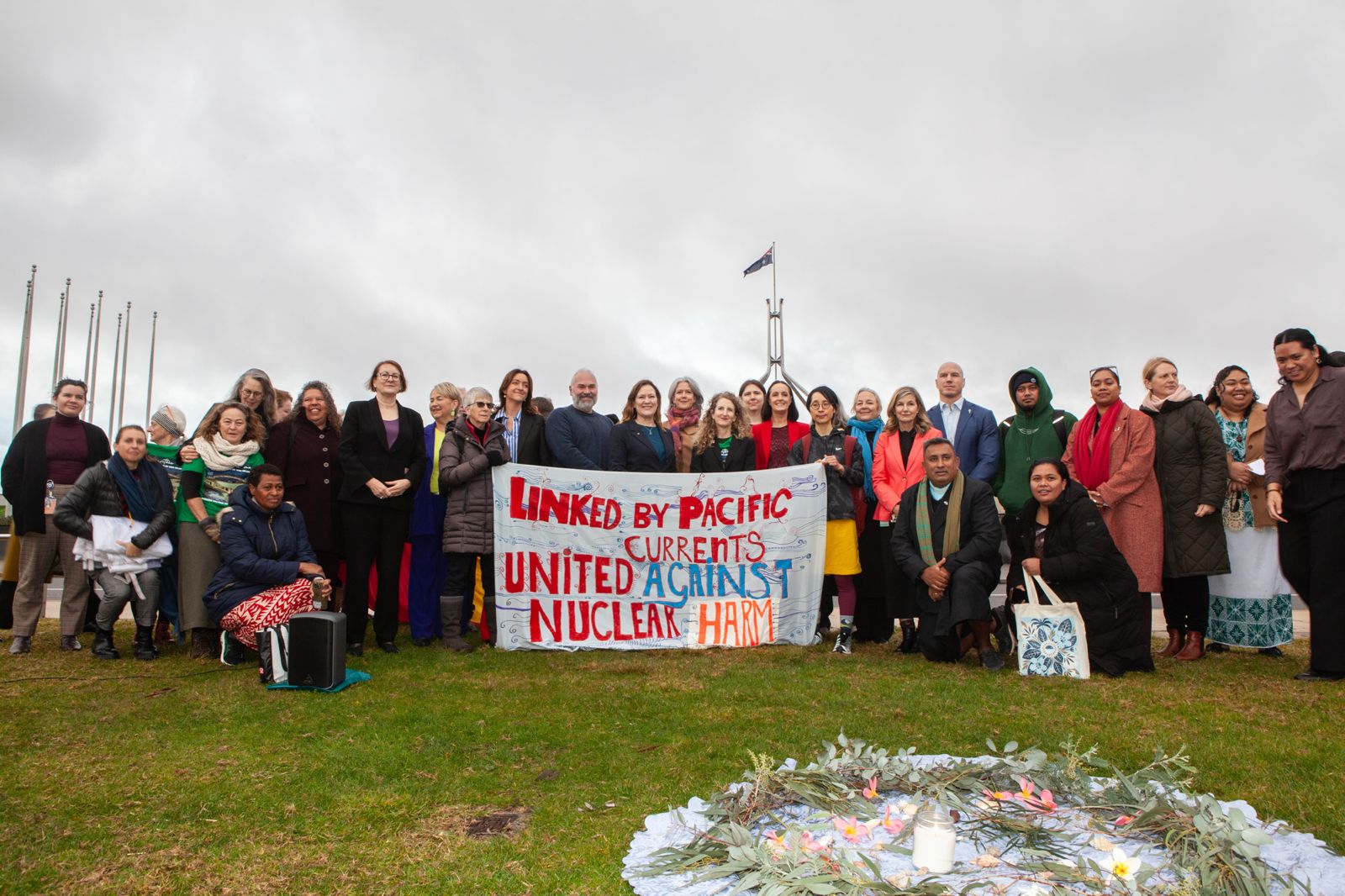
A delegation of Pacific nuclear survivors and advocates is in Canberra today to call on the Australian Prime Minister to sign and ratify the Treaty on the Prohibition of Nuclear Weapons (TPNW). They are joined by Anangu-Yankunytjatjara woman and second-generation nuclear test survivor Karina Lester, and members of the Parliamentary Friends of the TPNW.

The visit falls during two significant anniversaries: July 1 marks 80 years since the first US test detonation at Bikini Atoll, Marshall Islands; July 2 marks 60 years since the first French test detonation at Moruroa Atoll, Mā’ohi Nui (French Polynesia). The anniversaries were acknowledged in a motion put forward on Monday by Labor member for Macquarie, Susan Templeman, who said: “With the legacy of nuclear testing still felt deeply in Australia, our region and across the world, we want nuclear weapons testing to be relegated to history. […] I will continue to advocate for the importance of sustained international commitment to nuclear non-proliferation, including the Treaty on Nuclear Non-Proliferation and the Treaty on the Prohibition of Nuclear Weapons.”

“The experiences of the Marshall Islands and other Pacific communities remind us that decisions made by powerful nations can have consequences that last for generations. We ask the world to remember our history, stand with survivors, pursue nuclear disarmament, and place human dignity, justice, and peace at the centre of global decision-making.” — Samuel Barton, Marshall Islands Student Association (MISA)

“In a region increasingly militarised through AUKUS, the Quad and great-power competition, signing the Treaty on the Prohibition of Nuclear Weapons would be a clear commitment to a nuclear-free Pacific and a genuine Ocean of Peace.” — Rev. James Bhagwan, General Secretary, Pacific Conference of Churches

“The Pacific demands and deserves complete freedom from nuclear weapons and their threat – not simply management, but total elimination. Australia has shown it can lead. Australia must match its history with urgent new action.” — Merewalesi Tuilau, Fiji Veterans and Families Association

“Our lands, oceans and bodies carry the nuclear radiation scars and are further at risk to the climate impacts. The Pacific has carried this legacy for 80 years. Now we ask Australia to help carry the responsibility for ensuring it is never repeated.” — Frances Namoumou, Ecumenical Animator, Ecological Stewardship and Climate Justice, Pacific Conference of Churches

Background notes:

  • The Parliamentary Friends of the TPNW is a cross-party forum, currently made up of 47 federal parliamentarians who meet and interact with nuclear disarmament and non-proliferation advocates on matters relating to the Treaty on the Prohibition of Nuclear Weapons, and to discuss ways to ensure the Treaty’s success into the future.
  • Federal Labor committed to signing the TPNW in 2018 but has yet to do so. The delegation is highlighting the urgent need for signature ahead of the ALP National Conference later this month.The Canberra events are part of a wider lobby and advocacy tour to Canberra, Sydney and Melbourne running Monday 29 June to Friday 3 July, sharing testimony from communities affected by nuclear testing and calling for a Pacific that is decolonised, demilitarised, denuclearised and decarbonised.
  • Articles 6 and 7 of the TPNW on ‘victim assistance, environmental remediation, and international cooperation and assistance’seek to address ongoing and unresolved humanitarian, human rights, and environmental impacts from nuclear weapons.
BACK TO NEWS

Media Release: Defence Minister highlights nuclear risks – the challenge is to address them

Media Release: Defence Minister highlights nuclear risks – the challenge is to address them

CAMPAIGN NEWS:

Media Release: Defence Minister highlights nuclear risks – the challenge is to address them

Against a backdrop of growing international tension and conflict involving nuclear weapons states, Defence Minister Richard Marles told the National Press Club today that the world is on the “foothills of a new nuclear arms race” which “will drive elevated risks to Australia’s security and prosperity over the coming decade, increasing our exposure to conflict and coercion”.

 Minister Marles’ comments were used to justify a major increase in Defence spending and come amid Australia’s increasing defence engagement with the US and the UK—both nuclear weapon states. 

ICAN—the Australian civil society initiative that received the 2017 Nobel Peace Prize for its efforts in driving a global nuclear weapons ban treaty, the Treaty on the Prohibition of Nuclear Weapons (TPNW)—has called on the Australian government to urgently move to advance its long standing commitment to sign the TPNW as a clear and vital regional assurance and risk reduction step to lower nuclear tensions and temperatures.

The call comes as the federal Government continues to accept our AUKUS allies’ policy of “neither confirm, nor deny” as to whether their submarines and aircraft operating in Australian seas and skies are nuclear-capable or nuclear-armed.

“Minister Marles is right in identifying rising nuclear threats—now he and the federal Government need to take meaningful and effective action to reduce them,” said A/Prof Tilman Ruff AO, ICAN Australia co-founder.

“Australia must not facilitate nuclear weapons in our region and needs to send a clear message to our region that Australia does not support or endorse weapons of mass, indiscriminate destruction. Signing the TPNW is both Labor policy and common sense and is our best way to get rid of our worst weapons. When it comes to nuclear weapons Australians have both a right to know and a right to say No.”

BACK TO NEWS

Media Release: As tensions rise, Australian and Pacific voices unite to keep nuclear weapons out of Australia

Media Release: As tensions rise, Australian and Pacific voices unite to keep nuclear weapons out of Australia

CAMPAIGN NEWS:

Media Release: As tensions rise, Australian and Pacific voices unite to keep nuclear weapons out of Australia

Against the current global uncertainty and the growing threat of Australia hosting nuclear weapons over 150 civil society organisations across Australia and the Pacific have united in a call for a nuclear weapons free Australia. 

Led by the International Campaign to Abolish Nuclear Weapons (Australia), the No Nuclear Weapons in Australia Declaration calls on the Albanese government to sign and ratify the UN Treaty on the Prohibition of Nuclear Weapons (TPNW) without delay, as renewed global threats push the risk of nuclear conflict to its highest level in decades.

Groups representing millions of people including the Community and Public Sector Union, Nurses and Midwifery Union, Australian Conservation Foundation, Amnesty International, Uniting Church, Pacific Elders Voice, Medical Association for the Prevention of War, and many others have endorsed the call.

“The union movement has always stood against war, and we’re proud to stand with civil society to keep nuclear weapons out of Australia and uphold our national commitment to disarmament,” explained Jiselle Hanna, Branch Secretary from the Community and Public Sector Union. 

The move to keep Australia nuclear weapons-free has reached a critical point with the planned hosting of US nuclear-capable B-52 bombers and potentially nuclear-armed submarines under the AUKUS agreement significantly heightens local risks. These developments not only increase the danger of a catastrophic nuclear accident on Australian soil but makes Australia a potential target for adversaries.

Central to this declaration is a collective demand for Australia to uphold the spirit and letter of the Rarotonga Treaty. As a founding signatory to the South Pacific Nuclear Free Zone, Australia has a permanent obligation to ensure our region remains shielded from the existential threat of nuclear weapons and the horror of renewed testing. 

“As Australia deepens its military integration under arrangements like AUKUS, Pacific civil society is raising a clear call that these decisions must not undermine the integrity of our nuclear-free region,” said Epeli Lesuma, Nuclear Justice and Demilitarisation Campaigner for the Pacific Network on Globalisation (PANG). 

“Australia has a responsibility to uphold both the spirit and letter of its commitments under the Treaty of Rarotonga, and to reinforce those commitments by signing and ratifying the TPNW,” he continued.

Additional quotes:

“The massive scale of this declaration sends a clear message that Australians will not accept a slide toward Australia losing its nuclear weapon-free status. To truly protect our future and the Pacific, Australia must demonstrate leadership by signing and ratifying the Treaty on the Prohibition of Nuclear Weapons now. We cannot advocate for a rules-based order while staying outside of the only global treaty that bans the world’s most destructive weapons.”

— Janet Craven, Director, ICAN Australia

“The only way to avoid nuclear catastrophe and to discourage more states from seeking their own nuclear weapons, is to uphold and vigorously defend international law and to implement the TPNW—a treaty which seeks to ban nuclear weapons for all states. In moments of crisis such as these, the temptation is to close ranks. The responsibility of middle powers like Australia, however, is in fact the opposite: to insist that the rules matter most when they are most inconvenient.”

— ICAN Co-Chairs, Marianne Hanson & Tara Gutman

“The commitment to AUKUS further locks Australia into the unpredictable war games of our allies. It is time more citizens spoke out against the loss of Australian sovereignty and demanded our nation be independent in managing our own foreign and defence policies and they must be NUCLEAR FREE.”

— Margaret Reynolds, Women’s International League for Peace and Freedom (Australia)

“Nuclear weapons represent an unacceptable threat to human health and wellbeing—no health system could respond to their catastrophic impacts, and prevention is the only cure. We stand with the global health community in calling for Australia to reject nuclear weapons and commit to a future grounded in disarmament, transparency, and the protection of life.”

— Genevieve Dean, Australian Medical Students’ Association

BACK TO NEWS

Media Release: ICAN Australia alarmed at France’s moves towards nuclear arms race

Media Release: ICAN Australia alarmed at France’s moves towards nuclear arms race

CAMPAIGN NEWS:

Media Release: ICAN Australia alarmed at France’s moves towards nuclear arms race

The Australian founders of the International Campaign to Abolish Nuclear Weapons (ICAN) have warned that President Macron’s announcement of an expansion of France’s nuclear arsenal risks accelerating a new global arms race. The decision underscores a troubling shift towards growing global nuclear weapons stocks and the heightened risk of their use, placing strain on longstanding commitments to disarmament and non-proliferation. 

This reinforces the urgent need for renewed diplomatic efforts and collective action to strengthen the global non-proliferation regime and advance meaningful steps towards nuclear disarmament.

“We are at a turning point where we need to either get serious about ending these catastrophic arsenals before they end us, or face a new nuclear arms race,” said Dr Tilman Ruff, founding chair of the Nobel Peace Prize winning ICAN.

“Nuclear deterrence is just a theory. It assumes rational leadership and no accidental launches or hacking. President Macron stated a nuclear first strike could be used as a warning. That is not deterrence, instead it is proof of the unreliability of deterrence. Any use of nuclear weapons is likely to lead to rapid escalation,” continued Dr Ruff.

Deployment of nuclear weapons in other countries and ending transparency about nuclear forces, as President Macron has proposed, also increase the risk of escalation. The announcement violates France’s disarmament obligations under the nuclear Non-Proliferation Treaty.

“More weapons equals more risk of inadvertent use. We have already lived through many near misses due to human and technical error, and now increasingly sophisticated AI-enabled hackers are a concern,” said Dr Margaret Beavis, ICAN board member.  

“We have also seen the terrible impacts of France’s nuclear weapons program in Algeria and the Pacific, that has ruined lives and left ongoing contamination.”

“The Australian government talks loudly about nuclear disarmament. It needs to take urgent action and the best way it can do this is by joining the 99 other countries – a global majority including most of our Pacific neighbours – and sign the UN Treaty on the Prohibition of Nuclear Weapons,” Dr Beavis added.

BACK TO NEWS

Media Release: ICAN Australia Condemns Strikes on Iran and Calls on Australia to Champion International Law and Diplomacy

Media Release: ICAN Australia Condemns Strikes on Iran and Calls on Australia to Champion International Law and Diplomacy

CAMPAIGN NEWS:

Media Release: ICAN Australia Condemns Strikes on Iran and Calls on Australia to Champion International Law and Diplomacy

The International Campaign to Abolish Nuclear Weapons (ICAN) Australia joins ICAN International to unequivocally condemn yesterday’s military strikes by the United States and Israel on Iran. Nuclear-armed states launching unlawful attacks is no way to reduce nuclear threats. 

Responding to the Australian government’s position stating its approval of the US “acting to prevent Iran from obtaining a nuclear weapon”, ICAN Australia calls on the government to support diplomatic efforts to encourage the parties to the conflict to an immediate return to negotiations and to bolster its own position on nuclear non-proliferation by signing the Treaty on the Prohibition of Nuclear Weapons (TPNW).  

These shocking events have provoked a dangerous escalation in an already volatile region. This is underscored by the impact of retaliatory attacks on US bases in Kuwait, Bahrain, Qatar, and the United Arab Emirates, making the need to de-escalate more urgent. 

As a close military partner of the United States, Australia cannot assume it is insulated from these risks. By hosting joint facilities, providing logistical support, and willingly accommodating the enlarged presence of US forces in Australia, including nuclear-capable submarines and aircraft; Australia’s increasing vulnerability to the risk of entanglement is clear. 

ICAN Australia Co-Chairs Tara Gutman and Marianne Hanson stated:

“Australia is being too quick to support force, and too slow to grow peace.” 

“Australia was among the first nations to announce it backed the US and Israeli strikes. In doing so, it has aligned itself with high-risk military action before diplomatic avenues were exhausted and is knowingly condoning clear violations of international law—the very backbone of international peace and security architecture.”

“The United States and Israel are both nuclear-armed states. A conflict being waged by not one but two nuclear powers further heightens the risk of miscalculation, misunderstanding and mistake. The best way to manage nuclear risks is through diplomacy and respect for international law.  Australia needs to hold these principles close, not dispense with them.”

“By adding Australia to the list of 99 countries who have joined the Treaty on the Prohibition of Nuclear Weapons, Australia would be supporting the only global, legally binding instrument designed to comprehensively prohibit  nuclear weapons and reduce nuclear risk. This would also ring fence Australia from nuclear risks inherent in our growing military integration with nuclear-armed allies.”

“The only way to avoid nuclear catastrophe and to discourage more states from seeking their own nuclear weapons, is to uphold and vigorously defend international law and to implement the TPNW—a treaty which seeks to ban nuclear weapons for all states. In moments of crisis such as these, the temptation is to close ranks. The responsibility of middle powers like Australia, however, is in fact the opposite: to insist that the rules matter most when they are most inconvenient.”

BACK TO NEWS