
For a nuclear-free future

For a nuclear-free future

CAMPAIGN NEWS:

For a nuclear-free future

:

A farewell note from Gem Romuld, signing out as ICAN Australia Director. 

Taking on nuclear weapons is one of humanity’s greatest challenges. Not just because of the ruthless industry that develops and builds them but also due to their political status and the imaginative power they wield. It’s as if they are magical creatures, bestowing fear and exerting control wherever they are pointed. For many people, imagining the end of nuclear weapons is like imagining the end of the world as they know it; it’s a fantasy, a noble goal, but not a reasonable prospect. Half the challenge to move the conditions for nuclear disarmament forward is the mental leap; convincing others that nuclear disarmament will make them safer, that nuclear-armed leaders can disarm, that the nuclear world order is not permanent, natural or inevitable. 

It takes courage and a great deal of fierce optimism to demand nuclear abolition. That’s why I love the vision and the work of the International Campaign to Abolish Nuclear Weapons, and why I’ve been honoured to spend 12 years working on the campaign in our corner of the world. We celebrate and push for meaningful steps along the way, but never do we relent on demanding nuclear abolition. This abolitionist orientation is what makes the ICAN campaign unique, bold and powerful. It’s grounding in the humanitarian impacts of nuclear weapons is another core feature, recognising the ongoing damage done by nuclear colonialism on First Nations land and bodies worldwide, and fighting for justice.

The Treaty on the Prohibition of Nuclear Weapons represents the most significant challenge to the global nuclear order in decades. It sets a new common standard and forces every nation to choose, is it for or against nuclear weapons? And here is Australia’s predicament: our government presents itself as vehemently opposed to nuclear weapons, while simultaneously supporting their potential use on our behalf, both politically and practically. The governing Labor Party has committed in policy to sign and ratify the ban, but has thus far refrained from doing so. We can make this signature happen, and we must, before “rotational” AUKUS submarines and “visiting” nuclear-capable bombers entrench Australia more deeply in US nuclear war planning and preparations. We have a window of opportunity, while the man who held ICAN’s Nobel Peace Prize medal aloft, proudly introducing Labor’s national commitment to sign the treaty, is Prime Minister. 

It may be tempting to give up, in a swamp of realpolitik malaise, but that is not the way of the abolitionist. This difficult work is an everyday practice of love for the planet and its people, and is world-changing along the way to the ultimate goal. 

My involvement in ICAN came out of my experience and commitment to countering the nuclear industry in Australia, opposing uranium mines and nuclear waste dumps. I was brought on board by the late great ICAN co-founder Dr Bill Williams, and Tim Wright, both of whom were powerful influences in my development as a professional ratbag. 

If you’ll indulge me, I’ll share a few highlights of my time at ICAN:

Being in the room when the Treaty on the Prohibition of Nuclear Weapons was adopted at the UN in New York on 7 July, 2017, as the conference room erupted in applause, tears and hugs. I wrangled a collection of people present that day into reading out every single line of the Treaty for me to stitch this video together, capturing a moment in time. I saw Hiroshima survivor Setsuko Thurlow and Aunty Sue Coleman-Haseldine, Kokatha elder and nuclear test survivor, speak to the conference floor and celebrate this bittersweet moment: so much has been lost but nuclear weapons were finally banned under international law.

When the TPNW opened for signature on 20 September 2017, and we knew Australia was not going to be there signing on the dotted line, a friend and I climbed up onto the awning in front of the Department of Foreign Affairs in Canberra, holding up a massive banner saying “Sign the nuclear weapons ban treaty”. We stayed there for a few hours while TV cameras swarmed below before the police dramatically abseiled from the top of the building to arrest and remove us. We were released without charge.

Winning the Nobel Peace Prize. I was in a traffic jam in Sumatra, Indonesia, on holiday with friends, when the news came through. Later on we hosted a big party at the Melbourne Town Hall with music, art and speeches, and watched the ceremony live from Oslo.
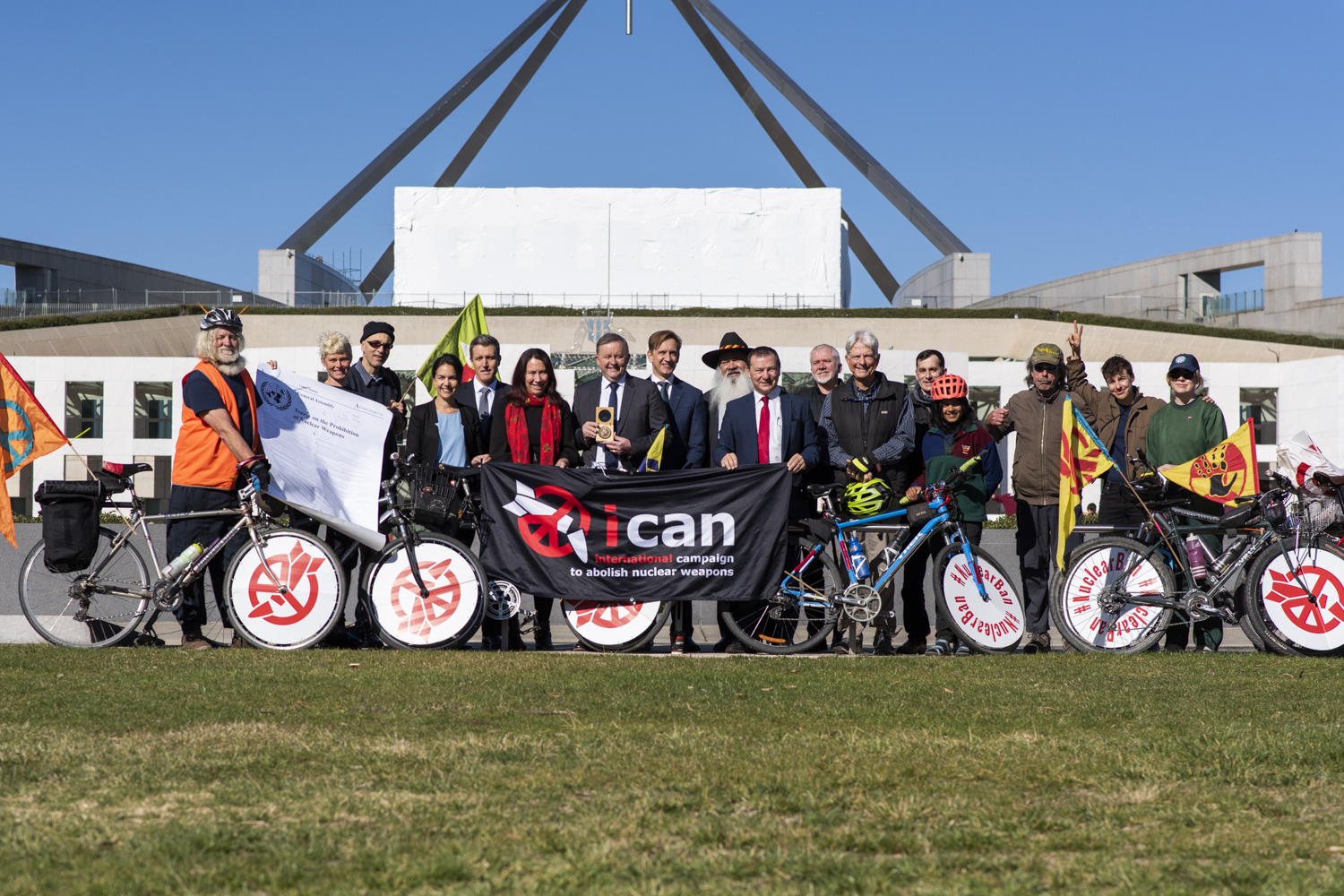
We organised a group of people to cycle from Melbourne to Canberra in 2018, touring the Nobel medal and talking about the ban treaty in small towns along the way. The ride concluded with a protest march escorted by fire trucks, a group of parliamentarians welcoming us to Parliament House and ICAN flags lining the bridge over Lake Burley-Griffin.
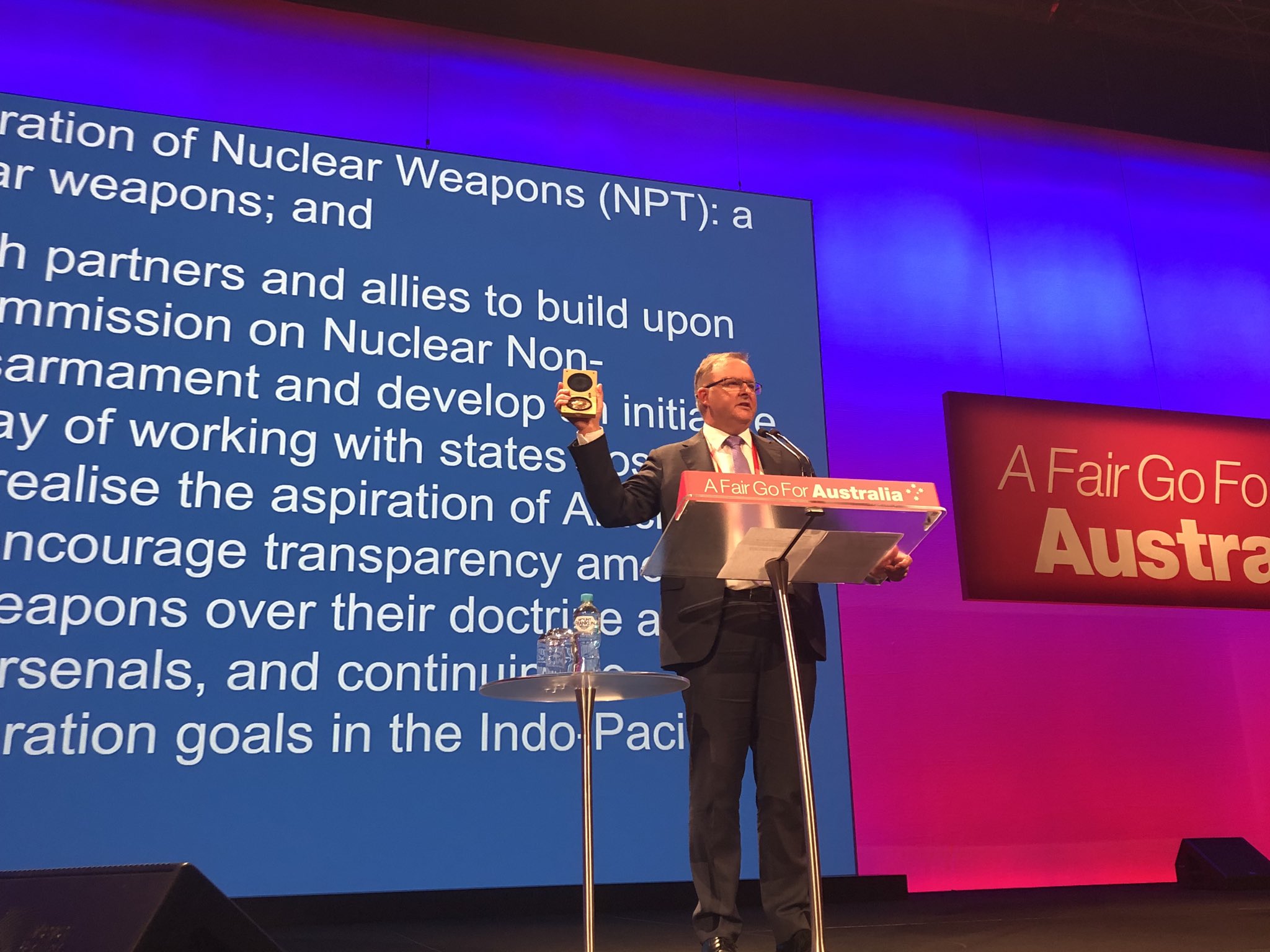
A team of us descended on the December 2018 National Labor Conference in Adelaide and worked the room and the halls while a few good people engaged in tough negotiations behind the scenes to reach Labor’s strong and clear commitment to signing the TPNW. When the future Prime Minister stood on stage to move the resolution, holding our Nobel Peace Prize medal aloft, we knew it was a hugely significant moment. Back at our accommodation, Tim, Marcus and I downed some bubbles, stunned, exhausted, and hopeful. 
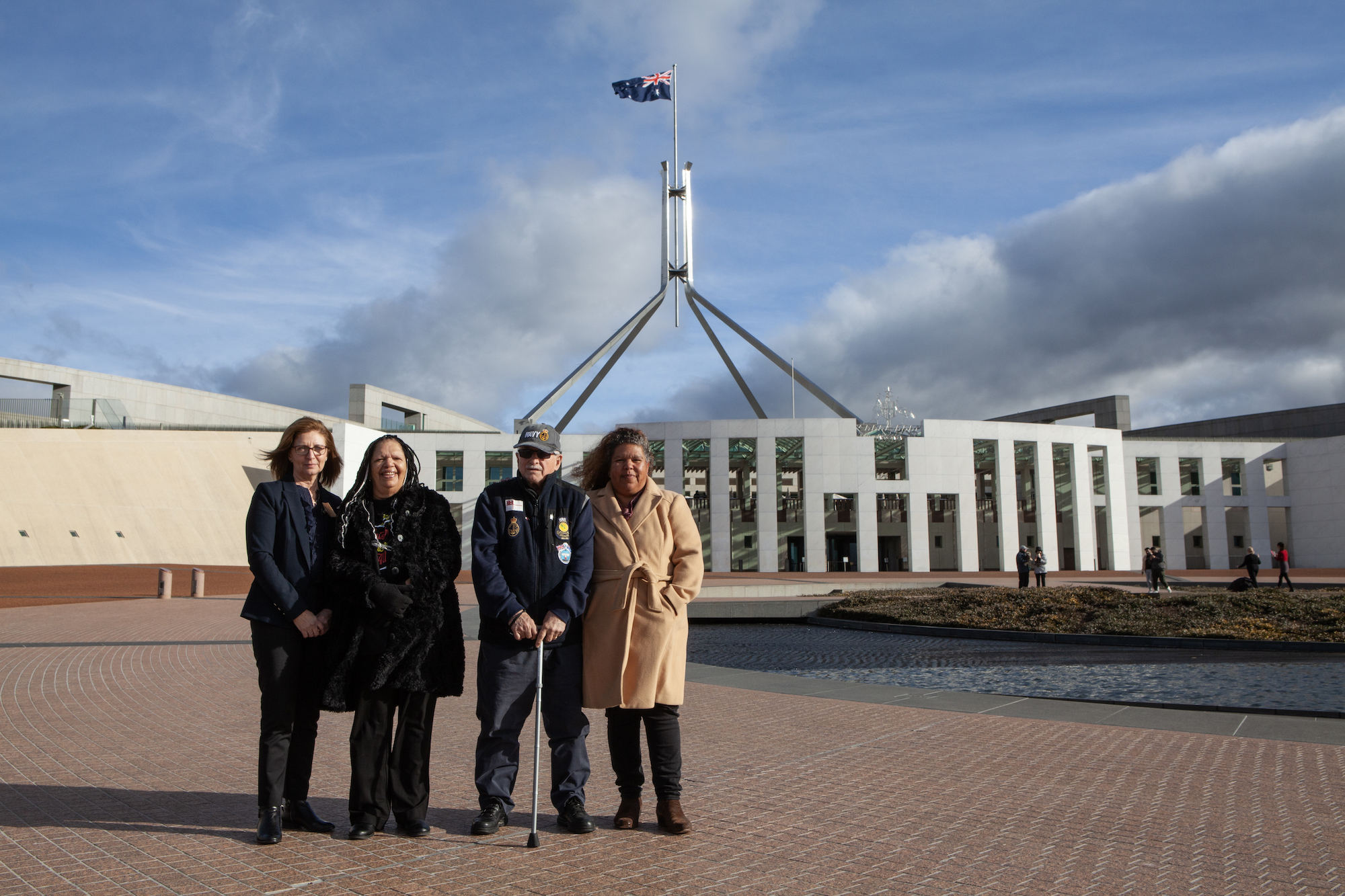
In 2023 we hosted an “Atomic Survivors Delegation”, bringing First Nations nuclear test-impacted women Karina Lester and Aunty June Lennon, as well as nuclear veteran Douglas Brooks and veteran descendent Maxine Goodwin to Canberra. They went from meetings to media spots to events, speaking about how nuclear weapons testing in Australia changed their lives for the worse. Their heart, humanity and commitment was deeply affecting, I hope the Foreign Minister felt it too.

2025 marked the 80th anniversary of the dawn of the nuclear age, with the Trinity nuclear explosion in New Mexico and the devastation of Hiroshima and Nagasaki a few weeks later on 6 and 9 August 1945. This year has seen an impressive rise in nuclear disarmament activism with commemorations, events and mobilisation nationwide to get the TPNW signed now.

Over the years we’ve been a creative team and on occasion have created video clips including the re-worked Rihanna “(Don’t want your) Nuclear Umbrella” and the dismantling of a large missile prop outside the gates of Pine Gap, for a video called “How to dismantle an atomic bomb“. The angle grinder discs were worn down quickly so we had to resort to brute and hilarious force.

In the early years of the TPNW, anything seemed possible, and then the covid-19 pandemic hit, as well as a devastating summer of bushfires. Like so many progressive campaigns, it took time to recover and build momentum again, especially throughout years of Liberal/National government. The nuclear-armed states have made progress more difficult, by continuing to spend billions, showcasing new delivery vehicles and throwing around nuclear threats. Every act of war stalls the possibility for disarmament, as fear reigns and bold action goes on the backburner. We’ve seen nuclear-armed states start wars, and in the case of Israel, two years of genocide on the Palestinian people. We’ve seen the Australian Government doggedly pursue the AUKUS alliance, inviting nuclear dangers, handing over billions of dollars and tying us more deeply to the US military. Militarism is increasingly creeping into Australian civic life, including schools and universities, as the government seeks to expand weapons manufacturing in this country. Countering these forces is difficult and takes a significant mental toll on everyone affected by war and racism at home and worldwide.

We’re also seeing a growing movement of people who have become literate in military supply chains and how exactly Australia is complicit in mass violence elsewhere in the world. War is closer to home when it’s supplied by the factories down the road and facilitated by the Cabinet room in Canberra. Challenging the US alliance has never been more popular with so many Australians revolted by President Trump and everything he stands for. This moment, and the next year or two, hold great possibility for good people to get something back and to win something meaningful. 

I’m stepping down as ICAN Australia Director, making way for someone brilliant to take the campaign forward, and to shift into the climate movement. I take great comfort knowing the brilliant staff team of Jemila, Jesse and Imogen have everything well in hand, and will continue to be an experienced, creative and dedicated team to support the new Director. I also take comfort from my plan to join the ICAN Australia board as a volunteer in 2026 to get Australia’s signature on the Treaty on the Prohibition of Nuclear Weapons. 

My final and favourite highlight is of course the people who’ve inspired, taught, accompliced and accompanied me in this work here in Australia and worldwide. Shout outs to some of my ICAN heroes Aunty Sue, Dave, Dimity, Jemila, Jesse, Karina, Margie, Marianne, Ray, Robert, Scott, Tim, Tilman and the rest of you, too many to name, in all corners of this continent and the world.

Thank you. And let’s keep going.

BACK TO NEWS

Target Australia: Four Corners sounds alarm on nuclear weapons

Target Australia: Four Corners sounds alarm on nuclear weapons

CAMPAIGN NEWS:

Target Australia: Four Corners sounds alarm on nuclear weapons

The International Campaign to Abolish Nuclear Weapons (ICAN), has called on the Australian government to urgently advance the signature of the Treaty on the Prohibition of Nuclear Weapons (TPNW) to address growing nuclear dangers.

The call follows last night’s ABC Four Corners investigation “Trading Fire” which highlighted elevated dangers in Australia as hosting US nuclear-capable platforms and supplying minerals that can facilitate nuclear weapons is making Australia a high probability target. 

Gem Romuld, Director of ICAN Australia, said:

“The ABC has put this issue on the national radar. The government needs to lift the veil of secrecy about what’s going on and require our nuclear-armed AUKUS partners to declare whether their vessels and aircraft are nuclear-capable or carry nuclear weapons. Australians have a right to know and a right to say no. There is no place for nuclear weapons in Australia.

To stop Australia becoming a launchpad for nuclear war we must sign the Australian-born treaty that bans the bomb and could save the world.” 

ICAN was awarded the 2017 Nobel Peace Prize for its role in achieving the TPNW. A year later, Anthony Albanese and Richard Marles led a successful resolution committing the Australian Labor Party to sign and ratify the TPNW in government. 

However when asked whether Australia would sign and ratify the TPNW on Four Corners last night, Minister Marles said;

“What’s really clear is that the [National] Conference understands that this is a decision of government… a decision of Labor in government. And the decision that Labor has made in government has been to follow the Non-Proliferation Treaty (NPT). The NPT is at the core of Labor in government’s policy.”

Dr Tilman Ruff AO, co-founder of ICAN, said:

“Minister Marles gave the impression that the Albanese Government is walking away from Labor’s longstanding ban treaty commitment. There’s no reason Australia can’t join the TPNW as well as the NPT. It can, should and must.” 

Government sources have subsequently reassured ICAN that Minister Marles’ comments do not represent a change in its policy and approach to the nuclear weapon ban treaty.

Josh Wilson, Assistant Minister for Climate Change and Energy, and Labor co-chair of the Parliamentary Friends of the Treaty on the Prohibition of Nuclear Weapon, spoke at the group’s first event of this Parliamentary term on Monday night. He said:

“The government’s position hasn’t changed. We continue to actively support disarmament and non-proliferation measures as part of our commitment to a world without nuclear weapons, and Australia recognises and values the contribution that the TPNW has made to that vital cause in terms of global focus and momentum. The Albanese government has engaged as an observer with the TPNW process, and continues to consider how the TPNW can interact with and reinforce foundation agreements like the NPT.”

Tilman Ruff said “Minister Marles is significantly out of step with his own party and platform. Hundreds of Labor parliamentarians, branches and dozens of unions back joining the treaty, as have three ALP national conferences.

As Australia pursues nuclear-fuelled submarines under AUKUS, it is essential that we send a clear message to our nation, our region and the world that nuclear weapons are a red line. We call for the government to set a timeline for the signature of the TPNW in this term of parliament.”

BACK TO NEWS

Media Release: Trump Administration to resume nuclear testing – and the Albanese government faces one

Media Release: Trump Administration to resume nuclear testing – and the Albanese government faces one

CAMPAIGN NEWS:

Media Release: Trump Administration to resume nuclear testing – and the Albanese government faces one

President Donald Trump has instructed the US Department of War to “immediately start testing US nuclear weapons” on an equal basis to China and Russia, who have recently conducted tests of nuclear-capable delivery vehicles. The last time Russia, China or the US conducted full-scale nuclear tests were in the 1990s. 

This is inconsistent with Trump’s earlier statements about the lack of value and massive cost of nuclear weapons.

The Australian Government must make clear its opposition to the US decision and the continued nuclear brinkmanship of numerous nuclear-armed states. There are no right hands for a wrong weapon. 

It is essential that Australia fast-tracks the signature of the UN Treaty on the Prohibition of Nuclear Weapons (TPNW), to indicate we do not support nuclear weapons under any circumstances,

said Dr Margaret Beavis, co-chair of ICAN Australia. ICAN received the 2017 Nobel Peace Prize for its work to raise awareness of the devastating humanitarian impacts of nuclear weapons, and its role in achieving the TPNW.   

Signing the TPNW has been ALP policy since 2018. This treaty has been joined by more than half the world’s nations. Signing would reassure our region that the AUKUS submarines are not the thin end of the wedge for a nuclear-armed Australia.”  

It is also critical that Australia sends a message to our AUKUS partners that we do not accept nuclear weapons on Australian soil, and will not facilitate their use.

Despite repeated statements from both Moscow and Washington about wanting to reduce the risk of nuclear war, Putin and Trump are now restarting the nuclear arms race. 

The 1985 Reagan Gorbachev statement “a nuclear war cannot be won and must never be fought” led to vital arms control and reduced nuclear stockpiles from over 70,000 warheads to around 12,000 now. This statement was affirmed in 2022 by the P5 (China, France, Russia, the United Kingdom, and the United States) 

The Australian government must demand disclosure about nuclear weapons on any planes and ships coming into Australia – nuclear ambiguity is not acceptable. Supporting nuclear weapons threats or use is madness, and illegal under the TPNW. Even a “small” nuclear war would be catastrophic, with a decade long nuclear winter and subsequent famine threatening the lives of billions,”

concluded Dr Beavis.

BACK TO NEWS

New Poll: Two-thirds of Australians want to sign the nuclear weapon ban

New Poll: Two-thirds of Australians want to sign the nuclear weapon ban

CAMPAIGN NEWS:

New Poll: Two-thirds of Australians want to sign the nuclear weapon ban

A new national poll reveals that two-thirds of Australians want the government to sign and ratify the UN Treaty on the Prohibition of Nuclear Weapons (TPNW), as the world marks 80 years since the atomic bombings of Hiroshima and Nagasaki.

Commissioned by the International Campaign to Abolish Nuclear Weapons (ICAN) Australia, the Essential Research survey shows two-thirds of Australians support signing and ratifying the treaty, with opposition very low at just 11%. Support is consistent across age, gender, and political affiliation.

The findings come as Australians join millions around the globe in commemorating the devastating human cost of the bombings of Hiroshima (6 August) and Nagasaki (9 August), which killed more than 210,000 people in 1945. Survivors have carried the warning for eight decades: nuclear weapons must never be used again.

Gem Romuld, ICAN Australia Director, said:

“Eighty years after Hiroshima and Nagasaki, Australians are crystal clear — our country must take action to ensure these weapons are never used again. The Treaty on the Prohibition of Nuclear Weapons is the global pathway forward. Australians expect our government to deliver on Labor’s longstanding promise to sign and ratify the treaty, and to do so in this term of Parliament.”

Labor first committed in its policy platform to sign and ratify the TPNW in 2018, reaffirmed in 2021 and 2023. The government has participated as an observer at treaty meetings since 2022, but has not yet announced signature of the treaty.

Romuld added: “This is not a symbolic gesture — it is a concrete step towards a safer future. Australians across the political spectrum want to see leadership that matches our values and reflects the lessons of Hiroshima and Nagasaki.”

Recent developments include a motion put to the federal House of Representatives and Senate commemorating the anniversaries, a motion put to the NSW Parliament recognising the Treaty on the Prohibition of Nuclear Weapons as a “vital international instrument” to achieve the goal of a world free of nuclear weapons, a strong motion adopted at the Victorian Labor conference urging signature of the treaty in this term of government, and the City of Perth became the 51st Australian council to back the treaty. 

BACK TO NEWS

Perth, WA

Perth, WA

CITIES APPEAL:

Perth, WA

The ICAN Cities Appeal was endorsed by Perth City Council on 29 July 2025.

MOTION

That Council:

a) ACKNOWLEDGES the 80th anniversaries of the US atomic bombings of the cities of Hiroshima and Nagasaki on August 6th and 9th, 1945. We honour the 210,000+ victims of these attacks, and the Hibakusha and Hibakunesei who continue to live with the legacy of nuclear weapons.

b) NOTES that our city is deeply concerned about the grave threat that nuclear weapons pose to communities throughout the world. We firmly believe that our residents have the right to live in a world free from this threat.

c) NOTES that any use of nuclear weapons, whether deliberate or accidental, would have catastrophic, far‐reaching and long‐lasting consequences for people and the environment.

d) ENDORSES the International Campaign to Abolish Nuclear Weapons Cities Appeal, a global call from cities and towns in support of the UN Treaty on the Prohibition of Nuclear Weapons, and calls on our national government to sign and ratify it without delay.

Moved by Councillor Clyde Bevan.

CARRIED.


BACK TO THE CITIES APPEAL