
ICAN on the Road

ICAN on the Road

CAMPAIGN NEWS:

ICAN on the Road

ICAN’s Roadshows

We’ve just wrapped up our fourth stop, Tasmania, as part of ICAN Australia’s national Roadshows project—a coordinated effort to visit every capital city by July 2026, deepen political and community engagement, and push the Albanese Government to stop delaying and sign the Treaty on the Prohibition of Nuclear Weapons (TPNW).

Across parliament houses, town hall meeting rooms, coffee shops, and Labor conferences, we’re meeting decision-makers, growing our supporter base, and building pressure for Australia to finally step up on nuclear disarmament.

Why Roadshows?

The purpose is simple: shift the national conversation and convert political interest into concrete commitments.

Our goals are to:

  • Brief and motivate parliamentarians across all parties
  • Grow the number of ICAN Parliamentary Pledge signatories
  • Support internal Labor efforts to secure a time-bound commitment to TPNW signature ahead of the July 2026 National Labor Conference
  • Strengthen civil society engagement and advocacy skills
  • Increase public understanding of extended nuclear deterrence—the key obstacle to progress

This is practical groundwork for a safer Australian foreign policy. And the momentum is already building.

Gem Romuld in Brisbane
Gem Romuld and Melissa McMahon MP (ALP)
Gem Romuld and Michael Berkman MP (GRN)

Where We’ve Been So Far

Queensland (October 2025)

Our first Roadshow stop in Brisbane set the tone: busy, constructive, and energising.

Meetings included Mark Bailey MP, Michael Healy MP, Margie Nightingale MP, Grace Grace MP, Lance McCallum MP, Joan Pease MP, and Melissa McMahon MP, all from the Queensland Labor Party, as well as Michael Berkman MP from the Queensland Greens.

Gem Romuld and Lance McCallum MP (ALP)
Marianne Hanson (ICAN), Ali France MP (ALP)

Queensland Labor Conference (November 2025)

With support from ICAN partners the Women’s International League for Peace and Freedom (WILPF) and the Quakers, ICAN hosted a popular conference stall that became a hub for conversations with delegates and MPs.

The Electrical Trades Union also secured a strong motion demanding signature of the TPNW in this term of government—a significant signal from the labour movement.

We also secured new ICAN Parliamentary Pledge signatories, including:

  • Ali France MP, Labor Member for Dickson  
  • Peter Russo MP, state Labor member for Toohey 
  • Linus Power MP, state Labor member for Logan 
  • James Martin MP, state Labor member for Stretton 
  • Mark Furner MP, state Labor member for Ferny Grove
  • Joe Kelly MP, state Labor member for Greenslopes

Canberra (November 2025)

Our federal Parliament meetings were packed, with two full days of briefings and advocacy, joined by our partners at the Uniting Church in Australia and the Public Health Association of Australia.

Faith-based and public health organisations share a commitment to protecting life and rejecting weapons designed to cause mass death and destruction. They are part of a growing chorus across Australian civil society calling for Australia to join the TPNW.

The Parliamentary Friends of the Treaty on the Prohibition of Nuclear Weapons in the 48th Parliament was also launched—thank you to the Co-Chairs Assistant Minister Josh Wilson, Senator David Shoebridge and Helen Haines MP. Special guest, Navi Pillay, former UN High Commissioner for Human Rights and 2025 Sydney Peace Prize winner, spoke at the lauch.

Parliamentary Friends of the TPNW

Parliamentarians and staff we met included Senator Fatima Payman (Australia’s Voice), Josh Wilson MP (ALP), Helen Haines MP (IND), Ben Small MP (LNP), staff from the offices of Tania Lawrence MP (ALP), Mary Aldred MP (LNP), Sarah Witty MP (ALP), Susan Templeman MP (ALP), Pat Conroy MP (ALP), Sussan Ley MP (Leader of the Opposition), Dan Tehan MP (LNP), Ged Kearney MP (ALP), Senator Penny Allman-Payne (Greens), Senator Lidia Thorpe (IND), Senator David Shoebridge (Greens), Andrew Leigh MP (ALP), David Smith MP (ALP), Mary Doyle MP (ALP), and senior staff from the Foreign Minister’s Office.

Dave Sweeney (ICAN), Susan Templeman MP (ALP), Ron Johnson (Uniting Church), Tara Gutman (ICAN), Gem Romuld (ICAN)

A reflection published by the Uniting Church captured the mood of these meetings. Uniting Church in Australia Policy Advisor Ron Johnson said:

Participating in these advocacy meetings … was at once the greatest honour of a lifetime of advocacy work but also the most frightening insight into the state of global militarism and geopolitics that I have ever experienced.

His words underline why political pressure and public engagement are so vital right now.

Western Australia (November 2025)

In Perth and Fremantle, our WA delegation—Dave Sweeney, Tara Gutman, Leigh Dix, representatives from the Medical Association for the Prevention of War, and Shayan Rasaratnam from Healthcare Students for the Prevention of War—met with Sophie McNeill MLC (Greens), Amanda Dorn MLC (Animal Justice), Dr Brian Walker MLC (Legalise Cannabis), Dave Kelly MLA (ALP), Frank Paolino MLA (ALP), Karen Beale (staffer to Colleen Egan MLA), David Scaife MLA (ALP), and delegates at the WA Labor Conference.

The United Workers Union secured a powerful motion reaffirming Labor’s commitment to nuclear disarmament and calling on the Federal Parliamentary Labor Party to sign the TPNW in this term of government.

These trips are coordinated with local supporters, faith groups, unions, and civil society organisations—strengthening alliances at every stop.

Dave Sweeney (ICAN), Dave Bruce Poon (National President Animal Justice), Brian Walker (Legalise Cannabis WA), Amanda Dorn (WA Animal Justice Party), Tara Gutman (ICAN)

Tasmania (December 2025)

Our Tasmanian Roadshow brought together parliamentarians, health professionals, union leaders, and peace advocates for some of the most wide-ranging discussions so far.

We met with Professor George Razay MP, Independent Member for Bass; David O’Byrne MP, Independent Member for Franklin; Peter George MP, Independent Member for Franklin; Ella Haddad MP, Labor Member for Clark; Sarah Lovell MLC, Labor Member for Rumney; Carlo Di Falco MP, Shooters, Fishers and Farmers Member for Lyons; and Margaret Reynolds, National President of WILPF Australia.

We also held a detailed briefing with the Tasmanian Greens, including Leader Rosalie Woodruff MP, Helen Burnet MP, Tabatha Badger MP, Cecily Rosol MP, and discussions with Cassy O’Connor MLC.

Vica Bayley MP (TAS, GRN), Sally McGushin, Cecily Rosol MP (TAS, GRN), Helen Burnet MP (TAS, GRN) , Peter George MP (TAS, IND), Tilman Ruff (ICAN)

A Tasmanian partner roundtable brought together a powerful cross-section of civil society voices, including representatives from ICAN Australia, WILPF, MAPW, Quaker Peace and Justice, Medact, and Unions Tasmania. The discussion focused on shared strategy, the humanitarian and health impacts of nuclear weapons, and how Tasmania can contribute to national momentum for the TPNW.

Key Takeaways So Far

  • Momentum is on our side. Parliamentarians across the political spectrum are increasingly concerned about nuclear risks and open to the TPNW.

  • Labor’s internal landscape is shifting. Conference motions in Queensland and Western Australia show strong grassroots support for signature and ratification.

  • A historic window of opportunity exists. Before Australia becomes more deeply entangled in the nuclear war preparations of AUKUS partners, it must draw a red line on nuclear weapons by joining the TPNW.

  • Civil society engagement is thriving. Partners are eager to host events, join delegations, and help build pressure locally.

Personal advocacy works. Delegates—including first-timers—are delivering powerful messages directly to decision-makers, and they are being heard.

Shayan Rasaratnam (MAPW), David Scaife MP (ALP), Dave Sweeney (ICAN)
Sally McGushin, Sally Atrill, Ella Haddad MP (TAS, ALP) Tilman Ruff (ICAN)

The Roadshows are just beginning, but the message is already clear: Australians want leadership on nuclear disarmament. Together, we’re building the pressure needed to ensure the government signs the TPNW and takes a decisive step towards a world without nuclear weapons.

Special thanks to the Mountain Air Foundation for supporting the ICAN Australia Roadshows project.

BACK TO NEWS

Government backflips on nuclear-capable submarines under AUKUS

Government backflips on nuclear-capable submarines under AUKUS

CAMPAIGN NEWS:

Government backflips on nuclear-capable submarines under AUKUS

The International Campaign to Abolish Nuclear Weapons (ICAN) has warned of escalating nuclear risks after Senate Estimates confirmed the government would not stand in the way of US Virginia-class submarines entering Australian waters while armed with nuclear weapons.

The Australian Government has acknowledged it would permit visits by US Virginia-class submarines that may carry nuclear weapons in future—a direct contradiction of Foreign Minister Penny Wong’s assurance at the National Press Club in April 2023 that AUKUS submarines visiting Australia would be conventionally armed.

During Senate Estimates on Wednesday night, senior Defence officials acknowledged that there is “no impediment” under Australian policy or treaty obligations to the visit of dual-capable platforms—an aircraft, submarine or missile designed to carry either conventional weapons or nuclear weapons—and that Australia would continue to respect the US policy of neither confirming nor denying the presence of nuclear weapons.

This means Australians could unknowingly host US or UK nuclear weapons offshore—with no right to be told.

Gem Romuld, Director of ICAN Australia, said:

“The Foreign Minister’s assurance that nuclear weapons won’t be rotating through Australia is now dead in the water. It’s taken just two years for expectations of an AUKUS partner to shift, so what will come next?

If AUKUS is ‘not about nuclear weapons’, then Australia’s numerous assurances must be backed up with legal commitments. The best way to draw the line on nuclear weapons is to sign and ratify the UN Treaty on the Prohibition of Nuclear Weapons.”

The Estimates exchange centred on the United States’ nuclear-armed sea-launched cruise missile program (SLCM-N), which the US Congress has directed the Navy to develop. Experts, including CNA analyst Decker Eveleth, have publicly confirmed these weapons can be deployed on Virginia-class submarines, the same class Australia is preparing to host at HMAS Stirling as early as 2027.

National Labor policy commits the government to sign and ratify the Treaty on the Prohibition of Nuclear Weapons (TPNW). Successive Labor conferences have reaffirmed this commitment, and more than 300 federal, state and local parliamentarians have signed the ICAN parliamentary pledge.

Romuld said: 

“Australia is a strong proponent of the 1970 nuclear Non-Proliferation Treaty (NPT), an essential multilateral agreement but one that is no longer fit for purpose. The TPNW extends the work of the NPT to meet the challenges posed by today’s nuclear risks, and in finally comprehensively outlawing these weapons of mass destruction,” Romuld Said. 

“National Labor policy commits to signing and ratifying the TPNW in government, a promise yet to be delivered. It’s time for Australia to move on from just engaging with this treaty to putting pen to paper. The Prime Minister championed it and now has a responsibility to enact his policy before Australia becomes a launchpad for nuclear war.

“Both of our AUKUS partners are heavily armed with nuclear weapons. As a nation opposed to nuclear weapons, signing the TPNW puts essential protections and future-proofing in place for our country and our region.”

BACK TO NEWS

Eighty years of the nuclear age, eighty years too long

Eighty years of the nuclear age, eighty years too long

CAMPAIGN NEWS:

Eighty years of the nuclear age, eighty years too long

Eighty years of the nuclear age, eighty years too long

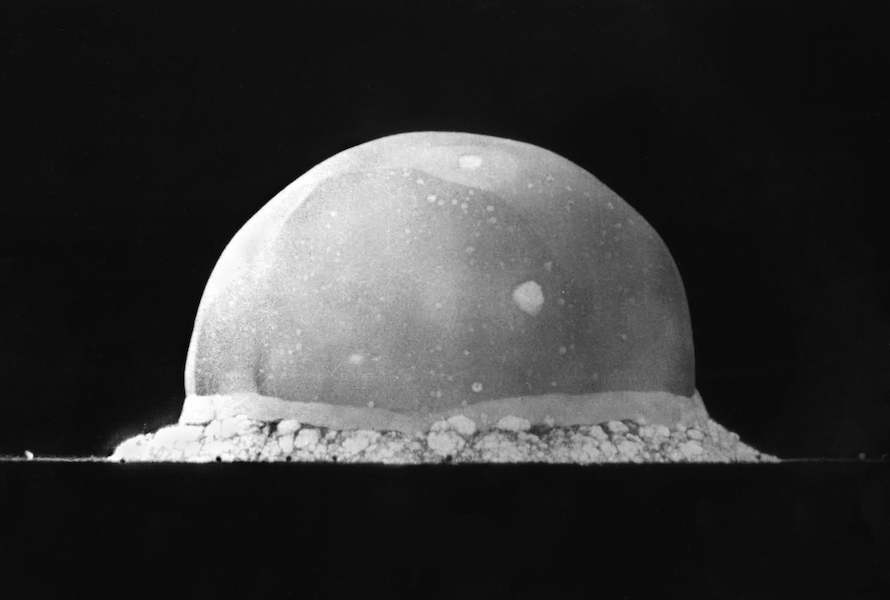
July 16, 2025 marks the 80th anniversary of the first nuclear explosion ever conducted.

Code named ‘Trinity’ and detonated on Native American land in Alamogordo, New Mexico, the 21 kiloton bomb not only had severe impacts for many of the communities who lived in—or downwind from—the area, but also the entire world, ever since. The Trinity bomb ignited the nuclear age and has cast a dark shadow over the world for the past eighty years. 

Three weeks after the United States detonated their first atomic weapon, they dropped two more on the Japanese cities of Hiroshima and Nagasaki, killing more than 210,000 people, demonstrating the destructive and indiscriminate power of nuclear weapons and spurring the global nuclear arms race. In response to Russian and US nuclear sabre-rattling in 2024, stated “nuclear-weapon States continue to roll the dice, resisting disarmament measures and believing that, somehow our luck will never run out.” 

Alongside the victims of Trinity, Hiroshima, and Nagasaki, the global victims of nuclear testing worldwide continues to grow.

Those living downwind from the Trinity tests in the Tularosa Basin—called ‘Downwinders’—would suffer lifetimes of illnesses from increased radiation exposure and would not receive any compensation from the United States government until 1990, when they received a $50,000 one-time compensation payout. 

The radiation contamination from Trinity poisoned the soil and water, in turn poisoning those who lived off the land, like the family of Tina Cordova, the founder of the Tularosa Basin Downwinders Consortium, and who is the fourth generation in her family to have cancer since 1945 and whose father died of cancer at age 71. 

“Our lives were changed forever after Trinity. We have never lived a day without the threat of a nuclear exchange with a rogue nuclear-armed country. […] It’s world history,” said Cordova. The United States government knew well “in advance of the detonation at Trinity that radiation was damaging to human health and very dangerous. They full-well knew that the bomb was going to create fallout that would likely affect many, many people across New Mexico. And they still moved forward.”

The disregard for native and local populations in areas surrounding nuclear testing sites would become characteristic for nuclear testing worldwide. Since 1945, an estimated 2,056 nuclear tests have been detonated across all continents, except Antarctica and South America. One quarter of these were exploded in the atmosphere, and three quarters were detonated on land on over sixty sites that still bear the traces to this day. 

Like the downwinders in New Mexico, many global nuclear test survivors were not warned about the tests taking place, nor have they been adequately compensated for the lasting and generational damage that these tests have caused. Those in the Marshall Islands are still experiencing the implications of the 1956 nuclear tests across multiple generations.

The international community adopted the Comprehensive Nuclear Test Ban Treaty in 1996, though it is still yet to enter into force due to a lack of support from certain states. Despite this, the treaty formed a de facto moratorium on all forms of nuclear testing.

Building on this earlier legal framework, the Treaty of the Prohibition of Nuclear Weapons (TPNW), was adopted by 122 states in 2017. This treaty not only seeks the total abolition of nuclear weapons, but also requires, for the first time, assistance to victims of their use and testing and the remediation of contaminated environments. This treaty was created in partnership with the survivors of nuclear war, to compel states to address the needs of victims and impacted environments. 

During the 80th anniversary of the Trinity tests, it is important to reflect that justice for survivors is an essential part of the quest for a world free of nuclear weapons.

By Noah Jones, ICAN Australia Intern


BACK TO NEWS

Media Release: Australian support for US nuclear strikes undermines international law, rules and norms.

Media Release: Australian support for US nuclear strikes undermines international law, rules and norms.

CAMPAIGN NEWS:

Media Release: Australian support for US nuclear strikes undermines international law, rules and norms.

Australian interests are not advanced by supporting US attacks on Iran. 

Formal Australian government support for recent US military strikes on nuclear facilities in Iran is inconsistent with key principles of international law and diplomacy and are deeply unhelpful in realising a peaceful resolution to this crisis. Australian support sends a dangerous message to the international community that Australia backs military aggression over dialogue and further erodes global disarmament norms, said the Nobel Peace Prize winning group the International Campaign to Abolish Nuclear Weapons (ICAN) Australia.

Instead of aligning with nuclear-armed states acting outside the law, Australia should act independently to uphold international law and negotiated outcomes and urgently move to sign and ratify the Treaty on the Prohibition of Nuclear Weapons (TPNW).

Australia, as a signatory to the Nuclear Non-Proliferation Treaty (NPT), has a responsibility to press for diplomatic solutions to nuclear concerns, not endorse illegal attacks on fellow parties to the treaty, including Iran. In a flagrant breach of the rules-based international order, the United States has violated these principles and set a dangerous precedent in targeting Iranian facilities instead of pursuing negotiations. A pre-emptive attack on a sovereign state and a direct strike on nuclear infrastructure protected under international law is not something Australia should support.

ICAN condemns any further escalation by any party and calls for Australia to:

  • Cease political support for military action of any party to the conflict.
  • Refuse any military, logistical or technical support for US attacks on Iran, for example by refuelling B2s in Australian airspace or assisting with targeting via Pine Gap.
  • Sign and ratify the UN Treaty on the Prohibition of Nuclear Weapons.
  • Support and engage with international calls for an urgent return to diplomacy and negotiation as the most credible pathway to resolution.

Before her deeply disappointing support for the American attacks, Foreign Minister Penny Wong has more helpfully called for de-escalation, dialogue and diplomacy. ICAN Australian supports this approach and urges the government to adopt one further D – disarmament. 

Australia must not allow nuclear weapons to be used as a pretext for launching another devastating war. Australia must reject this logic and refuse to support any action that fuels war under the banner of nuclear threat. We cannot bomb a path to peace and our government must act to reduce nuclear risks, not inflame them.

BACK TO NEWS

MEDIA RELEASE: US attacks on nuclear sites are a dangerous escalation — Australia must not assist

CAMPAIGN NEWS:

MEDIA RELEASE: US attacks on nuclear sites are a dangerous escalation — Australia must not assist

MEDIA RELEASE: US attacks on nuclear sites are a dangerous escalation — Australia must not assist

The International Campaign to Abolish Nuclear Weapons (ICAN) Australia condemns the United States’ reported strikes on three nuclear facilities in Iran. This reckless action brings the world closer to nuclear disaster and underscores the urgent need to reject nuclear weapons and the cover they provide for military aggression.

Nuclear facilities, whether civilian or military, must never be targeted. Such attacks not only violate international humanitarian law but also risk severe radiological consequences for people and the environment—within Iran and far beyond its borders.

Iran is a party to the Nuclear Non-Proliferation Treaty (NPT) and there is no evidence from the International Atomic Energy Agency or other authorities that Iran has developed nuclear weapons. Iran was also in full compliance with an agreement severely constraining its nuclear activities until the US walked away from the deal. Yet it has been hypocritically attacked by two nuclear-armed states: Israel—which has never signed the NPT and is widely understood to possess 90 nuclear weapons—and the United States, which possesses approximately 3,700 nuclear warheads. The United States is violating its disarmament obligations, as are the other eight nuclear-armed states. Such attacks risk pushing more states to pursue nuclear weapons.

“A military strike on nuclear facilities greatly elevates global risk and should be condemned by Prime Minister Albanese and Foreign Minister Wong” said Dr Margaret Beavis OAM, ICAN Australia Co-chair. “This escalation shows how quickly so-called ‘deterrence’ gives way to dangerous, destabilising force. We are playing with radioactive fire.”

“We call on the Australian Government to immediately rule out any logistical support for these operations, including by denying permission for US B-2 stealth or B-52 bombers attacking Iran to transit or refuel in Australia, as occurred recently during a US mission to attack Yemen,” said Gem Romuld, Director of ICAN Australia. “Australia must not facilitate, assist or enable these attacks — directly or indirectly.” 

If nuclear weapons were to be used in this conflict—whether by Israel   or the United States—the humanitarian consequences would be immediate and devastating. Even a single nuclear detonation over a city would kill hundreds of thousands of people instantly, overwhelm all medical systems, and contaminate the environment for decades. A regional nuclear conflict would cause a nuclear winter, massively disrupt global food production, drive famine and mass displacement, and risk further escalation. The Bulletin of the Atomic Scientists warns that we are closer to nuclear war than at any time since the Cold War—and recent events show just how quickly that risk can materialise.

“This is the terrifying reality of a world that continues to tolerate the possession of nuclear weapons by any state. The only path to safety is disarmament. Australia must urgently sign and ratify the Treaty on the Prohibition of Nuclear Weapons and stand against all acts of nuclear aggression” said Romuld. 

BACK TO NEWS