The ICAN Cities Appeal was endorsed by Perth City Council on 29 July 2025.
MOTION
That Council:
a) ACKNOWLEDGES the 80th anniversaries of the US atomic bombings of the cities of Hiroshima and Nagasaki on August 6th and 9th, 1945. We honour the 210,000+ victims of these attacks, and the Hibakusha and Hibakunesei who continue to live with the legacy of nuclear weapons.
b) NOTES that our city is deeply concerned about the grave threat that nuclear weapons pose to communities throughout the world. We firmly believe that our residents have the right to live in a world free from this threat.
c) NOTES that any use of nuclear weapons, whether deliberate or accidental, would have catastrophic, far‐reaching and long‐lasting consequences for people and the environment.
d) ENDORSES the International Campaign to Abolish Nuclear Weapons Cities Appeal, a global call from cities and towns in support of the UN Treaty on the Prohibition of Nuclear Weapons, and calls on our national government to sign and ratify it without delay.
Hibakusha testimony brought to federal parliament ahead of Hiroshima and Nagasaki anniversaries
Hibakusha testimony brought to federal parliament ahead of Hiroshima and Nagasaki anniversaries
On 6 and 9 August, the world will remember the US atomic bombings of Hiroshima and Nagasaki. 80 years on from these abhorrent attacks, people everywhere are demanding urgent action to ensure nuclear weapons are never used again.
Here in Australia we have been in Parliament House in Canberra with Isao Morimoto, second-generation Hiroshima Hibakusha (survivor) Isao Morimoto to encourage federal Parliamentarians to acknowledge these anniversaries and turn acknowledgement into action on the Nuclear Weapon Ban Treaty.
Isao is the son of late Junko Morimoto, author and illustrator of the Children’s book ‘My Hiroshima’, who was born in Hiroshima in 1932 and came to Australia in 1982, and lived in Sydney until she passed away in 2017. Isao carries his mothers testimony and will for nuclear weapons abolition. Before she passed away in 2017, she urged then Prime Minister Malcolm Turnbull to sign an ratify the Treaty on the Prohibition of Nuclear Weapons.
While in Canberra we met with MPs from across the political spectrum so they could hear directly from Isao about the lasting impacts for survivors and their descendents, and the Hibakusha’s call for all government’s to urgently sign and ratify the Treaty on the Prohibition of Nuclear Weapons in their lifetime.
“Peace is not passive. It requires effort, courage, and above all, memory.”
This week we also welcomed a powerful motion commemorating the 80th anniversaries of the Hiroshima and Nagasaki attacks put to the House of Representatives by Tania Lawrence, Labor MP for Hasluck, WA.
In speaking to the motion, Ms Lawrence solemnly remembered the more than 200,000 victims of the attacks, and noted the trauma and intergenerational legacy of the bombings. Ms Lawrence honoured the 2024 Nobel Peace Prize Winners Nihon Hidankyo, a Japanese group of atomic bomb survivors, for their tireless advocacy over 8 decades to drive forward action on nuclear disarmament. She further ackowledged the suffering and lasting impacts on communities in Australia and the Pacific exposed to nuclear weapons testing.
Lawrence outlined Australia’s histroy of support for the international legal frameworks that underpin nuclear disarmament, and welcomed the growing number of countries joining the Treaty on the Prohibition of Nuclear Weapons (TPNW).
Peace is not passive. It requires effort, courage, and above all, memory. That’s why this anniversary is crucial.
We do not remember Hiroshima and Nagasaki to dwell on the past; we remember them to shape a better future. A future where no child grows up under the shadow of a mushroom cloud. A future where no land is poisoned by radiation. A future where diplomacy, not devastation, is our default.
Let us honour the victims, the survivors, and the advocates with more than words. Let us honour them with action.
Tania Lawrence
Member for Hasluck,Australia Labor Party
The Fire Still Burns: Hiroshima, Resistance and Disarmament
If you would like hear Isao share his mothers testimony, and more about the significance of the 80th anniversaries of Hiroshima and Nagasaki, please join our webinar on Hiroshima Day.
Eighty years after the bombing of Hiroshima and Nagasaki, the fire still burns — in memory, in resistance, and in the global movement to abolish nuclear weapons.
As nuclear tensions escalate and Australia becomes more entangled in nuclear alliances, this one-hour online event brings together survivors, artists, campaigners and parliamentarians to reflect on Hiroshima’s legacy — and the urgent task of disarmament.
Speakers include:
Peter Garrett– Musician, environmentalist and former federal cabinet minister. Best known as the frontman of Midnight Oil, Garrett has spent decades campaigning on issues of peace, justice and nuclear disarmament. He served as Minister for the Environment and Minister for Education, and is a longstanding critic of nuclear weapons and the nuclear industry.
Isao Morimoto– Second-generationHibakushaand son of the late author/illustrator Junko Morimoto. Isao will share personal reflections on his mother’s life and survival.
Gem Romuld– Director, ICAN Australia, leading national efforts to promote the UN Treaty on the Prohibition of Nuclear Weapons and challenge Australia’s support for nuclear militarism.
Scott Ludlam– Writer, former Greens Senator and lifelong national and international campaigner for peace and climate justice (MC)
The event will also feature:
Video contributionsfrom Australian parliamentarians and civil society leaders
Music and storytellingto honour the memory of Hiroshima and those working for peace today
Introducing New Parliamentary Pledge signatory – Matt Smith MP, Member for Leichhardt
We were delighted to meet with newly elected ALP Member for Leichthardt, Matt Smith MP, share the Nobel Peace Prize awarded to ICAN in 2017 and brief him on Australia’s progress on the TPNW to date. Matt has shared his support for Australia signing and ratifying the TPNW by signing the ICAN Parliamentary pledge, which has now been signed by 104 Federal and 192 State and Territory parliamentarians.
We also were please to have the opportunity to catch up with reprsenatives from the Foreign Minster’s office, and to update many others on Australia’s opportuntiy to make history by signing and ratifying the TPNW, including Julie-Ann Campbell MP, Rob Mitchell MP, Alicia Payne MP Louise Miller-Frost MP, Tania Lawrence MP Josh Burns MP, Mark Dreyfus MP, Steve Georganas MP, Sharon Claydon MP, Senator David Shoebridge and Senator Lisa Darmanin.
Matt Smith MP (ALP)
Sharon Claydon MP (ALP)
Julie-Ann Campbell MP (ALP)
Alicia Payne MP (ALP)
Rob Mitchell MP (ALP)
Fiona Phillips MP (ALP)
In the last month, more than 15 Australian councils have passed motions commemorating the anniversaries and calling for Australia to sign the TPNW – incuding new endorsements of the ICAN Cities Appeal from with City of Perth, West Arnhem Regional Council and the City of Victor Harbor – and a number of landmark buildings around the country will be illuminated during the anniversary week.
“Peace is not passive. It requires effort, courage, and above all, memory.”
Just one week out from the 80th anniversaries of the US atomic bombings of Hiroshima and Nagasaki in 1945, Tania Lawrence, Labor MP for Hasluck, WA, delivered a powerful motion commemorating the 80th anniversaries of the Hiroshima and Nagasaki attacks in the House of Representatives.
The same motion was introduced to the Senate by Senator Karen Grogan from South Australia.
In speaking to the motion in the lower house, Ms Lawrence solemnly remembered the more than 200,000 victims of the attacks, and noted the trauma and inter-generational legacy of the bombings. Ms Lawrence honoured the 2024 Nobel Peace Prize Winners Nihon Hidankyo, a Japanese group of atomic bomb survivors, for their tireless advocacy over 8 decades to drive forward action on nuclear disarmament. She further acknowledged the suffering and lasting impacts on communities in Australia and the Pacific exposed to nuclear weapons testing.
Lawrence outlined Australia’s history of support for the international legal frameworks that underpin nuclear disarmament, and welcomed the growing number of countries joining the Treaty on the Prohibition of Nuclear Weapons (TPNW).
Peace is not passive. It requires effort, courage, and above all, memory. That’s why this anniversary is crucial.
We do not remember Hiroshima and Nagasaki to dwell on the past; we remember them to shape a better future. A future where no child grows up under the shadow of a mushroom cloud. A future where no land is poisoned by radiation. A future where diplomacy, not devastation, is our default.
Let us honour the victims, the survivors, and the advocates with more than words. Let us honour them with action.
Tania Lawrence
Member for Hasluck,Australia Labor Party
The motion moved in the Federation Chamber on Monday 28 July:
(1) commemorates the 80th anniversaries of the nuclear bombings of Hiroshima and Nagasaki on 6 and 9 August 1945, which caused the deaths of over 200,000 people and left enduring human, environmental and generational harm;
(2) congratulates Nihon Hidankyo on their 2024 Nobel Peace Prize for their lifelong work to draw the world’s attention to the impact of nuclear weapons, and acknowledges the profound suffering of direct and descendent nuclear bomb survivors (Hibakusha) and nuclear test survivors, including First Nations communities and military veterans affected by British nuclear testing in Australia and the Pacific;
(3) recognises the importance of a robust international legal architecture for nuclear disarmament and non-proliferation, including the cornerstone Treaty on the Non-Proliferation of Nuclear Weapons, the Comprehensive Nuclear-Test-Ban Treaty, the South Pacific Nuclear Free Zone Treaty (Treaty of Rarotonga) and a Fissile Material Cut-off Treaty;
(4) reaffirms that Australia shares the ambition, with States Parties to the Treaty on the Prohibition of Nuclear Weapons, of a world without nuclear weapons;
(5) welcomes global efforts to reduce the risk of nuclear war and strengthen disarmament norms; and
(6) calls on the Government to continue engaging constructively in international disarmament forums and to work with allies, civil society, and affected communities to advance practical steps towards a world without nuclear weapons.
Eighty years of the nuclear age, eighty years too long
Eighty years of the nuclear age, eighty years too long
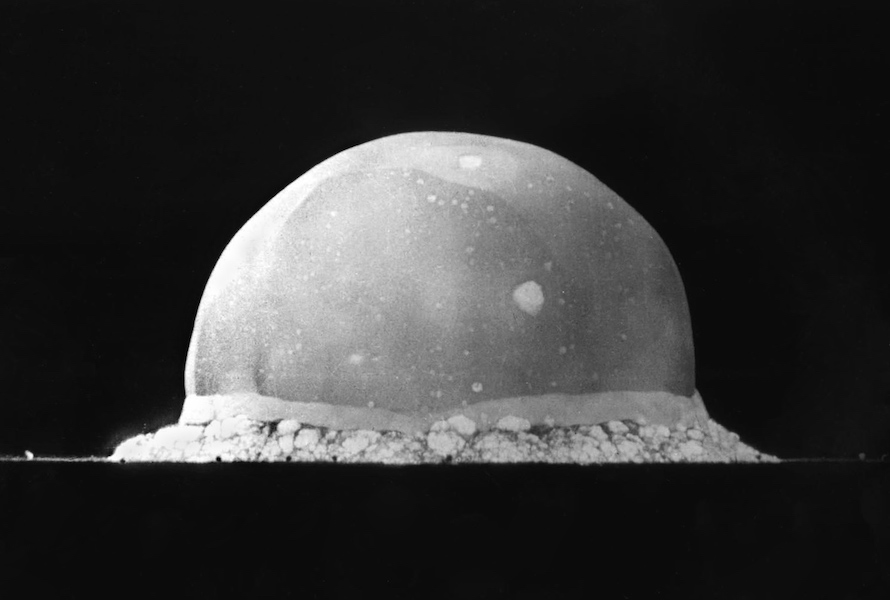
July 16, 2025 marks the 80th anniversary of the first nuclear explosion ever conducted.
Code named ‘Trinity’ and detonated on Native American land in Alamogordo, New Mexico, the 21 kiloton bomb not only had severe impacts for many of the communities who lived in—or downwind from—the area, but also the entire world, ever since. The Trinity bomb ignited the nuclear age and has cast a dark shadow over the world for the past eighty years.
Three weeks after the United States detonated their first atomic weapon, they dropped two more on the Japanese cities of Hiroshima and Nagasaki, killing more than 210,000 people, demonstrating the destructive and indiscriminate power of nuclear weapons and spurring the global nuclear arms race. In response to Russian and US nuclear sabre-rattling in 2024, stated “nuclear-weapon States continue to roll the dice, resisting disarmament measures and believing that, somehow our luck will never run out.”
Alongside the victims of Trinity, Hiroshima, and Nagasaki, the global victims of nuclear testing worldwide continues to grow.
Those living downwind from the Trinity tests in the Tularosa Basin—called ‘Downwinders’—would suffer lifetimes of illnesses from increased radiation exposure and would not receive any compensation from the United States government until 1990, when they received a $50,000 one-time compensation payout.
The radiation contamination from Trinity poisoned the soil and water, in turn poisoning those who lived off the land, like the family of Tina Cordova, the founder of the Tularosa Basin Downwinders Consortium, and who is the fourth generation in her family to have cancer since 1945 and whose father died of cancer at age 71.
“Our lives were changed forever after Trinity. We have never lived a day without the threat of a nuclear exchange with a rogue nuclear-armed country. […] It’s world history,” said Cordova. The United States government knew well “in advance of the detonation at Trinity that radiation was damaging to human health and very dangerous. They full-well knew that the bomb was going to create fallout that would likely affect many, many people across New Mexico. And they still moved forward.”
The disregard for native and local populations in areas surrounding nuclear testing sites would become characteristic for nuclear testing worldwide. Since 1945, an estimated 2,056 nuclear tests have been detonated across all continents, except Antarctica and South America. One quarter of these were exploded in the atmosphere, and three quarters were detonated on land on over sixty sites that still bear the traces to this day.
Like the downwinders in New Mexico, many global nuclear test survivors were not warned about the tests taking place, nor have they been adequately compensated for the lasting and generational damage that these tests have caused. Those in the Marshall Islands are still experiencing the implications of the 1956 nuclear tests across multiple generations.
The international community adopted the Comprehensive Nuclear Test Ban Treaty in 1996, though it is still yet to enter into force due to a lack of support from certain states. Despite this, the treaty formed a de facto moratorium on all forms of nuclear testing.
Building on this earlier legal framework, the Treaty of the Prohibition of Nuclear Weapons (TPNW), was adopted by 122 states in 2017. This treaty not only seeks the total abolition of nuclear weapons, but also requires, for the first time, assistance to victims of their use and testing and the remediation of contaminated environments. This treaty was created in partnership with the survivors of nuclear war, to compel states to address the needs of victims and impacted environments.
During the 80th anniversary of the Trinity tests, it is important to reflect that justice for survivors is an essential part of the quest for a world free of nuclear weapons.
Media Release: Australian support for US nuclear strikes undermines international law, rules and norms.
Australian interests are not advanced by supporting US attacks on Iran.
Formal Australian government support for recent US military strikes on nuclear facilities in Iran is inconsistent with key principles of international law and diplomacy and are deeply unhelpful in realising a peaceful resolution to this crisis.Australian support sends a dangerous message to the international community that Australia backs military aggression over dialogue and further erodes global disarmament norms, said the Nobel Peace Prize winning group the International Campaign to Abolish Nuclear Weapons (ICAN) Australia.
Instead of aligning with nuclear-armed states acting outside the law, Australia should act independently to uphold international law and negotiated outcomes and urgently move to sign and ratify the Treaty on the Prohibition of Nuclear Weapons (TPNW).
Australia, as a signatory to the Nuclear Non-Proliferation Treaty (NPT), has a responsibility to press for diplomatic solutions to nuclear concerns, not endorse illegal attacks on fellow parties to the treaty, including Iran. In a flagrant breach of the rules-based international order, the United States has violated these principles and set a dangerous precedent in targeting Iranian facilities instead of pursuing negotiations. A pre-emptive attack on a sovereign state and a direct strike on nuclear infrastructure protected under international law is not something Australia should support.
ICAN condemns any further escalation by any party and calls for Australia to:
Cease political support for military action of any party to the conflict.
Refuse any military, logistical or technical support for US attacks on Iran, for example by refuelling B2s in Australian airspace or assisting with targeting via Pine Gap.
Sign and ratify the UN Treaty on the Prohibition of Nuclear Weapons.
Support and engage with international calls for an urgent return to diplomacy and negotiation as the most credible pathway to resolution.
Before her deeply disappointing support for the American attacks, Foreign Minister Penny Wong has more helpfully called for de-escalation, dialogue and diplomacy. ICAN Australian supports this approach and urges the government to adopt one further D – disarmament.
Australia must not allow nuclear weapons to be used as a pretext for launching another devastating war. Australia must reject this logic and refuse to support any action that fuels war under the banner of nuclear threat. We cannot bomb a path to peace and our government must act to reduce nuclear risks, not inflame them.
MEDIA RELEASE: US attacks on nuclear sites are a dangerous escalation — Australia must not assist
MEDIA RELEASE: US attacks on nuclear sites are a dangerous escalation — Australia must not assist
The International Campaign to Abolish Nuclear Weapons (ICAN) Australia condemns the United States’ reported strikes on three nuclear facilities in Iran. This reckless action brings the world closer to nuclear disaster and underscores the urgent need to reject nuclear weapons and the cover they provide for military aggression.
Nuclear facilities, whether civilian or military, must never be targeted. Such attacks not only violate international humanitarian law but also risk severe radiological consequences for people and the environment—within Iran and far beyond its borders.
Iran is a party to the Nuclear Non-Proliferation Treaty (NPT) and there is no evidence from the International Atomic Energy Agency or other authorities that Iran has developed nuclear weapons. Iran was also in full compliance with an agreement severely constraining its nuclear activities until the US walked away from the deal. Yet it has been hypocritically attacked by two nuclear-armed states: Israel—which has never signed the NPT and is widely understood to possess 90 nuclear weapons—and the United States, which possesses approximately 3,700 nuclear warheads. The United States is violating its disarmament obligations, as are the other eight nuclear-armed states. Such attacks risk pushing more states to pursue nuclear weapons.
“A military strike on nuclear facilities greatly elevates global risk and should be condemned by Prime Minister Albanese and Foreign Minister Wong” said Dr Margaret Beavis OAM, ICAN Australia Co-chair. “This escalation shows how quickly so-called ‘deterrence’ gives way to dangerous, destabilising force. We are playing with radioactive fire.”
“We call on the Australian Government to immediately rule out any logistical support for these operations, including by denying permission for US B-2 stealth or B-52 bombers attacking Iran to transit or refuel in Australia, as occurred recently during a US mission to attack Yemen,” said Gem Romuld, Director of ICAN Australia. “Australia must not facilitate, assist or enable these attacks — directly or indirectly.”
If nuclear weapons were to be used in this conflict—whether by Israel or the United States—the humanitarian consequences would be immediate and devastating. Even a single nuclear detonation over a city would kill hundreds of thousands of people instantly, overwhelm all medical systems, and contaminate the environment for decades. A regional nuclear conflict would cause a nuclear winter, massively disrupt global food production, drive famine and mass displacement, and risk further escalation. The Bulletin of the Atomic Scientists warns that we are closer to nuclear war than at any time since the Cold War—and recent events show just how quickly that risk can materialise.
“This is the terrifying reality of a world that continues to tolerate the possession of nuclear weapons by any state. The only path to safety is disarmament. Australia must urgently sign and ratify the Treaty on the Prohibition of Nuclear Weapons and stand against all acts of nuclear aggression” said Romuld.