Australia urged to press US to ‘act responsibly’ as threat of nuclear disaster rises amid Israel-Iran conflict

CAMPAIGN NEWS:

Australia urged to press US to ‘act responsibly’ as threat of nuclear disaster rises amid Israel-Iran conflict

Nobel prize-winning anti-nuclear group calls for ‘urgent de-escalation and a return to diplomacy’

Ben Doherty, Guardian Australia
June 21st 2025

The International Campaign to Abolish Nuclear Weapons (Ican) has described the escalating conflict between Israel and Iran as a “terrifying reminder of how close the world remains to nuclear disaster”, arguing Australia should condemn illegal military attacks and ratify the global treaty banning nuclear weapons.

Israeli strikes on Iranian nuclear facilities violate international law, Ican has alleged, and could cause radioactive contamination with long-term consequences for human health and the environment.

“The prospect of radiation release, the erosion of non-proliferation norms, and the emboldening of nuclear-armed states to act without accountability – this is the deadly logic of nuclear deterrence playing out in real time,” said Gem Romuld, the Australian director of Ican, a Nobel prize-winning anti-nuclear group.

“We need urgent de-escalation and a return to diplomacy. Australia should press its allies, particularly the United States, to act responsibly and stop enabling this cycle of violence.”

Israel, the only nuclear-armed state in the Middle East, is widely believed to be modernising its arsenal. It remains outside the nuclear non-proliferation treaty (NPT), but is estimated to have 90 nuclear warheads. Israel has never officially acknowledged that it possesses nuclear weapons.

Israel has maintained its strikes on Iranian nuclear facilities are lawful and necessary to prevent Iran acquiring nuclear weapons and using them in the future. The attacks were “pre-emptive and precise strikes” against military targets, the Israel Defense Forces spokesperson Brig Effie Defrin said.

Iran, which had previously proposed a nuclear weapons-free zone in the Middle East, is a state party to the NPT but has now threatened to withdraw. The Iranian foreign minister, Abbas Araghchi, insisted Iran’s nuclear programme was peaceful and that it sought an end to hostilities: “Iran is ready to consider diplomacy once again – once the aggression is stopped and the aggressor is held accountable for the crimes committed.”

Globally, the nuclear threat is growing.

The decades-long trend of the number of dismantled warheads outstripping the deployment of new warheads – resulting in an overall year-on-year decrease in the global inventory of nuclear weapons – appears set to end: the pace of dismantlement is slowing, while the deployment of new nuclear weapons is accelerating.

Figures released this week by the Stockholm International Peace Research Institute (SIPRI) show that of the 12,241 nuclear warheads globally, 9,614 remain in military stockpiles, and 3,912 are deployed on missiles and aircraft, with 2,100 kept on high operational alert.

“The era of reductions in the number of nuclear weapons in the world, which had lasted since the end of the cold war, is coming to an end,” said Hans M Kristensen, an associate senior fellow with SIPRI’s Weapons of Mass Destruction Programme.

“Instead, we see a clear trend of growing nuclear arsenals, sharpened nuclear rhetoric and the abandonment of arms control agreements.”

Since before winning office in 2022, Labor has committed to ratifying the UN Treaty on the Prohibition of Nuclear Weapons (TPNW) in government, but it has not yet done so.

The government has argued it is “considering the TPNW systematically and methodically as part of our ambitious agenda to advance nuclear non-proliferation and disarmament”.

Globally, 94 countries have signed the ban treaty, and 73 have ratified it. No nuclear weapons states are party to the treaty.

BACK TO NEWS

Media Release: Israel-Iran conflict shows the deadly danger of nuclear brinkmanship — Australia must reject nuclear weapons

CAMPAIGN NEWS:

Media Release: Israel-Iran conflict shows the deadly danger of nuclear brinkmanship — Australia must reject nuclear weapons

MEDIA RELEASE: Israel-Iran conflict shows the deadly danger of nuclear brinkmanship — Australia must reject nuclear weapons

The International Campaign to Abolish Nuclear Weapons (ICAN) Australia warns that the escalating conflict between Israel and Iran is a terrifying reminder of how close the world remains to nuclear disaster — and calls on the Australian Government to condemn illegal military attacks, reject nuclear deterrence, and join the UN Treaty on the Prohibition of Nuclear Weapons (TPNW).

On 13 June, Israel launched strikes on Iranian nuclear facilities. This illegal attack has provoked a military response and escalation on both sides threatens to further unravel the already fragile nuclear non-proliferation framework. The use of force against nuclear facilities violates international law and risks radioactive contamination with long-term consequences for human health and the environment.

“The prospect of radiation release, the erosion of non-proliferation norms, and the emboldening of nuclear-armed states to act without accountability — this is the deadly logic of nuclear deterrence playing out in real time,” said Gem Romuld, Director of ICAN Australia. “We need urgent de-escalation and a return to diplomacy. Australia should press its allies, particularly the United States, to act responsibly and stop enabling this cycle of violence.”

Israel, the only nuclear-armed state in the Middle East, is widely believed to be modernising its arsenal. In 2024, it conducted a missile propulsion test potentially linked to its Jericho nuclear-capable ballistic missiles, and appears to be upgrading its Dimona plutonium production nuclear site. Israel remains outside the Nuclear Non-Proliferation Treaty (NPT), and its nuclear weapons are a major source of instability in the Middle East. Iran, among the first to propose a nuclear weapons-free zone in the Middle East, is a state party to the NPT but has now threatened to withdraw.

“Because it is nuclear-armed Israel acts with impunity — and because it is provided with funding, intelligence, weapons and support, including by the recent G7 statement expressing support for Israel’s ‘security’, its violations go unchecked,” said Assoc. Prof. Tilman Ruff AO, founding chair of ICAN Australia. “This sets a dangerous precedent. Israel’s aggression, its timing and murder of the lead Iranian negotiator suggests it wanted to kill diplomacy. All countries should condemn Israel’s illegal and hypocritical attack and call for an end to hostilities before the world faces even more catastrophic escalation.”

ICAN Australia stresses that treaties like the NPT and the TPNW are vital for global and regional peace. While the NPT is under enormous strain, the TPNW offers a new and necessary pathway toward delegitimisation of nuclear weapons and disarmament. Every state has a role to play in universalising these treaties and reinforcing international law.

Meanwhile, the nuclear threat is growing globally. According to newly released figures from the Stockholm International Peace Research Institute (SIPRI), all nine nuclear-armed states — including the US, Russia, China, and Israel — continued to expand and modernise their arsenals in 2024. Of the estimated 12,241 nuclear warheads globally, 9,614 remain in military stockpiles, and 3,912 are deployed on missiles and aircraft, with 2,100 kept on high operational alert.

Australia’s policy of relying on US nuclear weapons — so-called “extended nuclear deterrence” — ties us to these risks. It undermines our credibility as a proponent of disarmament and international law and makes us complicit in the threat of mass destruction.

“This is a global emergency,” said Romuld. “We need leadership — not loyalty to an existential threat. Australia should lead by example, reject nuclear weapons, and join the TPNW.”

In 2024, nuclear-armed states spent over US$100 billion on their arsenals — an 11% increase from the previous year. According to ICAN’s new report Hidden Costs: Nuclear Weapons Spending in 2024, private weapons contractors earned at least US$42.5 billion from nuclear weapons activities. Every dollar invested in weapons of mass destruction is a dollar stolen from climate action, health care, and public safety.

“Eighty years after Hiroshima and Nagasaki, this is the reality: rising spending, rising risks, and no accountability,” said Romuld. “Australia must help shift the tide. Now is the time to take a stand.”

ICAN Australia urges the Albanese Government to:

  • Condemn Israel’s illegal strike and call for an immediate end to hostilities.
  • Oppose any threat or use of nuclear weapons under any circumstances.
  • Implement Labor’s national policy commitment to sign, then ratify the TPNW without delay.

“We must not be complicit partners in a system that normalises nuclear threats,” said Ruff. “Australia has a choice: double down on being part of the problem and the nuclear status quo — or help build a safer, disarmed world.”

BACK TO NEWS

The ‘unsustainable’ reason behind who can have nuclear weapons, and who can’t

CAMPAIGN NEWS:

The ‘unsustainable’ reason behind who can have nuclear weapons, and who can’t

16 June 2025 
By Alex Gallagher, SBS News

Israel has said its attack on Iran on Friday was partially aimed at destroying its nuclear infrastructure. But it’s far from the only country to have developed its capacity in recent years.

On Friday, Israel launched its largest attack on Iran in decades, with a wave of airstrikes that hit nuclear facilities, military sites and residential buildings in the capital, Tehran.

Iran responded with retaliatory strikes on Israel, and the two countries have continued trading missile fire for days.

Iran’s health ministry said 224 people have been killed by Israel’s attacks, while Israel said 13 have been killed by Iranian strikes. Hundreds of people have been wounded in both countries.

Iran has consistently denied it is developing nuclear weapons, saying its uranium enrichment program is exclusively for peaceful purposes such as energy, and international assessments have found no evidence that Iran, over the past 20 years, has had an active nuclear weaponisation program.

Iran is also one of the signatories to the United Nations-backed Treaty on the Non-Proliferation of Weapons. Israel is not, despite international pressure, and remains the only country in the Middle East widely believed to possess nuclear weapons.

Iran’s Supreme Leader, Ayatollah Ali Khamenei, has repeatedly said there is an Islamic fatwa — a legal ruling — against the development of nuclear weapons, and that such development is prohibited under Islamic law.

Shortly before Israel’s strikes on Iran, the United Nations’ global nuclear watchdog, the International Atomic Energy Agency (IAEA), declared Iran was in breach of its non-proliferation obligations for the first time in 20 years.

The IAEA cited “many failures” since 2019 to uphold its obligations to provide the agency with “full and timely co-operation regarding undeclared nuclear material and activities”.

Earlier this month, the IAEA said Iran had enough uranium enriched to near-weapons grade to potentially make nine nuclear bombs if it were further enriched.

In recent days, Foreign Minister Penny Wong, Defence Minister Richard Marles and Opposition leader Sussan Ley have all described Iran’s nuclear program as a significant “threat” to international peace and security.

Israeli Prime Minister Benjamin Netanyahu said the goal of Friday’s strikes was partially to wipe out Iran’s nuclear program, calling the strikes “pre-emptive”.

The strikes caused significant damage to linked sites such as the Natanz nuclear facility and a uranium enrichment facility in Isfahan, and killed multiple nuclear scientists in addition to military officials and civilians.

Israel has long claimed Iran is developing a nuclear weapon, with Netanyahu calling it an “existential threat to Israel”.
Tilman Ruff is an honorary principal fellow at The University of Melbourne and the co-president of International Physicians for the Prevention of Nuclear War and was a founding chair of the International Campaign to Abolish Nuclear Weapons.

He told SBS News while it’s “pretty clear that Iran was flirting with nuclear weapons” and had an early nuclear weapons program around 20 years ago, there was no evidence of active weaponisation, or that Israel’s strike was “pre-emptive in the sense that Iran was clearly planning an attack on Israel that was imminent”.

Israel has never formally confirmed or denied whether it has nuclear weapons itself, long maintaining a policy of deliberate ambiguity, though multiple Israeli politicians have acknowledged the country having nuclear capabilities over the years.

These factors, along with the fact that it has never signed international agreements aimed at the non-proliferation and prohibition of nuclear weapons, have contributed to the widely held perception that Israel owns nuclear weapons.

Ruff described Israel’s “extremely dangerous” attack on Friday as “the most flagrant example of double standards that you could possibly imagine”.

When it comes to countries developing nuclear capacities, Ruff said the “inherent ambiguity” of nuclear programs made it a far bigger issue than just Iran.

“Any country that’s determined to do so, that’s got either an enrichment plant or a nuclear reactor, can build a nuclear weapon,” he said.

“If you can produce uranium to run in reactors, then you’ve got everything you need to enrich it to weapons grade. And there are other countries with vast stocks much larger than Iran’s of weapons-usable material.

“There are many other countries who have been flirting with having nuclear facilities and the capacity to produce fissile material quickly to shorten the path to a weapon, should they choose to do so.”
Which countries have nuclear weapons?
Eight countries have declared they have nuclear weapons: Russia, the United States, China, France, the United Kingdom, India, Pakistan and North Korea.

Russia and the US control the vast majority of these weapons, together possessing around 90 per cent of the 12,241 estimated warheads that exist globally, according to the Stockholm International Peace Research Institute (SIPRI).

While Israel is also strongly believed to have nuclear weapons, including by SIPRI, it has long maintained a policy of deliberate ambiguity.

Ruff said there had been “very clear threats” of nuclear weapon use from Israeli government members.

Most recently, in November 2023, Israeli minister Amihai Eliyahu said a nuclear strike on Gaza would be “one way” of responding to Hamas’ October 7 attack on Israel.

Some viewed Eliyahu’s comments as an implicit admission that Israel had nuclear capabilities.

The comments were disavowed by Israeli politicians, including a rebuke by Netanyahu.

SIPRI, in its annual assessment of armaments, disarmament and international security on Monday, warned the world’s nuclear arsenals were being enlarged.SIPRI stated that the nine nuclear-armed states continued to modernise and upgrade their nuclear capabilities throughout 2024.

SIPRI’s Hans M Kristensen said: “The era of reductions in the number of nuclear weapons in the world, which had lasted since the end of the Cold War, is coming to an end.”

“Instead, we see a clear trend of growing nuclear arsenals, sharpened nuclear rhetoric and the abandonment of arms control agreements.”

What steps have been taken to limit nuclear weapons?

Multiple international agreements have aimed at curbing the spread of nuclear weapons with a view towards disarmament.

The United Nations-backed Treaty on the Non-Proliferation of Weapons (NPT) came into effect in 1970, and included agreements from Russia, the US, the UK, China and France.

Those states agreed to pursue disarmament in exchange for the rest of the treaty’s signatories agreeing never to acquire nuclear weapons.

The treaty has overwhelming support, with 191 states being party to it, including Iran.

Israel is one of the few countries — along with India, Pakistan, North Korea and South Sudan — to not have signed on, due to its policy of deliberate ambiguity.

Ruff said a shortcoming of the treaty was that, while it contained a detailed regime regarding non-proliferation by states that didn’t already have nuclear weapons, there were no clear details or timeframe for other countries to implement disarmament.

Those countries, Ruff said, “show absolutely no sign of fulfilling that obligation after more than half a century” and have continued to justify their possession of nuclear weapons.

“And there’s of course also the four nuclear armed states — Israel, India, Pakistan, and North Korea — that are outside the treaty that are not formally bound by its requirements,” he said.

The Treaty on the Prohibition of Nuclear Weapons, adopted in 2017 and coming into effect in 2021, marked the first legally binding, comprehensive international agreement to ban nuclear weapons.

Signatories are prohibited from the development, testing, production, acquisition, stockpiling, use, threat of use, and transfer of nuclear weapons

According to the UN, 73 states have ratified or acceded to the treaty.
What about the Iran nuclear deal?
In 2015, under the Joint Comprehensive Plan of Action, Iran agreed to limit its nuclear program in exchange for relief from certain sanctions imposed by the US, the European Union, and the UN Security Council.

Ruff said it was a “very successful agreement” while active, in which the IAEA carried out “extraordinarily intrusive” inspections to ensure Iran was compliant with its obligations.

In 2018, during his first term, US President Donald Trump walked away from the deal and reinstated sanctions.

Iran said it would stop complying with parts of the agreement, and has substantially ramped up its enrichment program in the years since.

Earlier this year, the US started holding talks with Iran in an attempt towards a new agreement over the latter’s nuclear program.

The sixth round of talks had been set to take place on Sunday, but Iran withdrew, saying such discussions were “meaningless” amid Israel’s ongoing strikes.

‘Law of the jungle’

Ruff described the current situation, in which several countries continue to own nuclear weapons, as a “completely unsustainable, unjust and very dangerous law of the jungle”, and that complete disarmament was necessary for peace to occur.

While countries such as the US have often cited a deterrent element to justify their continued possession of nuclear weapons, Ruff said that argument was a “fig leaf” that doesn’t contribute to stability, and as a strategy, was susceptible to inaccuracy and failure.

“It’s an extraordinarily dangerous idea, and it’s really just trumped out because deterrence sounds defensive and reasonable.

“What it means is a willingness to prepare and plan for the radioactive incineration of millions of civilians somewhere in the world. It’s completely unacceptable.”

BACK TO NEWS

Australia has voted to be nuclear-free

CAMPAIGN NEWS:

Australia has voted to be nuclear-free

At Saturday’s federal election, the Australian public clearly rejected nuclear energy, giving the new Anthony Albanese Labor Government a mandate for bold leadership on issues that truly matter. Banning nuclear weapons is one of them.

In rejecting the Opposition’s nuclear energy proposal, a key part of their election platform,  Australians have rejected the risks, costs and burden of nuclear power. If Australians don’t want nuclear power, then they certainly don’t want any involvement in nuclear weapons. Independent polling verifies this, showing three in four Australians agree that Australia should “end any support for nuclear weapons and sign and ratify” the Treaty on the Prohibition of Nuclear Weapons (TPNW). 

Anthony Albanese introduced the 2018 motion committing Labor to sign and ratify the TPNW. This policy has now been reaffirmed twice, in 2021 and 2023.

Nuclear weapons are the most destructive, inhumane and indiscriminate weapons ever created. Today, we have an opportunity to take a step towards their elimination. (Anthony Albanese, December 2018)

In Albanese’s first term as Prime Minister, Australia ended its opposition to the Treaty on the Prohibition of Nuclear Weapons and began to engage with it. Now, Prime Minister Albanese has been given a mandate to sign and ratify. 

There is nothing stable or secure about the geopolitical landscape. Nine nuclear-armed countries have the ability to begin a nuclear war, or to launch a nuclear weapon by accident. This is not the time to wait and see, nor to follow President Trump into nuclear catastrophe.

This August is 80 years since the nuclear destruction of Hiroshima and Nagasaki. Every person under the age of 80 has not lived a day without the nuclear threat hanging over our heads.

Eliminating nuclear weapons is a difficult, but essential task. Australia can be a global leader by demonstrating strength through diplomacy and international law.

The most effective step Australia can take on nuclear weapons? Join the ban. Nothing less will do. 

Congratulations to the newly-elected TPNW supporters:

Jess Teesdale

The new Labor member for Bass, Tasmania, supports the Treaty on the Prohibition of Nuclear Weapons

Renee Coffey

The new Labor member for Griffith, QLD, supports the Treaty on the Prohibition of Nuclear Weapons

Julie-Ann Campbell

The new Labor member for Moreton, QLD, supports the Treaty on the Prohibition of Nuclear Weapons

Carol Berry

The new Labor member for Whitlam, NSW, supports the Treaty on the Prohibition of Nuclear Weapons

Rebecca White

The new Labor member for Lyons, TAS, supports the Treaty on the Prohibition of Nuclear Weapons

Sarah Witty

The new Labor member for Melbourne, VIC, supports the Treaty on the Prohibition of Nuclear Weapons. Pictured here with Tanya Plibersek MP and ICAN’s Nobel Peace Prize medal in April 2025.

Trish Cook

The new Labor member for Bullwinkel, WA, supports the Treaty on the Prohibition of Nuclear Weapons

Thank you to the TPNW champions who lost their seats:

Adam Bandt

Former Greens MP for Melbourne, VIC, and longtime supporter of the Treaty on the Prohibition of Nuclear Weapons

Zoe Daniel

Former independent MP for Goldstein, VIC, and vocal advocate supporter of the Treaty on the Prohibition of Nuclear Weapons since her election in 2022. Pictured here with ICAN in February 2025.

Max Chandler-Mather

Former Greens MP for Griffith, QLD, and supporter of the Treaty on the Prohibition of Nuclear Weapons since his election in 2022.

Stephen Bates

Former Greens MP for Brisbane, QLD, and supporter of the Treaty on the Prohibition of Nuclear Weapons since his election in 2022.

BACK TO NEWS

ICAN Australia Tribute to Pope Francis

CAMPAIGN NEWS:

ICAN Australia Tribute to Pope Francis

Nuclear Weapons an ‘affront to heaven’
ICAN Australia Pays tribute to Pope Francis, a leader for peace and disarmament

ICAN Australia pays tribute to His Holiness Pope Francis who passed away yesterday, April 21st. He was 88 years old and had been Pope since 2013.

Pope Francis was a champion of nuclear disarmament and a strong advocate for the United Nations Treaty on the Prohibition of Nuclear Weapons (TPNW). Under his leadership, the Vatican was one of the first states to ratify the TPNW when it opened for signature in 2017.

During a historic visit to Hiroshima and Nagasaki in 2019, when he met survivors of the atomic bombings of those cities, Pope Francis condemned the use and possession of nuclear weapons as “immoral” and urged support for “the principal international legal instruments of nuclear disarmament and non-proliferation, including the Treaty on the Prohibition of Nuclear Weapons”. He also said that a world without nuclear weapons is “possible and necessary”.

Pope Francis was a strong critic of the doctrine of nuclear deterrence. During his speech in Nagasaki, he said that “nuclear doctrines” foment “a climate of fear, mistrust, and hostility”, adding that the possession of nuclear weapons is never the answer to our longings for security, peace, and stability. Nuclear weapons only ever afford a “false sense of security”, he said, as peace cannot be achieved through “the threat of total annihilation”.

Our thoughts are with our Partners at the Australian Catholic Social Justice Council, Catholic Religious Australia and Catholics in Coalition for Justice and Peace at this difficult time and to Catholics around the world mourning this loss.

Pope Francis calls for a 'world without nuclear weapons' during Nagasaki visit | Pope Francis | The Guardian

BACK TO NEWS

Profile: Maxine Goodwin – ICAN Ambassador

Profile: Maxine Goodwin – ICAN Ambassador

PROFILE: MAXINE GOODWIN
ICAN AMBASSADOR

By Jesse Boylan
April 16th, 2025

No special preparations or precautions had been made with a view to entering the cloud*

As the youngest of three children, Maxine Goodwin had a happy childhood. She grew up in a close-knit family in southwest Sydney in the 1960s and 1970s during a time of great social, political, and cultural change. Her family would enjoy meals out together, visit the grandparents on the weekend, and spend long days at the beach during the summer. Her mother, Delphine, was a housewife, and her father, Max, worked full time as an electronics avionics engineer. Maxine’s parents had met on a dancefloor in Amberly, Queensland, while both serving in the Royal Australian Air Force (RAAF). After they married, Delphine had to leave the Air Force as she was no longer allowed to serve, which upset her, as she had loved being part of it. Delphine was smart and became involved in all sorts of volunteer work to keep herself engaged while raising young children. “She was really into computers,” said Maxine. When computers were not even generally in people’s households. She was quite the go-to for everybody if they had issues with those things.”

When Maxine was nine, her father was diagnosed with lymphoma. “He’d apparently been sick for many years,” said Maxine. “He had obvious lumps visible under his chin and in his neck. But doctors were dismissive, and no one was interested in doing anything about it until my parents insisted on having the lumps removed, and that’s when he was diagnosed.” For the next several years, Max went in and out of remission, and in the years prior to his death in 1981, stories about nuclear veterans who had served at Australia’s atomic testing sites had begun to surface in the mainstream media. Avon Hudson, who was deployed to Maralinga in South Australia as a RAAF mechanic, blew the whistle on national television in 1976 about the fact that plutonium was still buried at Maralinga, delaying the return of land to the Anangu Traditional Owners. Other veterans were also starting to speak out because they were seeing their mates get diagnosed with cancers and die in their thirties and forties. Maxine’s parents, too, began questioning: could Max be sick from his work at the Montebello Islands?

Operation Hurricane, October 3, 1952, Monte Bello Islands, Australia

“I knew he was in the Air Force, but I had no idea about his experience,” Maxine said. Delphine knew that he had served at Montebello, but “it wasn’t until the later stages of his illness that he mentioned anything about it,” said Maxine. Realising that his experience at Montebello could have caused his cancer, Max told his family that he had been in a plane that had flown through a radioactive cloud. “That’s all he said,” Maxine recalled. “That was all we knew until he passed away and then my mum connected with the Australian Nuclear Veterans Association [ANVA],” who helped the family gain more understanding about the nuclear testing program at Montebello and what Max might have done while stationed there.

After Max died, Delphine applied for compensation with Veterans Affairs, and Ric Johnstone, then President of the ANVA, helped guide her through the process. Delphine was told that her initial application was rejected because “it was possible, but not probable, that his illness was caused by his potential exposure to radiation,” said Maxine. “We certainly know a lot more now in hindsight. I would say 99% chance it probably was [caused by radiation], there’s no other history of cancer in our family on either side.” Delphine appealed the decision in 1983 but was eventually advised to close the application. Over the years, Delphine joined several class actions alongside the ANVA, but all of those were denied as well.

ANVA Index Cards, Balaklava, South Australia, 2015. The Australian Nuclear Veterans Association documented servicemen’s posts and their illnesses associated with their work.
By Jesse Boylan

Well we’ve had many die since we’ve started going to Canberra to the consultative forum, and I’ve taken all of ’em [the names] down and presented ’em to the, meetings, and said what’s the deal with the widows of these people, and how come… Oh I get upset down there… because they’re only interested in lookin’ at the people who are dead, how many are dead, what they died from, and was it cancer? And I say to you, stuff the dead, we can’t help them, we can only help the widows. And the way they’re going, they won’t have to pay out much because they’ll be all dead.

Ric Johnstone in an interview included in ‘British Nuclear Testing in Australia: Performing the Maralinga Experiment through Verbatim Theatre’, by Paul Brown
Journal & Proceedings of the Royal Society of New South Wales, Vol. 139, p. 39-50, 2006

“When Mum first started this process applying for compensation I was still at high school,” said Maxine. “I was doing year 11 and 12 and we were dealing with the fact that my father had passed away and my mum was now a single parent.” Delphine had also become the sole carer of the three grandparents who lived nearby. “While she’s dealing with the loss of her husband, she’s also taken on this new role as carer for all the grandparents. And I knew all of this was going on in the background that she’d applied for compensation, but I didn’t really understand fully what it was.”

Following Max’s death, Maxine studied paramedicine and worked as a paramedic for eight years, putting the cause of her father’s death to the back of her mind. It wasn’t until twenty years later that Maxine began to want to know more about her father’s experience at Montebello. “I started researching the story more and I applied for his records through the National Archives, and I actually found the two compensation files,” she said. The files documented what unit Max had been in, as well as what day he had arrived at Onslow in Western Australia. “It talked a little bit about what his role was. It was really interesting looking at how the Australian government solicitor was quite… you could sense his frustration with the authorities who didn’t want to provide information to assist him to investigate the claim. You can read through those files and sense the arrogance of certain individuals that are trying to just block the natural process of giving a widow due compensation.”

While raising her own children, Maxine continued to scour the archives and read as much as she could. Through this research, Maxine began to piece together more of her father’s story. “He was a radio technician, he’d only just finished his apprenticeship, which was a new scheme for the Air Force,” said Maxine. “Within weeks he was sent to Onslow.” Max’s role was to service the Dakota Aircraft and fit it with special equipment for testing, such as filter canisters and equipment for measuring radiation. “My understanding is that his unit was sent to Onslow [to monitor] for radioactivity along the coastline,” said Maxine. “My mum always said she didn’t understand why he was in the aircraft because he was ground crew, but I think it’s pretty clear that he was in the aircraft because the equipment that he’d fitted was being used on the day after the test to monitor the coastline and so perhaps he was there to ensure it worked.”

Max Ward (third left front row), Onslow, Western Australia, 1952. 

Maxine will never be able to know if her father knew that he and his colleagues were about to fly through a radioactive cloud. “To me it sounded like it wasn’t expected to happen,” said Maxine. “But when I look at the archives and what I’ve read since and the Royal Commission findings, it seems pretty clear to me that they were deliberately looking for that cloud. They weren’t just monitoring the coastline; they flew at different altitudes and for several hours to look for that radioactivity. And it’s pretty clear from any sort of information that the scientists have reported on that day after the test, that was the sole purpose of their flights between Onslow and Broome.”

Paul Grace’s book, Operation Hurricane: The story of Britain’s first atomic test in Australia and the legacy that remains (2023), describes in detail the activities of aircraft and ground crew in the lead up to, and on the day of, the Hurricane test on October 2, 1952. It’s possible that Paul Grace’s grandfather, Lieutenant Ron Grace, was piloting the exact plane that Maxine’s father was in:

Flight Lieutenant Grace was flying Dakota A65-99. ‘The return flight from Broome to Onslow was planned direct over the sea’, he wrote in response to a 1982 Department of Health survey. ‘At a point approximately halfway, Mr Hale reported high levels of Radiation being recorded by his instruments and declared that we were in the Atomic Cloud.’ The Dakota had flown straight into an invisible concentration of radioactive particles over the coast near Port Hedland, sending the ultra-sensitive radiac device right off the scale.

Although Maxine will never get to hear her father’s own story, she can connect to others like it. By searching the ANVA website, Maxine found a diary section of the page with posts written by children of veterans, who had very similar experiences to her own. She left a comment on one of the posts and put it out of her mind. A year later, Maxine received a call from Ellise Barkley, a theatre producer who had found the comment on the ANVA website. Ellise was working with Paul Brown, a playwright, on a verbatim theatre project called Half a Life, about the experiences of British and Australian veterans who had served in the British atomic testing program. Paul visited Maxine and Delphine to record their story. The experience of Paul sitting down and listening to them was validating. “[It] helped mum and I come together to explore this story,” Maxine said. “When we watched the play [and] listened to our own words being spoken back to us from the actors on the stage, it was kind of a bizarre experience, but it was also really powerful because… you always know this story, and it’s so mysterious and the government continued to say, ‘oh, this never happened and you were never exposed,’ and ‘there was never any risk,’ but here’s a group of actors on stage relaying the story of multiple people all pretty much saying the same thing. So, you kind of walk away thinking ‘I’m not making this up.’”

Maxine went on to be involved with another of Brown’s productions called Nuclear Futures, a community arts project, which linked artists with atomic survivor communities in a series of interconnected projects. Paul and Maxine went to the British Nuclear Test Veterans Association conference in Manchester in the UK, where she met with politicians and UK veterans and their descendants. “That was a big turning point for me,” said Maxine. “Meeting all of those descendants and also meeting veterans who had the similar role to my dad and some of the widows who sat down with me and told me why my father would have been in the plane; they were filling in the gaps and saying he most certainly would have been in the plane to ensure the equipment was working.” Those encounters helped Maxine put all the pieces together. It was also through Nuclear Futures where Maxine met nuclear veterans Avon Hudson and Doug Brooks, as well as nuclear survivors and their descendants from the Yalata Aboriginal community in far-west South Australia. “The community arts have been really important in having an opportunity to tell [my] story without having to justify it with compensation claims and class actions,” said Maxine. “It recognises the story exists and it’s one that needs to be told. [It’s] a positive way to continue telling the story without creating that negative energy that [you get left with] when you have these experiences.”

Ten Minutes to Midnight, Balaklava, SA, 2015, Nuclear Futures
Photo: Tania Safi
Avon Hudson in the Adelaide Advertiser as part of the Nuclear Futures Project, 2015

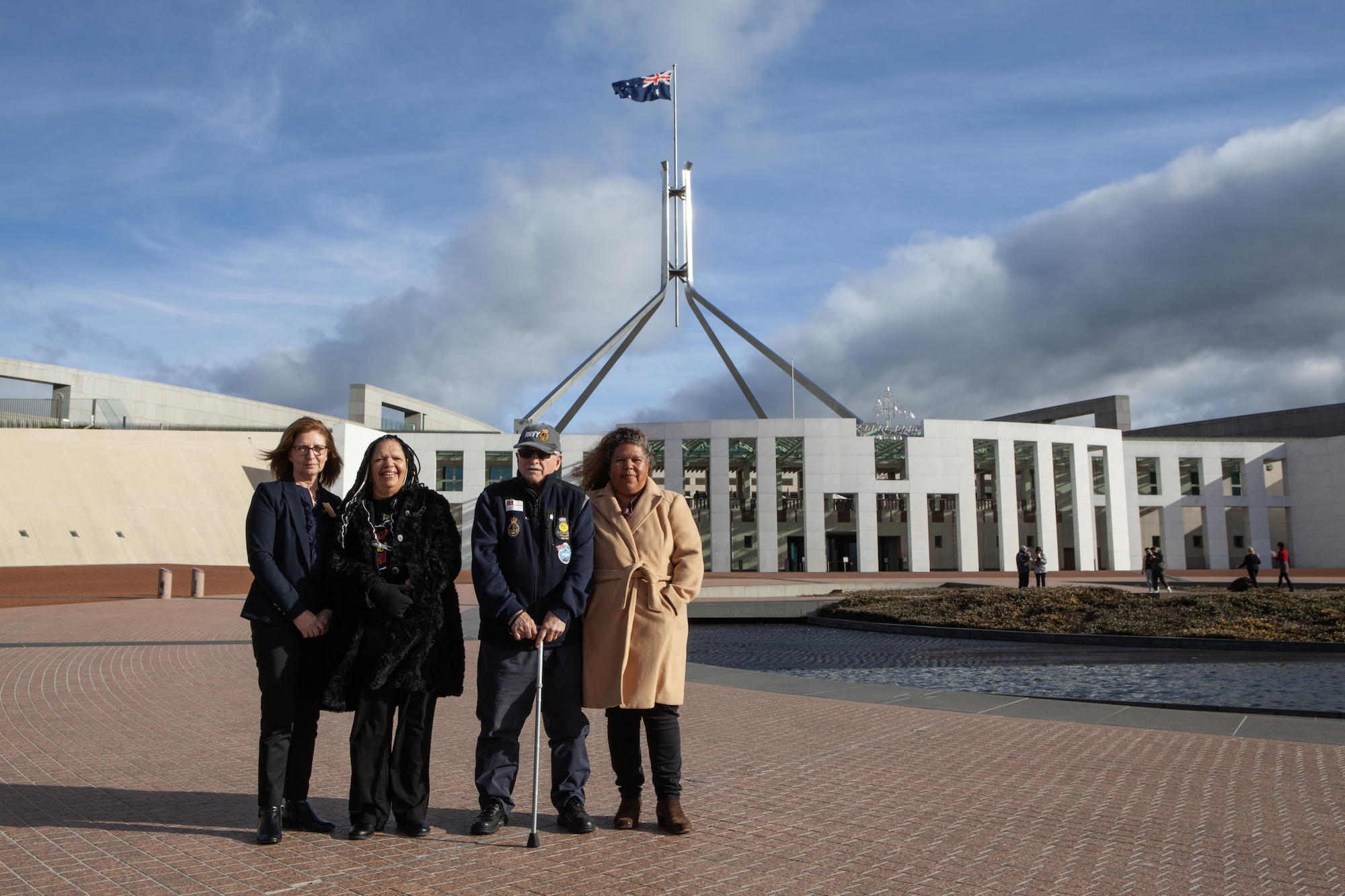
In 2023, Maxine was invited to participate in an atomic survivors delegation to Canberra organised by ICAN Australia. Joining the trip was Karina Lester, a Yankunytjatjara Anangu woman and second-generation nuclear test survivor, June Lennon a Yankunytjatjara, Antikarinya and Pitjantjatjara woman and nuclear test survivor, and Doug Brooks, a nuclear veteran from the Montebello Islands tests. “It was a special couple of days,” said Maxine. “The story’s often been told as a veteran story or an Aboriginal story, and obviously all stories are valid and need to be heard, but, in respect to politicians, [to hear it] as a united group was really important. We have this unique shared experience, even though each experience is an individual one. And considering we were talking about some very personal and emotional experiences, it was really lovely to just hang out together and hang out with the ICAN team and learn more about the TPNW [Treaty on the Prohibition of Nuclear Weapons].”

Maxine’s mum passed away in 2018, which prompted Maxine to question how much more she can gain from continuing to research her father’s story and from continuing to participate in class actions. “What’s the purpose for me? Do I really continue with this?” she asked. “Going to Canberra helped me realise, well there is a reason to keep talking about it and it’s the future, not the past, and I think that’s where I’m headed now, to be honest.”

Maxine Goodwin interviewed on ABC Canberra during the atomic survivors delegation, 2023. 
Atomic Survivors Delegation, Canberra, 2023. Photo: Jesse Boylan

An ICAN (International Campaign to Abolish Nuclear Weapons) ambassador’s role is to promote the campaign’s mission to achieve universal adherence to the Treaty on the Prohibition of Nuclear Weapons and advocating for nuclear abolition. This involves raising awareness about the humanitarian consequences of nuclear weapons, engaging in advocacy, and supporting ICAN’s work to achieve a world free of nuclear weapons.

*Doug Peirson, one of the men comprising the Radiological Survey Division team tasked with running the coastal-monitoring programme out of Onslow. Quoted in Paul Grace, “Operation Hurricane: The story of Britain’s first atomic test in Australia and the legacy that remains.” Hachette Australia, 2023.

BACK TO NEWS