Sachertorte #6: Meeting of States Parties to the TPNW, Day 3

CAMPAIGN NEWS:

Sachertorte #6: Meeting of States Parties to the TPNW, Day 3

Sachertorte: a famous Viennese chocolate cake. Easier to eat than to pronounce correctly. Used here to provide a slice of the action for the Treaty on the Prohibition of Nuclear Weapons in Vienna, Austria.

Thursday 23 June

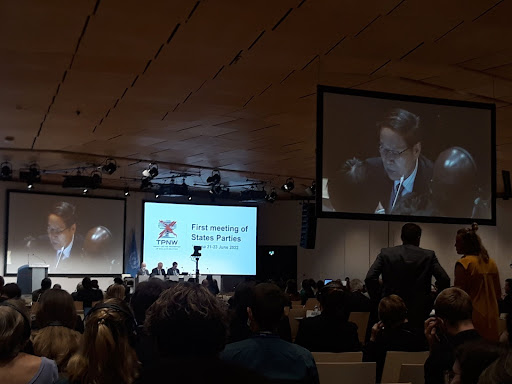
First Meeting of States Parties to the Treaty on the Prohibition of Nuclear Weapons, Day 3

Report by Talei Luscia Mangioni, ICAN Australia board member, and Dr Tilman Ruff, ICAN Co-Founder.


The final day of the 1MSP concluded with a very strong commitment on implementation of the TPNW with the adoption of the Vienna Declaration and Action plan, an ICAN briefing paper of which can be found here. Both were commended as a very strong political declaration condemning nuclear weapons as well as a very detailed and comprehensive action plan with a strong emphasis on universalisation, positive obligations of victims assistance and environmental remediation, establishment of a scientific advisory group, the deadline of ten years to destroy nuclear stockpiles, and 90 days to remove nuclear weapons of another country if hosted on their territory. It was also decided that Mexico would chair 2MSP scheduled for November 2023 in New York City, given its historical and ongoing role in advancing disarmament and non-proliferation especially with regards to the TPNW. 

A detailed account of national positions and discussion can be found in the excellent Reaching Critical Will Nuclear Ban Daily reports; in this account I will focus on the substantive outcomes and offer some reflections of a more general nature about the process and conduct of the meeting and their implications for our ongoing work.

Particularly as the TPNW does not have a dedicated secretariat in the way that for example the Chemical Weapons Convention and Comprehensive Nuclear Test Ban Treaty do, it is widely recognised by supporters of the treaty that intersessional work that goes on between formal meetings is vital to progress and implement the treaty. The overall structure agreed involves a coordinating committee comprising the outgoing and incoming presidents of the treaty meetings as well as the co-chairs of the informal working groups which were agreed, supported by the UNODA as secretariat. Importantly, both the International Committee of the Red Cross (ICRC) and ICAN are invited to participate in meetings of this committee, which will meet at least quarterly.

Three informal working groups were established, addressing:

1. Universalisation – co-chaired by South Africa and Malaysia. This reflects Article 12 of the treaty requiring states parties to encourage states not yet parties to join the treaty. The approach to universalisation efforts is broad including through increasing signatures and ratifications, as well as promoting the norms, values and underlying arguments of the treaty, including about the inherent risks and catastrophic humanitarian consequences of nuclear weapons, and the treaty’s effective contribution towards disarmament and international peace and security. A range of specific actions were delineated.

2. Processes towards the elimination of nuclear weapons – co-chaired by Mexico and New Zealand. This group will address Article 4 of the treaty. States agreed on timelines which the treaty specifies required decision at this MSP. The maximum duration for the elimination of nuclear weapons from a nuclear-armed state which joins the TPNW was agreed at 10 years, with extension under exceptional circumstances for up to 5 further years. It was further agreed that for nuclear weapons hosting states which join the TPNW, nuclear weapons must be removed from their territory within 90 days. An important area of ongoing work for this group will be to explore and develop further the role, functioning and nature of the competent international authority or authorities required under the treaty to verify the time-bound. irreversible dismantling of nuclear weapons and nuclear weapons programs and facilities required under the treaty.

3. Victim assistance, environmental remediation and international cooperation and assistance – co-chaired by Kazakhstan and Kiribati. This group will focus on the treaty’s so-called ‘positive obligations’ enshrined in Articles 6 and 7. This ongoing work has significant potential to engage states which have not yet joined the treaty. It was notable that Germany, a nuclear hosting state which currently rejects the TPNW, expressed interest in this work. One possibility which the group will explore is the establishment of an international trust fund to support international cooperation around victim assistance and environmental remediation related to nuclear weapons use and testing.

These informal working groups will be open to the participation of all states parties, again with ICRC and ICAN and the UNODA secretariat and relevant international organisations as observers. For each working group, states parties are to appoint a national contact point within between 60 and 90 days.

Three further supportive programs of work were agreed:

Scientific Advisory Group

Beginning the 5th plenary meeting for the 1MSP, Ambassador Alexander Kmentt opened discussions on institutionalizing scientific and technical advice for effective implementation of the Treaty. It will have up to 15 members with diverse expertise relevant to the implementation of the treaty. States have 90 days to nominate members, and a few nominations have already been made. 

Kmentt highlighted the rationale behind establishing a scientific and technical advisory group with access to up to date scientific and technical advice, especially on issues such as victim’s assistance, environmental remediation and appropriate humanitarian response. Malaysia, South Africa, Mexico and Cuba remarked on the issues such as membership, rules, roles and reporting mechanisms of this group. 
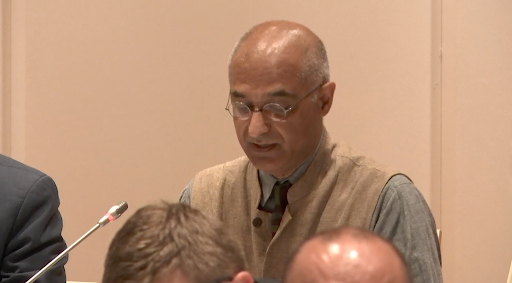
Image: Zia Mian, Princeton University

In addition, some comments from civil society were made, including Princeton University, Zia Mian who gave a short history on scientists’ complicity in nuclear weapons and resistance to nuclear weapons use through disarmament and raised the scientists’ possible central and progressive role in this group. IPPNW stated the importance of evidence-based policy making, and highlighted that “we believe it is critical to create an advisory panel of scientists and  on the humanitarian consequences and risks associated with it and the requisite humanitarian response.”

Overall, states agreed to create a Scientific Advisory Group which will: “Advise states parties and report regularly on the status and developments regarding nuclear weapons, nuclear weapon risks, the humanitarian consequences of nuclear weapons, nuclear disarmament, and related issues. Also, comprise of up to 15 members and take into account the need for a comprehensive spread of relevant fields of scientific and technological expertise, gender balance, and equitable geographical distribution.”


Intersessional Structure 

The issue of formulating an intersessional structure including such as working groups on issues like positive obligations was then discussed. Kmentt highlighted the need to keep a level of flexibility given limited financial and human resources and create focal points on gender and complementarity. Amongst South Africa, Cuba, ICAN,  Mexico, Jamaica, New Zealand and Ireland there was discussions about the intersessional structure, including on establishing a coordinating committee, the future location of all meetings to take place in New York to allow participation of “developing” states-parties and equitable participation and continued collaboration between states-parties. 

Overall, states agreed to: “establish informal working groups to advance these actions and a committee to coordinate them, including civil society and to meet at least once every quarter. – Informal working groups include: – One on universalization, co- chaired by South Africa and Malaysia; – One on victim assistance, environmental remediation; international cooperation and assistance, co-chaired by Kazakhstan and Kiribati; – And one on the implementation of Article 4, in particular work related to the future designation of (a) competent international authority(ies), co-chaired by Mexico and New Zealand.”


Complementarity with other Treaties, especially NPT

One of the most dishonest but persistent and strident criticisms of the TPNW from states supportive of nuclear weapons has been that it somehow contradicts or undermines other treaties related to nuclear weapons, particularly the nuclear Non-proliferation Treaty (NPT). This criticism was thoroughly and comprehensively repudiated by states parties during the meeting, all of whom strongly support the NPT and are members in good standing.

A discussion of a working paper led by Ireland and Thailand also ensured the complementarity of the TPNW with other disarmament and non-proliferation Treaties. This was done with regard to how the TPNW has been wrongly denigrated by nuclear weapon states and their allies as being oppositional to the NPT. Ireland introduced the working paper with provisions that TPNW is complementary to other disarmament agreements. The primary decision was to assign an informal facilitator/s to look at tangible cooperation between TPNW and NPT complementarity and with other treaties between 1MSP and 2MSP. And also several actions to encourage states parties to advocate complementarity with disarmament and non-proliferation and enhanced cooperation with other international bodies like CTBTO and IAEA on nuclear safeguards and verification. Thailand powerfully stated that “we are committed to doing more and we will continue to do so until the misinformation and accusation against the Treaty has been eradicated and all states are on the right side of history”. States including Philippines, Malaysia, South Africa, Cuba, Mexico, Kazakhstan, Peru, ICAN and ICRC affirmed support of the working paper, with many commenting on the mutual compatibility between NPT (as cornerstone of disarmament) and TPNW and other Treaties and SDGs. Kmentt formally appointed Ireland and Thailand to be informal facilitators on this issue.

This important political work should greatly assist and encourage states not yet parties to engage with the TPNW and broaden the contribution of the TPNW in advancing disarmament.
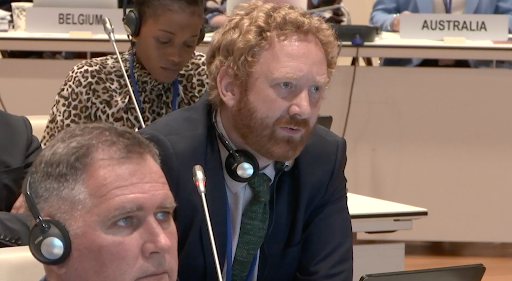
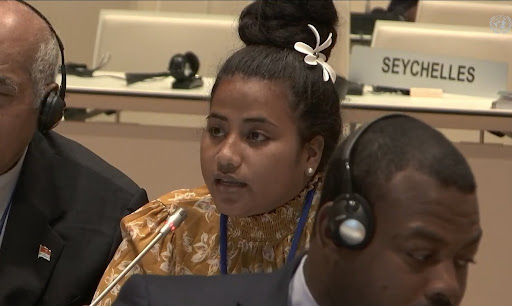
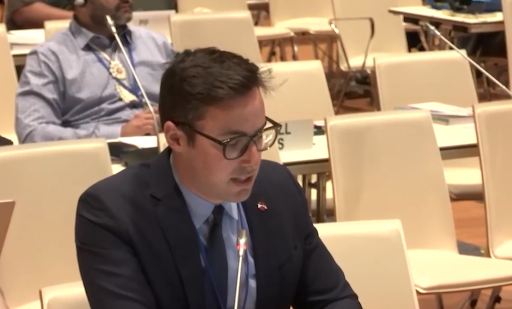
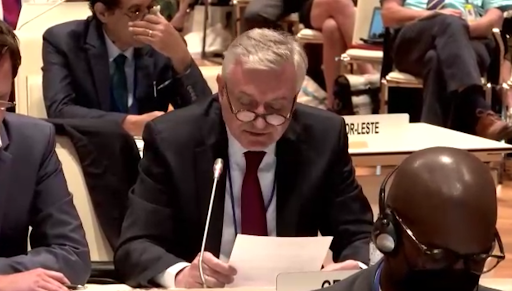
Image: Ireland’s delegation speaking.
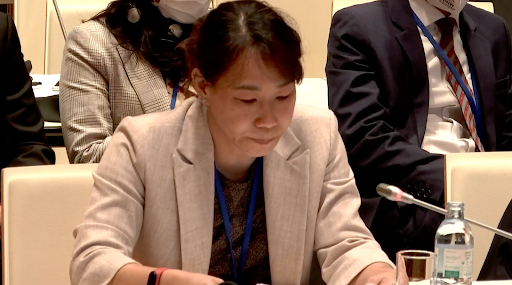
Image: Thailand’s delegation speaking.

Overall, states agreed to: “the TPNW builds upon, contributes to and complements a rich and diverse disarmament and non-proliferation architecture and agreed on some steps to highlight this including: – Appointing an informal coordinator to articulate areas for cooperation between the TPNW and Nuclear Non-Proliferation Treaty (NPT) (Action 36) – Cooperate with other international bodies, such as the IAEA and the CTBTO, in order to enhance cooperation (Action 37).”

Gender provisions

The meeting appointed Chile as gender focal point to advance intersessional work to support the implementation of the gender provisions of the treaty.


Preparations for 2MSP 2023

States parties appointed the state-party of Mexico as convenor of 2MSP at New York. Mexico stated its 

commitment to continuing inclusive and substantive consultations prior to the meeting, we believe it is the way to make progress with the ambitious mandate that we have adopted in regards to adopting decisions. This current meeting and the humanitarian aspect which was very successful shows more than ever the importance of eliminating nuclear weapons in a world in which nuclear weapons are becoming eminent.”

The representative of Mexico also affirmed a commitment to working groups and continuing the collaborative spirit of the Treaty going forward, especially with Austria who convened the 1MSP and Kazakhstan who will convene the 3MSP. Ambassador H.E. Juan Ramón de la Fuente was then elected President of 2MSP. The venue of the headquarters of the United Nations of New York and dates of 27 November – 1 December 2023 were confirmed. Kazakhstan thanked Austria for convening 1MSP and thanked Mexico, and proposed to work progressively with both for the future.
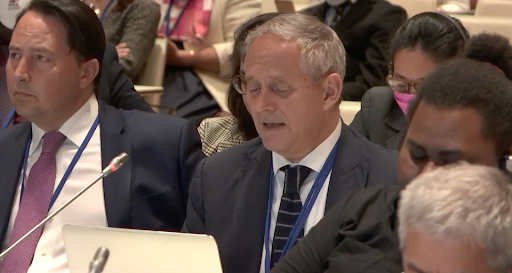
Image: Mexico’s delegation speaking.

MSP1 process

These processes with delineated actions (50 of them), many with specified timelines, will help to advance the implementation of the treaty efficiently, with a cooperative division of labour, and are realistic in view of the limited funds and capacities of many states parties. These processes also continue the unique and precious openness and inclusivity that have characterised the evolution of the Humanitarian Initiative culminating in the TPNW, with productive and positive partnership between states, international organisations, the UN, diverse civil society organisations, academics and experts. The MSP continued the TPNW’s unique role in the nuclear field in bringing global democracy and humanity to nuclear weapons matters. Diverse civil society organisations had regular and meaningful opportunities to contribute to the discussion and debate during the MSP.

A number of aspects of the process of this MSP and its preparation stand out. The processes were efficient, constructive, cooperative and involving well-planned and inclusive consultations enabling unusually speedy consensus decision-making around final adjustments and adoption. The president of MSP1, Austrian Ambassador Alexander Kmentt, ensured that this valuable political capital of high ambition consensus decision-making remained unbroken through the meeting. As one who has observed other disarmament fora, this is refreshing compared with the degraded lowest common denominator consensus processes one observes with monotonous regularity in NPT and Conference on Disarmament meetings.

Adoption of the Final Document, Declaration and Action Plan

The conference concluded after the adoption of the “Vienna Declaration on the TPNW: Our Commitment to a World Free of Nuclear Weapons”. There was a brief proposal from South Africa that the title should be changed to remove the geographic location of “Vienna ” from the beginning of the title of the declaration to highlight that it was the result of the 1MSP rather than one specific state. Mexico, Ireland, Indonesia, Costa Rica and Kazakhstan appealed to South Africa to leave “Vienna” in the title since similar international declarations do the same and to highlight Austria’s ongoing support in the TPNW. This was followed by the adoption of the very detailed Draft Vienna Action Plan.

The political declaration promulgated from MSP1 is a compelling document. As noted by Ambassador Kmentt, it is very likely the clearest and strongest rejection of nuclear weapons ever issued by a multilateral forum.  It describes nuclear weapons as heightening tensions and being used to coerce and intimidate:

This highlights now more than ever the fallacy of nuclear deterrence doctrines, which are based and rely on the threat of the actual use of nuclear weapons and, hence, the risks of the destruction of countless lives, of societies, of nations, and of inflicting global catastrophic consequences.

The Declaration expresses deep concern that:

despite the terrible risks, and despite their legal obligations and political commitments to disarm, none of the nuclear-armed states and their allies under the nuclear umbrella are taking any serious steps to reduce their reliance on nuclear weapons.

Hopefully Australia signing the treaty in the near future will change that!

The declaration concludes:

We will take every path that is open to us, and work persistently to open those that are still closed. We will not rest until the last state has joined the Treaty, the last warhead has been dismantled and destroyed and nuclear weapons have been totally eliminated from the Earth.

Ambassador Alexander Kmentt then closed the conference in a moving speech, stating: 

In the situation where multilateralism is very strained… where every indicator of nuclear weapons is pointing in the wrong direction, we point very clearly in the right direction. We have shown our united determination to forge ahead to make real progress on nuclear disarmament and non-proliferation, we have adopted an impressive and ambitious action plan, we have set up an innovative, flexible and inclusive intersessional structure that ensures all states-parties can contribute and achieve maximum results without over-burdening anyone. We have agreed a powerful and clear political declaration, that we do not accept the status quo of the nuclear nuclear status quo of the Sword of Damocles above us. So the path is prepared and now of course the real work starts. So let us continue to work in this spirit and show the world what is possible.

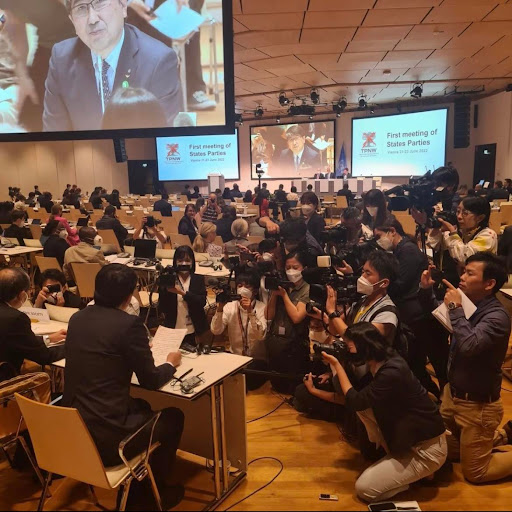
This was met with a large and celebratory standing ovation by all of those in the room. After a long week, the 1MSP was brought to a close with many actions for us in the disarmament and non-proliferation community to look forward to over the next year. 

During 1MSP, eight countries announced they are working to ratify the TPNW: Brazil, Democratic Republic of the Congo, Dominican Republic, Ghana, Indonesia, Mozambique, Nepal and Niger.

By the next MSP late next year, we have every right to expect our new Australian government to have signed this landmark instrument which is the one positive light in the face of every measure of nuclear weapons risk currently worsening. We all can play a role in ensuring our new government follows up its welcome first step of joining MSP1 by delivering on its important commitment to join the TPNW.
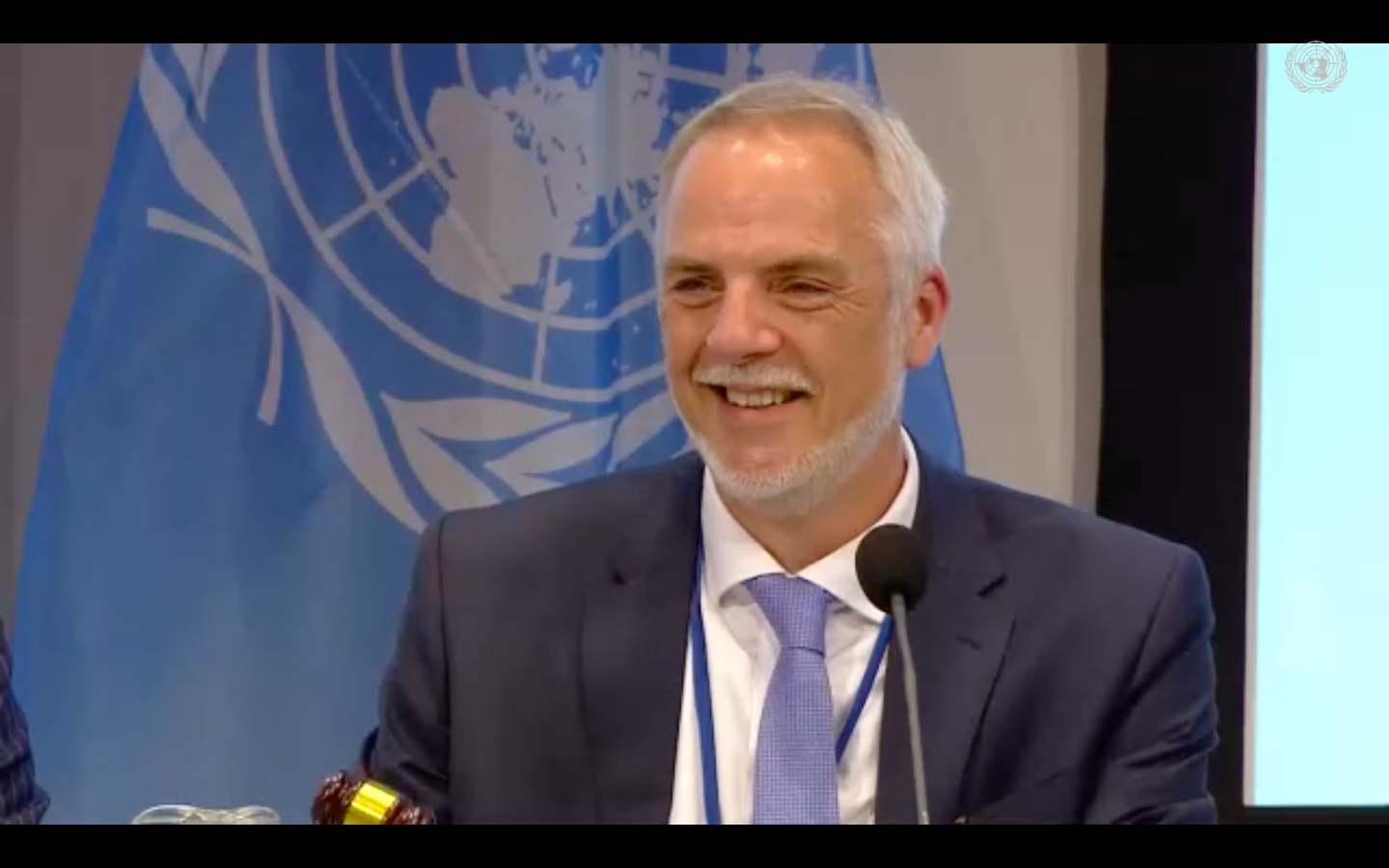
 

Image: President of the conference Alexander Kmentt closes the first Meeting of States Parties to the TPNW on 23 June 2022.
BACK TO NEWS

Sachertorte #5: Meeting of States Parties to the TPNW, Day 2

CAMPAIGN NEWS:

Sachertorte #5: Meeting of States Parties to the TPNW, Day 2

Sachertorte: a famous Viennese chocolate cake. Easier to eat than to pronounce correctly. Used here to provide a slice of the action for the Treaty on the Prohibition of Nuclear Weapons in Vienna, Austria.

Tuesday 22 June

First Meeting of States Parties to the Treaty on the Prohibition of Nuclear Weapons, Day 2

Report by Lachlan Good, ICAN Australia Campaigner.


The deliberations of the TPNW’s historic First Meeting of States Parties continues, with attendees’ focus shifting to the consideration of the current status and implementation of the Treaty.

Observer Participation

Back in Vienna, representations to the conference were made by non-state parties, joining as signatories or interested observers.

Indonesia, a signatory yet to ratify the Treaty, spoke forcefully about the legal and technical advancements presented by the TPNW, compared with existing nuclear weapons instruments. The Dominican Republic described the treaty as “a new and valuable instrument of nuclear disarmament.”

Morocco, the first observer state to speak, offered a strong endorsement of the Treaty and its aims. The delegation offered a history of strong verbal support for TPNW during its development, and offered remarks on the importance of multilateral negotiations in achieving nuclear disarmament.

This emphasis was one of several themes among the non-state party observer contributions. Germany, host to US nuclear warheads, referenced the NPT and its Review Conference (due in August) as an “irreplaceable” venue for continuing disarmament efforts, while acknowledging the “strain” the NPT has come under in recent decades, as armed states continue to replenish their nuclear stocks. Germany also suggested the TPNW was incompatible with their membership of the North Atlantic Treaty Organization – a claim that MSP President Alexander Kmentt has explicitly contradicted to NATO itself.

Image: German delegation making a statement at MSP1.

Switzerland, Norway, and the Netherlands made similar gestures to critiques of the TPNW. ICAN Australia has a number of resources that address these and other misconceptions about the Treaty, including our Choosing Humanity report and For the Record.

Not all observers gestured towards multilateralism in their reservations towards the TPNW. Observer state Sweden explicated that it does not view the non-participation of nuclear armed states as a limitation of the TPNW’s efficacy, instead asking for clarification on the Treaty’s interaction with existing verification architecture. Brazil reported that the Treaty is currently before the National Congress, and reaffirmed support for TPNW processes. All observers expressed verbal commitment to the cause of nuclear disarmament, and the elimination of nuclear weapons.

“We Are Crying”: Survivors Continue to Lead

Among the most impressive contributions to MSP have been from nuclear survivors and communities affected by nuclear testing. Masao Tomonaga, Chair of the Nagasaki Global Citizens Assembly for the Elimination of Nuclear Weapons, made one of many such powerful testimonies.


Image: The Nagasaki Global Citizens Assembly for the Elimination of Nuclear Weapons making a statement at MSP1.

Dr Tomonaga was 3 years old on August 9 1945, when he was saved from a small wooden house by his 20 year old mother. He became a doctor and encountered a high prevalence of cancer and disease among survivors, and the lifelong anxiety this presents to Hibakusha communities. He offered a sharp critique of Japan’s reliance on the so-called nuclear umbrella:

“We are crying…to see this dilemma, and the high wall we need to overcome to realise a nuclear-free world before all Hibakusha die.”

Kiribati ended discussion of Article 12 with an impassioned plea for cooperation on disarmament. The more than 300 tests in the Pacific (in the Marshall Islands, French Polynesia, and elsewhere) “cast long shadows”. The delegate noted the Treaty of Raratonga, which bans testing of weapons in the pacific region, and the TPNW as continuation of this policy:

“Why don’t we come here and feel like we are brothers and sisters of one humanity, and that we can all come together and talk…Can we, for a moment, just bring down all these divisions, and remember that we are brothers, we are one humanity, we are one big happy family?”


Image: Kiribati delegation making a statement at MSP1.

The Nitty Gritty: Status and Operation of the Treaty


The Conference then proceeded to discuss the detail of working papers and draft action plans prepared by States Parties since the Treaty entered into force, for consideration and escalation by States Parties and observers. The discussion was divided into sections dealing with specific articles of the Treaty.

Article 2: Declarations regarding the ownership, possession or control of nuclear weapons

60 declarations had been made by States Parties, but no state declared developing, testing, producing, manufacturing, transferring, possessing, stockpiling, or hosting nuclear weapons since January 22 2021.


Article 12: Universality

Costa Rica presented the relevant working paper.

Fiji reported on consultation around universalisation; the paper proposes establishing a working group of key stakeholders to oversee efforts to further this objective.

The Philippines argued the objective goes beyond seeking new formal accessions; Article 12 also covers adherence to the treaty’s norms, and public education on its goals.

Cuba suggested the use of upcoming anniversaries to call for accessions; enjoins States Parties to act similarly with RevCon statements, No Nukes day, statements in the September session of the UN General Assembly, etcetera.


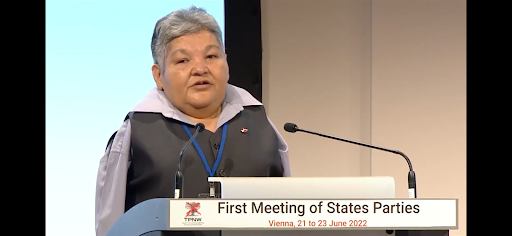
Image: Tim Wright, ICAN’s Treaty Coordinator, speaks to MSP1.

ICAN’s Treaty Coordinator Tim Wright presented the civil society case for expansion of the Treaties membership. Tim reported that 86 states are now signatories, and 50 states have explicitly supported the Treaty in the UN GA. He stressed importance of the September UN GA session in making new signatory announcements, and was confident that “membership of this indispensable Treaty will grow steadily over time…which region will be next?” He reaffirmed the work of encouraging new States Parties as ICAN’s highest priority:

“We pledge to work with you, the States Parties, until every last country is on board.”

The World Council of Churches, representing 145 organisations, offered a forceful endorsement of the Treaty:

“Our faith traditions call us to denounce this misuse of resources, and to call for greater  international cooperation to end nuclear weapons forever. Nuclear weapons are a tool of domination and violent coercion in a time where we urgently need to prioritise human security.”


Article 4(2): Deadlines for the removal from operational status and destruction of nuclear weapons and other nuclear explosive devices, and their removal from national territories

South Africa presented the working paper, noting a proposed 10 year deadline for disarming states under the Treaty.

The Philippines, Indonesia, and Cuba concurred with the working paper’s proposals. The delegation from the Philippines thanked South Africa for their unprecedented unilateral surrender of nuclear weapons, and called for technical and logistical guidance in defining “realistic and practical, yet credible” deadlines.


Article 4(6): Competent international authority, including verification 

Mexico presented the working paper. The delegation argued expanding verification infrastructure, including establishing a competent international or national authority, was central to the purpose of the TPNW.

Malaysia and South Africa agreed with the need for new verification infrastructure, with the South African delegation noting the “so-called lack of verification mechanism in the Treaty”.

Cuba expressed openness about the nature of new verification infrastructure. The delegation addressed the allegation (made by nuclear states or members of NATO) that the Treaty’s requirements are not verifiable, “and we need to demonstrate, in practice, that this allegation is false.

Image: The Kiribati delegation speaks to MSP1.

Article 6 & Article 7: Victim Assistance, environmental remediation, international cooperation and assistance

Kiribati and Kazakhstan presented the working paper, which addresses six aspects of the positive obligation required under Articles 6 and 7: implementation, establishing implementation framework, reporting, intercessional work, a trust fund, commitment to inclusivity.

The Philippines stress that “the onus to undertake victim assistance should not fall on the affected states, who are the very victims of this humanitarian impact.”

The Cook Islands reiterated support for proposed international trust fund: “We see this human aspect as an important point of difference between this treaty and others.


Article 5: National implementation measures

Ahead of schedule, the Meeting then skipped to this item, due for the final day of the Meeting. 

A consensus of establishing a working group to invigilate the proposed action plan during the intercessional period emerged from statements made.

Cuba noted the illegal occupation of Guantanamo Bay by the United States, and that this diminishes Cuban responsibility for the operation of the Treaty in this area.

Nuclear Ban.US stressed the accountability of businesses and other institutions that make possible the production of nuclear weapons and material. The delegate argued for penal sanctions to prosecute individuals and corporations for violations. Repeating proposals made by ICAN, stressed the need for full incorporation into domestic law: “It is critical to the success of this Treaty that the financing of nuclear weapons becomes as stigmatised as the weapons themselves”. The delegate cited Irish law, which provides for life imprisonment for offenses against the Nuclear Prohibition Act 2019:

“That’s what I would call a deterrent.”

With one day to go, the First Meeting of States Parties has already made progress on a number of practical and substantive matters. The conference will wrap tomorrow, when a final report will be adopted, and attendees will depart from Vienna with a renewed purpose in the struggle against nuclear weapons.


BACK TO NEWS

Sachertorte #4: Meeting of States Parties to the TPNW, Day 1

CAMPAIGN NEWS:

Sachertorte #4: Meeting of States Parties to the TPNW, Day 1

Sachertorte: a famous Viennese chocolate cake. Easier to eat than to pronounce correctly. Used here to provide a slice of the action for the Treaty on the Prohibition of Nuclear Weapons in Vienna, Austria.

Tuesday 21 June

First Meeting of States Parties to the Treaty on the Prohibition of Nuclear Weapons, Day 1

Report by Lachlan Good, ICAN Australia Campaigner.


Five years on from the conference that birthed the Treaty on the Prohibition of Nuclear Weapons (TPNW), its 65 states parties have converged on Vienna, to consider the implementation and status of this groundbreaking Treaty.

This historic day was an opportunity for parties and observers to engage with the challenges of realising the Treaty’s ambition, and reflect on the urgency and value of nuclear disarmament.

An Australian in Vienna

The meeting was formally opened by the Under Secretary-General of the United Nations, Izumi Nakamitsu. There was a high turnout from observer states (including some who host nuclear warheads), including Germany, Switzerland, Norway, Netherlands, Sweden, Belgium – and of course, Australia.

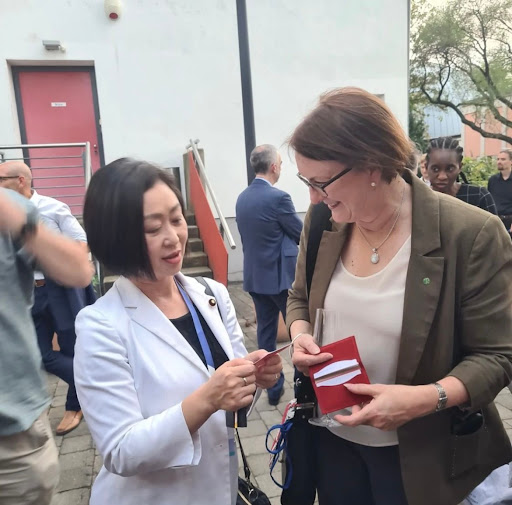
While Australia did not offer remarks in this session, the government’s representative Susan Templeman MP joined Jemila, Tim, and the rest of ICAN to formally witness and connect with the countless activists, survivors, and other stakeholders on the ground in Vienna.

Susan Templeman is one of 100 Federal Parliamentarians who have publicly backed Australia joining the TPNW. You can check out the rest here.

Image: Japanese parliamentarian Mari Kushibuchi speaks with Susan Templeman MP in Vienna.

First Plenary Session

The Meeting’s President was then formally elected, with Alexander Kmentt taking the chair. He emphasised the seriousness of the Treaty achieving universality, whatever the challenges, and his ongoing commitment to a world without nuclear weapons. He expressed particular appreciation for observer states, for engaging with the conference and contributing to its development. A loud cheer let out when Kmentt thanked the three countries that had ratified the night before – Timor-Leste, Grenada, Cabo Verde.

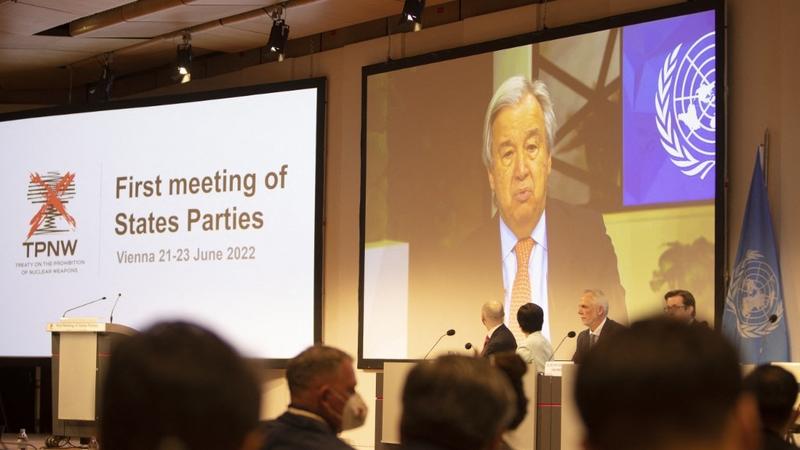
“Nuclear weapons offer false promises of security and deterrence, while only guaranteeing endless destruction and gamesmanship.” (Image: Antonio Guterres)

Secretary-General Antonio Guterres presented a recorded address, where he emphatically praised the Treaty and its proponents, while stressing its significance to global security. The President of the International Committee of the Red Cross, Peter Maruer, condemned any countenancing of ‘tactical’ nukes, or any other type of nuclear weapon, as existentially threatening. He reflected on the rapid progress of the past few years:

“A decade ago, this may have seemed illusory; today, a global, comprehensive, unequivocal prohibition of nuclear weapons – the most catastrophic weapons ever created – is a reality”

Our very own Executive Director of ICAN, Beatrice Fihn, was another key speaker. She recalled the earlier stages of the Treaty’s development, citing the seminal 2014 Vienna Conference on the Impact of Nuclear Weapons as a turning point in the dominance of discredited notions of ‘nuclear deterrence’. She was optimistic about the future of our project: “As we have worked to prohibit nuclear weapons, we must now work to eliminate them.”

Centering Survivors

Nuclear testing survivor and artist from Kazakhstan, Karipbek Kuyukov, shared his community’s harrowing experiences growing up near the Semipalatinsk nuclear testing facility, at which the USSR performed 456 separate nuclear tests before 1991. Karipbek would frequently be woken by the sound and power of the distant explosions, growing up. The resulting radiation exposure poisoned and continues to tear at the fabric of Karipbek’s community, where orphanages swell with injured children, while scrappers poison themselves trying to sell radioactive metal:

“Shepherds would brag about surviving a vast explosion…later they would taste iron in their mouths; their heads would ache; their teeth would fall, as well as their hair; they would lose their sight.”

Karipbek’s advocacy distills the profound injustices that nuclear weapons have produced, and continue to rely on. His story deepens the urgency for Australia and all nations to ratify the TPNW, and begin to assist peoples who have been ravaged by decades of reckless nuclear testing, under Articles 6 and 7 of the Treaty.

Image: Karipbek Kuyukov addresses MSP1.

Global Support

Frank Bainimarama, Fiji’s Prime Minister, reflected on how his father was exposed to radiation poisoning due to widespread nuclear testing throughout the Pacific in the 20th century; the Pacific alone endured more than 300 nuclear tests – equivalent to more than 14,000 Hiroshima or Nagasaki bombs. In endorsing the TPNW’s full scope and ambition, Bainimarama reminded us that the approximately $100 billion spent on nuclear weapons renewal each year is also the amount promised by richer countries to support climate-affected regions like the Pacific:

“It is not idealism that convinced us; it is level-headed common sense that calls on us to eliminate this means of species extinction.”

The Deputy Prime Minister of Kazakhstan, Mukhtar Tleuberdi, sought to establish common ground on complete nuclear disarmament. He emphasised the positive relations that had seen states parties bring the Treaty into force so quickly, and welcomed the enforcement of a contemporary timeline, to eliminate nuclear weapons irreversibly and internationally.

Alexander Schallenberg, Austria’s Foreign Affairs Minister, argued that “nuclear risks have not been this high for decades,” and debunks the suggestion that the war in Ukraine might have been avoided but for the assistance of nuclear weapons.He discussed how such manipulations are essentially a call for further nuclearisation, the suspension of “nothing less than a nuclear Sword of Samocles, hanging over all humanity.

As speakers progressed, themes began to stitch themselves into the fabric of proceedings. Cuban Foreign Minister Bruno Parilla emphasised the persistent modernisation of warhead stocks as a profound threat to world peace, as did Minister Alvin Botes from South Africa:

“Global security cannot be achieved when enormous financial and other  [resources] are still being diverted to more and more destructive capabilities while more and more around the world suffer from hunger and desperation”

Our neighbors in Aeteroea/New Zealand made a clear and direct appeal through their dedicated Minister for Disarmament and Arms Control, Phil Twyford, who cited Russia’s “illegal and unjustified invasion of Ukraine” as having “brought us to the brink of a nuclear catastrophe.” Twyford addressed key priorities to resolve over the course of conference, namely implementing the Treaty’s verification regime, establishing a disarmament timeline, and implementing the provisions to assist with international articles 6 or 7.

Pope Francis, represented by Archbishop Gabreile Caccis, reiterated the impassioned plea he first made in 2017:

“Trying to defend and ensure stability and peace, through a false sense of security, and a balance of terror, sustained by a balance of fear and mistrust, inevitably ends up poisoning relationships between peoples, and obstructing any possible form of dialogue.”

Mayors for Peace

It was humbling to be joined by Mayors for Peace, and experience the wisdom of Nagasaki and Hiroshima Mayors Tomihisa Taue and Kazumi Matsui. Mayor Taue reiterated the good will and patience that is required to see lasting change, and made clear yesterday that it is our responsibility to “make Nagasaki the last atomic bombing site.”

Image: Mayors Tomihisa Taue and Kazumi Matsui make a statement to MSP1.

General Statements

After the headline speeches had been made, all states parties had a chance to articulate their priorities and perspective to the conference floor:

Peru highlighted the value of nuclear free zones, particularly in areas suffering conflict; promoted continued peaceful use of nuclear; thanked the IAEA/safeguards regime.

Thailand offered gestures towards the “pragmatic” implications of verification concerns and international cooperation outside the Treaty.

Ireland noted the value of the Treaty’s inclusiveness, and the importance of centering women and girls in the treatment of radiation poisoning and related community hazards.

Malaysia made clear they “fully intend the TPNW to make practical and concrete contributions to global security.”

Ecuador supported strengthening NPT architecture through the Treaty and other means; congratulated Kazakhstan and Mexico for hosting the next MSPs.

Guyana noted that, to achieve objects of TPNW, particularly universality, will require vast cooperation between states.

Kirribati recounted the dozens of tests their community has been forced to live with the consequences of. They proposed making use of provisions in Articles 6 and 7 to establish an international fund for affected states, as well as a centralised science unit to share research. They situated today’s struggle for global peace and security in a historical context:

“The international community cannot forget how the former colonial powers treated innocent Pacific Islanders in their pursuit of mass destruction”

Samoa cited the particularly devastating impact nuclear and other environmental hazards pose to Samoa’s natural environment.

Cambodia discussed the history of nuclear and other conventional war implements, including the Comprehensive Nuclear Test Ban Treaty, NPT, Biological Weapons Conventions, etc.

Mongolia showed a particular interest in the nuclear security of North-East Asia; Mongolia initiated the Ulaanbaatar Dialogue to facilitate regional dialogue.

El Salvador noted that, since Grenada’s deposit of the Treaty on June 20, all Central American nations have now ratified the TPNW.

Indonesia wrapped the day by reiterating the distinction between civil and military uses of nuclear, and otherwise agreeing wholeheartedly with the Treaty.

So substantial is the participation of states parties and observers at MSP, the day concluded with 17 nations still left to present! They will be given a chance tomorrow to speak, before the conference’s attention turns to the detail of the Treaty, and assessing how effectively its goals are being pursued.

BACK TO NEWS

Sachertorte #3: Conference on the Humanitarian Impacts of Nuclear Weapons

CAMPAIGN NEWS:

Sachertorte #3: Conference on the Humanitarian Impacts of Nuclear Weapons

Sachertorte: a famous Viennese chocolate cake. Easier to eat than to pronounce correctly. Used here to provide a slice of the action for the Treaty on the Prohibition of Nuclear Weapons in Vienna, Austria.

Monday 20 June

Conference on the Humanitarian Impacts of Nuclear Weapons

Report by Marlon Morice, student at the University of Melbourne and intern with ICAN Australia.


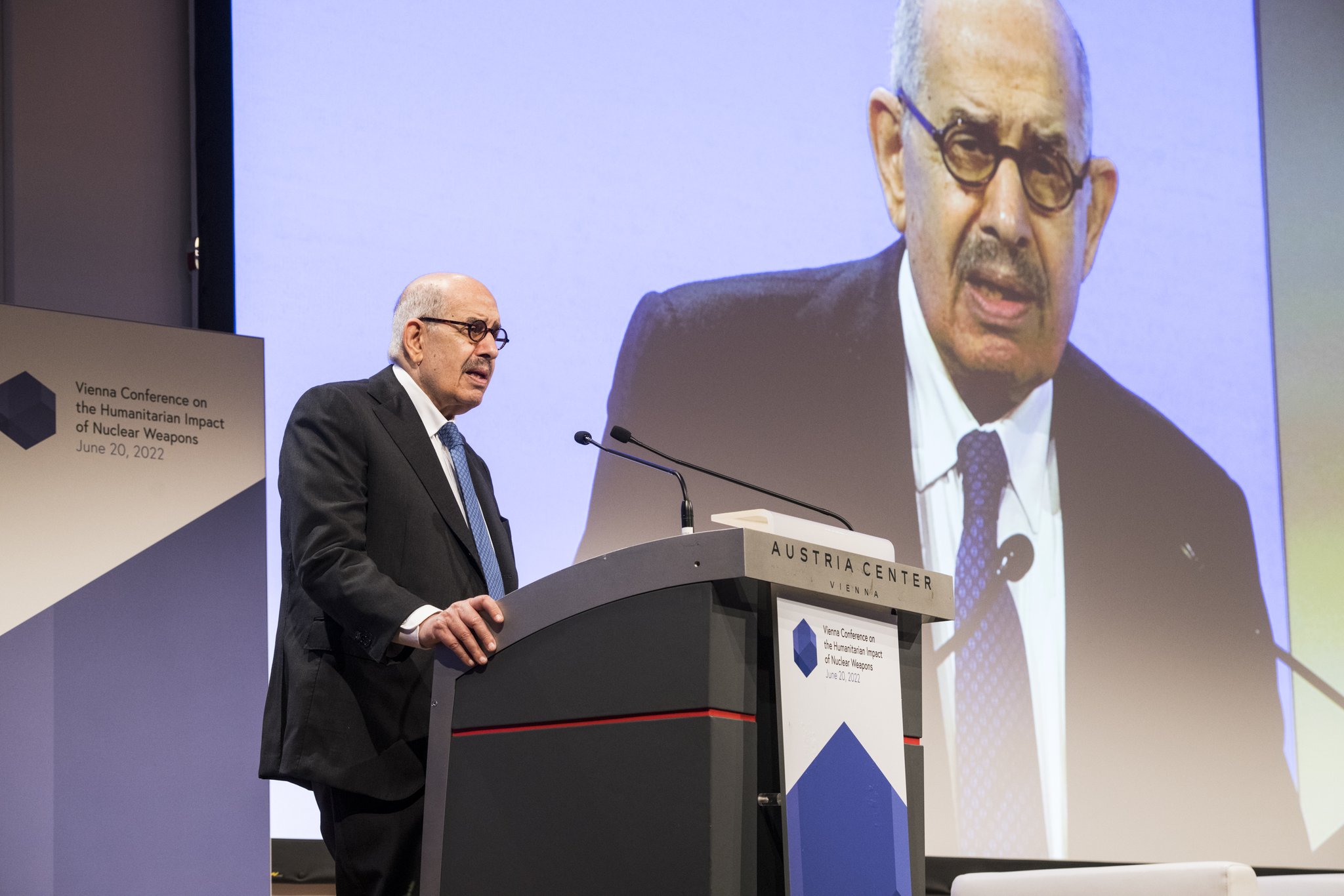
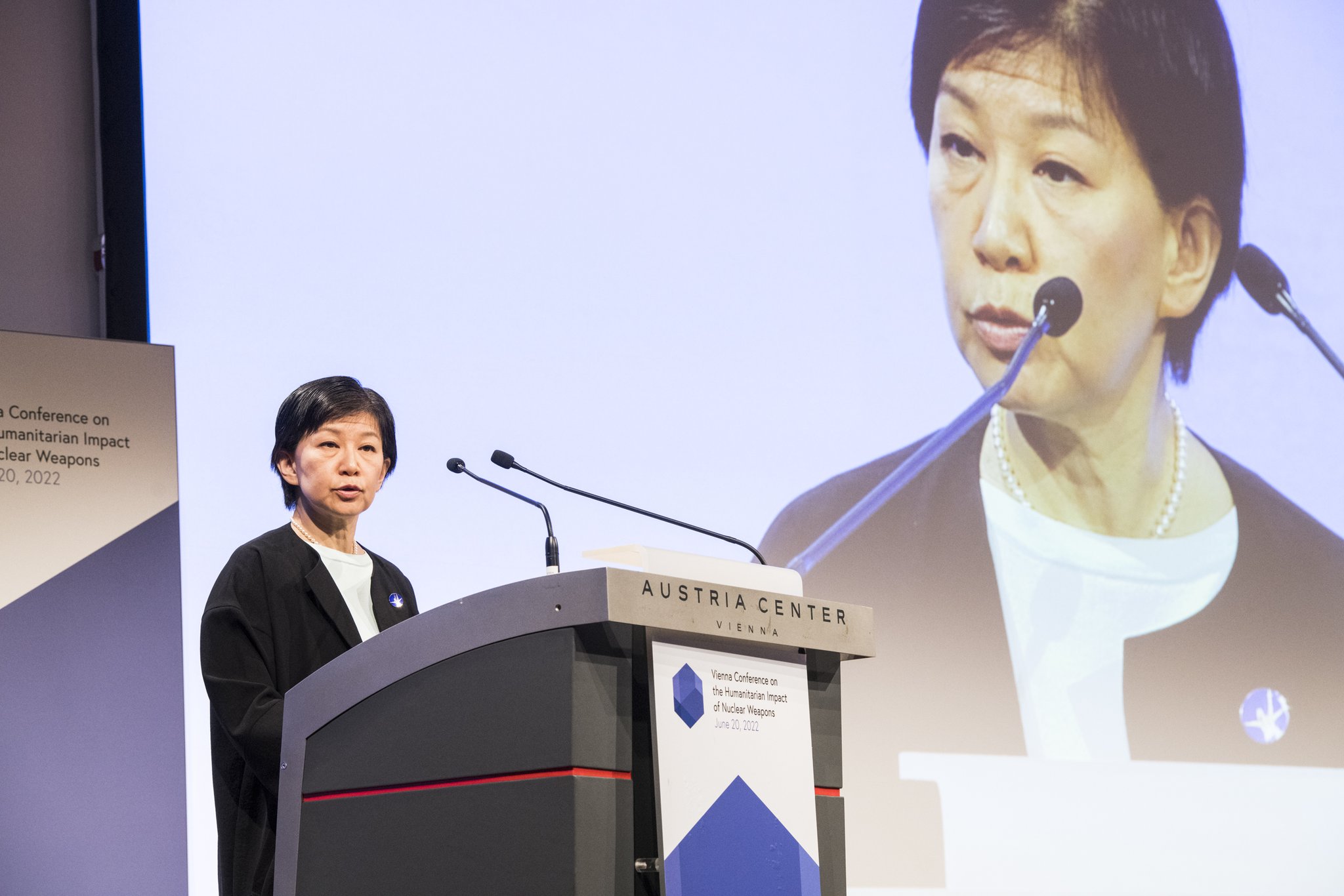
The Conference opened with a video address from Alexander Schallenberg, the Austrian Federal Minister for Europe and International Affairs. Minister Schallenberg stressed that the spectre of nuclear war is now no longer hypothetical for Europeans, and that as long as nuclear weapons exist, they will be a threat to humanity. He also criticised the doctrine of nuclear deterrence, arguing that it inherently requires the threat to use nuclear weapons to be real and credible. Izumi Nakamitsu, the UN High Representative for Disarmament Affairs applauded the humanitarian approach to arms control, as seen in the TPNW. She also made the point that nuclear weapons “cannot be contained by time or space” – meaning it is necessary to work for total abolition, and not just to maintain the status quo. Dr Mohamed Elbaradei, the Director-General Emeritus of the International Atomic Energy Agency evoked the words of the creators of the atomic bomb, such as Robert Openheimer, noting that the horrors of nuclear weapons were immediately apparent, and that we should always strive for their elimination.

Following this, we heard testimony from victims and survivors. Kido Suechi – Secretary-General of Nihon Hidankyo and Hibakusha from Nagasaki – shared his experience of the day the bomb was dropped. He said that the city had “effectively disappeared”, and that he remembers seeing bodies lying in the street with survivors begging for food and water. He regretted the fact that so many lives were ended in an instant, and that so many were to die without the support of their families. He also spoke to the fear and anxiety that many Hibakusha experience throughout their lives as they see the legacy of the bombings in their children and grandchildren. He believes that the TPNW embodies the spirit of the Hibakusha and hopes for the success of the MSP. Suzuka Nakamura, of Know Nukes Tokyo and a third-generation survivor of the bombing of Nagasaki stated that as the number of survivors dwindles, it is incumbent on us to share and pass down their stories and experiences. Finally, Danity Laukon of MISA4ThePacific told the Conference of how, in the course of her advocacy work, she came to realise the need to learn more of the history and legacy of nuclear testing in the Pacific. She talked of the horrifying legacy of testing, including burns, forced displacement, cancers, miscarriages, and stillbirths.

Image left: Danity Laukon of MISA 4 the Pacific

Image above: Dr Mohamed Elbaradei, the Director-General Emeritus of the International Atomic Energy Agency

Session 1 – What we Know: Key Facts on Humanitarian Consequences and Risks of Nuclear Weapons.

The first session of the day featured a panel focusing on the short and long-term consequences of nuclear explosions, as well as the challenges that the international humanitarian system will face in the event of a nuclear detonation on a population centre. 

Dr Cordula Droege, Chief Legal Officer with the Red Cross, spoke of the reality on the ground following the bombings of Hiroshima and Nagasaki. In particular, she noted that health infrastructure in both cities was wiped out, with many doctors and nurses dying in the blasts. The destructive power of nuclear weapons thus severely limited the humanitarian response. This point was built on by Dr James Revill, Head of the WMD Programme at the UN Institute for Disarmament Research, stating that there is a lack of knowledge in the humanitarian system on how to respond to a nuclear detonation. Dr Revill argued that the world must be better prepared for the humanitarian consequences of such a disaster. 

Dr Patricia Lewis, Director of the International Security Programme at Chatham House, presented a history of past experiences of ‘close calls’, which almost resulted in deliberate nuclear disasters. She argued that these are often chaotic scenarios in which the facts and the chain of command are unclear. In many cases it is the caution and restraint of single individuals that avoided catastrophe. While these actions can come as a relief, they also highlight the urgency to abolish nuclear weapons. Finally, Mary Olson, former Senior Radioactive Waste Policy Specialist with the US-based Nuclear Information and Resource Service, highlighted the gender divide of the effects of nuclear weapons. She noted that among children there are two girls for each boy that develops cancer during their lives as a result of nuclear exposure. She stressed the need for more research into the human effects of radiation exposure to develop a better understanding of the dangers. 

Following a short break, the panel was joined by retired ambassador Steffen Konstad of Norway along with UN High Representative Nakamitsu. Both Representative Nakamitsu and Ambassador Konstad applauded the actions of campaigners in revitalising the nuclear disarmament process, which had in recent years become “stale”. Both also warned of the growing danger of states seeking to acquire their own nuclear capabilities due to ongoing global insecurity – demonstrating the need for a non-security, humanitarian approach to nuclear weapons.

Image: UN High Representative Izumi Nakamitsu

Session 2 – Impact of Nuclear Weapons on People and the Planet: New Developments and Findings 

The next session opened with an address from Canadian Chemist and Nobel Laureate Dr John C. Polanyi. He said that scientists have often been complicit in the advancement and development of weapons, including WMDs such as nuclear weapons. Science demands a responsibility to share and collaborate, and scientists have an obligation to “speak the truth”, which has only become more relevant in the realm of nuclear weapons. The scientific methods of reason and rigorous study, Dr Polanyi argues, must be applied to the pursuit of peace and disarmament. 

The subsequent panel discussion presented findings and research on the effects of nuclear weapons on communities and the environment.

Dr Moritz Kütt, Senior Research at the Institute for Peace Research and Security Policy, explained the folly of discussing “small” or “tactical” nuclear weapons. He showed a number of diagrams and graphs that demonstrated the sheer scale of modern nuclear weapons, and the massive urban areas that would be desolated by a nuclear detonation. He also showed that health infrastructure would be overwhelmed by even the smallest nuclear weapons, both due to the direct burn injuries, as well as ongoing radiation poisoning. Dr Michael Mills of the National Centre for Atmospheric Research presented the effects of nuclear war on the global climate. He showed models of a nuclear exchange between India and Pakistan, using half of their nuclear stockpiles. This conflict would result in massive amounts of smoke and debris entering the Earth’s atmosphere, causing extended low temperatures not seen since the last Ice Age, while also degrading the ozone layer.

Kim Scherrer of the Department of Biological Sciences at the University of Bergen built on this point by discussing the effect of nuclear war on the global food system She noted that a nuclear war involving only 100 warheads would result in a devastating reduction in agricultural yields, with decreases of around 30% in temperate zones, causing mass starvation and famine. Further, Ms Scherrer added that this research did not even take the effects of radioactive contamination into account, which would have further detrimental effects on global food security.

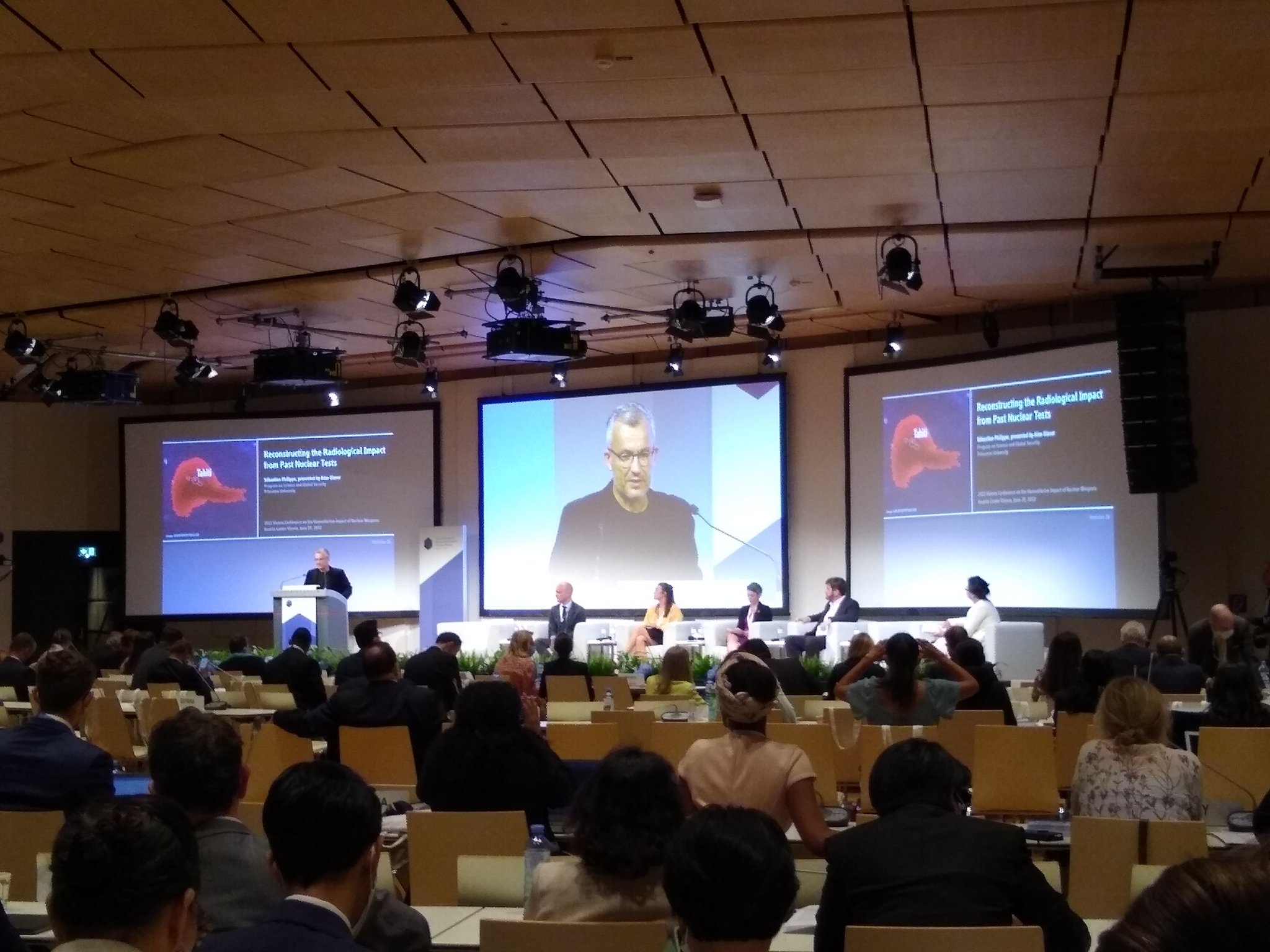
On the issue of nuclear testing, Associate Professor Alexander Glaser from Princeton University presented his team’s models reconstructing the fallout from past nuclear testing around the world. Specifically, he showed that the effects of testing have been vastly underestimated, highlighting the damaging radioactive exposure of communities and the ongoing harmful legacies. Following this, Dr Toghzan Kassenova, Senior Fellow at the Centre for Policy Research in New York state, told the Conference of the legacy of Soviet nuclear testing in Kazakhstan. She spoke of the secrecy under which the testing was conducted, and of the fact that the Soviet government made no consideration for the people or environment when choosing nuclear test sites. Any medical research that was conducted was not used to help victims, but instead to study the effect of radiation exposure for military purposes. 

Image: Alex Glaser presents the work of the Moruroa Files, which is an investigation of the real impacts of French nuclear tests in the Pacific.

Session 3 – The Risks of Nuclear Weapons, the Threat of Use and Nuclear Deterrence: New Developments and Findings, and the Limits of Our Knowledge

The final session of the Conference focused on the risk of nuclear war, and how the changing global landscape is increasing the risks of escalation.

Addressing the Conference remotely, Hans Kristensen – Director of the Nuclear Information Project for the Federation of American Scientists – provided an overview of shifts in the rhetoric and doctrines of nuclear states. He argued that rhetoric by nuclear states has become more combative in recent years, with Vladimir’s nuclear threat in Ukraine only the latest example. He stated that the nuclear weapons doctrines of nuclear states such as Russia, China and the U.S. are currently in a state of flux as they reconsider their nuclear strategies. This is fostering uncertainty and insecurity in global politics.

Dr Tytti Erästö, a Senior Researcher at the Stockholm International Peace Research Institute, spoke on technological evolution in the field of nuclear weapons, warning that this is resulting in “new vulnerabilities”. For example, developments in accuracy and remote targeting have provided states with enhanced first-strike capabilities, increasing insecurity and further undermining the theory of nuclear deterrence. Daryl Kimball, Executive Director of the Arms Control Association, explored the risk of nuclear weapons in the context of Russia’s invasion of Ukraine. He argued that Vladimir Putin’s threat to use nuclear weapons has raised the prospect of nuclear confrontation and increased the risk of their use. In particular, Mr Kimball warned that the prospect of a long war in Ukraine means the world may be in a state of heightened risk of nuclear conflict for some time to come. Additionally, he made the point that nuclear weapons have failed to prevent Russian aggression in Ukraine, and have only resulted in the possibility of nuclear confrontation. 

Eva Lisowski, an Associate Fellow with the Asia-Pacific Leadership Network, detailed the conditions under which nuclear weapons may be used in Northeast Asia. She presented the results of her team’s research into potential scenarios for the use of nuclear weapons. Specifically, Ms Lisowski showed that there was a wide range of “triggering events” that can lead to a nuclear detonation. History has shown us that events once considered unlikely or impossible can occur rapidly and unexpectedly. Specifically, the team identified periods of leadership change as critical points of vulnerability due to possible shifts in behaviour and strategy. Scenarios ranged from nuclear detonations by non-state actors to lengthy crises resulting in inter-state nuclear warfare.

The final speaker, Dr Zia Mian of Princeton University asked how national stories and identity will manifest during a nuclear crisis, using the example of India and Pakistan. He warned of growing nationalism, and argued that while we know history and identity matters, we do not necessarily know how they will matter. Dr Mian also criticised deterrence theory as an “illusion of control” – the myth that one can be skilled and talented enough to control the decisions of others. It is this belief, he argues, that will lead political and military leaders down the road of escalation towards nuclear conflict.

Concluding Remarks

In his concluding remarks, former Austrian UN Ambassador Thomas Hajoczi called for more research and discussion on the humanitarian consequences of nuclear explosions in order to create a stronger cross-disciplinary understanding of these destructive weapons and their effects. He warned that “nuclear conflict is not an abstract danger, but a very real one”, and that it is only the total elimination of nuclear weapons that will offer true protection against their use.

Dr Hajoczi’s full Chair Summary of the day’s proceedings can be found online here.

BACK TO NEWS

Sachertorte #2: Nuclear Ban Forum (Day 2)

CAMPAIGN NEWS:

Sachertorte #2: Nuclear Ban Forum (Day 2)

Sachertorte: a famous Viennese chocolate cake. Easier to eat than to pronounce correctly. Used here to provide a slice of the action for the Treaty on the Prohibition of Nuclear Weapons in Vienna, Austria.

Sunday 19 June

ICAN Nuclear Ban Forum Day 2

Report by Marlon Morice, student at the University of Melbourne and intern with ICAN Australia.


Vienna Hub – Live from South Australia

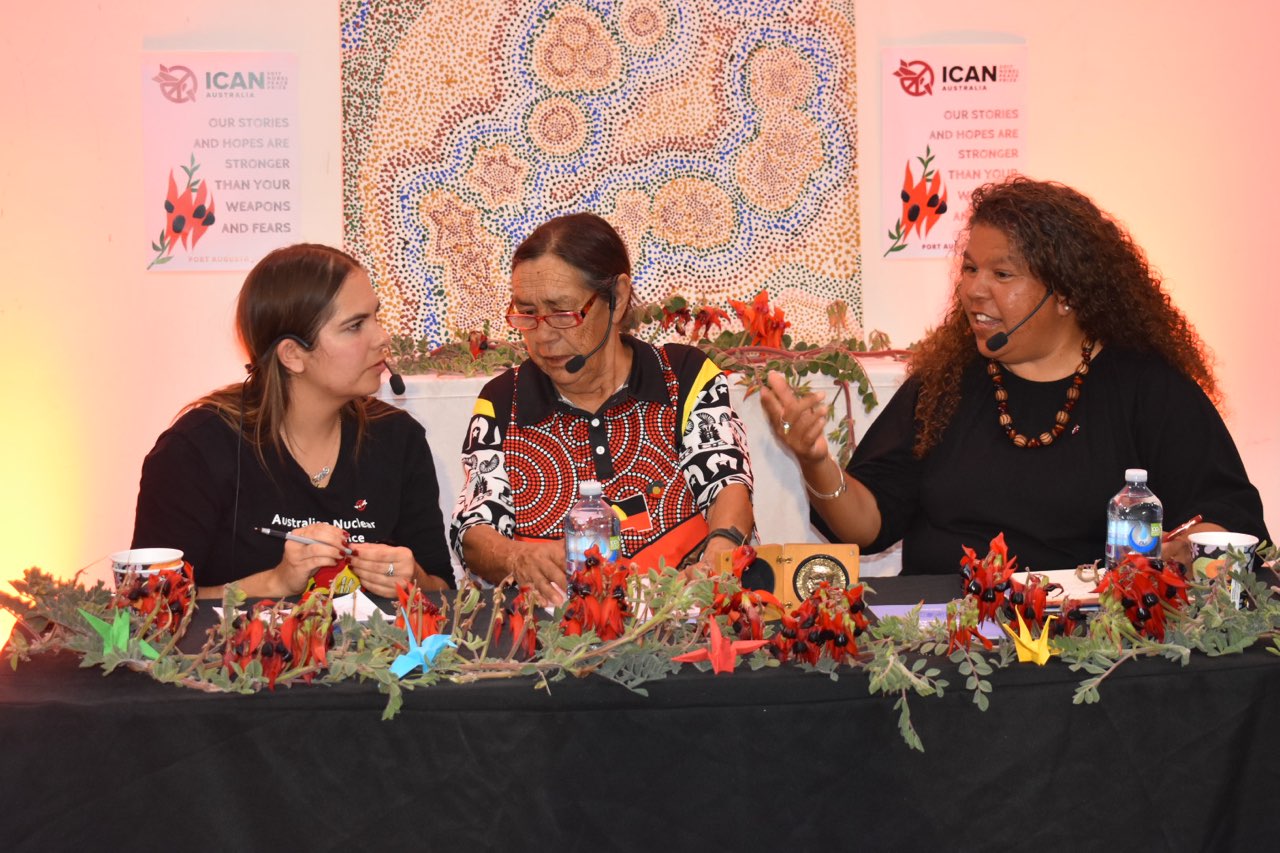
Day two’s proceedings kicked off in a decidedly homegrown setting, with Aunty Sue Coleman-Haseldine, Karina Lester, and Mia Haseldine – three generations of activists – addressing the Forum via livestream from Port Augusta in South Australia. Karina spoke of her family’s history of activism on the issue of nuclear weapons testing in Australia, and talked about the importance of sharing stories about the testing and its legacy. She told the forum of how communities were not informed about the tests, and that they never consented to them. Finally, she noted that while the history of nuclear testing on Indigenous land may be painful, the truth of what happened in South Australia and around the globe must be told.

Aunty Sue said that she can see the consequences of nuclear testing in her own family, including genetic mutations and physical deformities. She also expressed solidarity with victims of nuclear testing around the world, noting that if we forget the past, we will be doomed to repeat it. Mia shared her heartbreaking experiences with the legacy of nuclear testing, feeling compelled to continue the fight alongside her family and community. In particular, she argued for more research into the effects of nuclear testing on genetic diseases, as well as the impact on food and water supplies in remote communities. Aunty Sue, Karina and Mia all advocated for greater education on the history of nuclear testing and its impacts – including in First Nations’ languages – as people have a right to know how they can and have been affected by nuclear contamination. They also called for Australia to sign and ratify the TPNW.

Vienna Hub – Live from Hiroshima and Nagasaki

Following this, we heard from campaigners and survivors from Hiroshima and Nagasaki. We were shown a video on Atomic Bomb Microcephaly, a condition caused by in-utero exposure to high levels of radiation, causing intellectual and physical disabilities – for which there is no cure. It demonstrated the enormous difficulties for sufferers and their families associated with the long-term effects of radiation exposure.

From Hiroshima, we heard from survivors of the atomic bomb. Hiroe Kawashimo, of the Association of Atomic Bomb Microcephaly Sufferers and Their Families, has no sight in her right eye, no hearing in her right ear, has intellectual impairments and is undergoing treatment for Thyroid abnormalities. She draws pictures and authors poems of her experiences – thinking of how much she hates war, and the devastation it brings to people. Another survivor, Toshiko Tanaka, expressed hope for a nuclear-free future, saying that:

“Today, the entire world is being threatened by the countries that have nuclear weapons. They threaten us. Our thoughts become frozen, and peace seems to be far away. But whatever difficulties we may face, I join my young friends and continue calling for a world without nuclear weapons. I hope this meeting of the State Parties to the TPNW will give us new input and energy so we can move forward. My young friends, I believe you will carry on our messages and deliver olive branches of peace to every corner of the world.”

Next, we were shown a video featuring the testimonies of Chieko Iwanaga and Takeo Hamada, survivors of the bombing of Hiroshima, on their horrifying experiences, and in particular their fight for recognition by the Japanese Government as Hibakusha (Hiroshima Survivors). Recognition as Hibakusha, and the support this entails, is determined by arbitrary administrative lines, not by the lived experiences of survivors. They spoke of their long court battles, along with nearly four hundred other survivors seeking recognition of their status.

From Nagasaki, we listened to an address by Hibakusha Sumiteru Taniguchi, who unfortunately passed away in 2017. He implored non-nuclear states to “besiege” nuclear weapons states to push them to dismantle their weapons, and ensure they can never be used again. Campaigners in Nagasaki expressed their desire that their city be the last to experience the horrors of nuclear weapons. We also heard again from Chieko Iwanaga, who addressed MSP delegates, saying that “nuclear weapons threaten our ability to love each other, our capability to love ourselves.” The experiences of victims in Hiroshima and Nagasaki show the inhumanity of nuclear weapons, the irreversibility of their effects, and the urgency of the fight for their abolition.

Main Stage – Building Justice Through the Law

On the Main Stage, meanwhile, was a discussion on how international law can hold nuclear weapon norm-breakers to account. The conversation featured Seth Shelden, UN Liaison for ICAN and forum MC; Dr Olamide Samuel, Research Associate of Nuclear Politics at the University of Leicester; Bonnie Docherty, Associate Director of Armed Conflict and Civilian Protection with the Human Rights Clinic at Harvard University; and Colin Namalambo, a diplomat for the Namibian Ministry of Foreign Affairs. The speakers highlighted the importance of justice to international law on nuclear weapons, as well as the issue of inequality between states, as well as vulnerable communities. Addressing these challenges can enhance the legitimacy and authority of international law, improving compliance by state parties.

Namalambo spoke about the process of denuclearisation on the African Continent, and in particular the success of the Treaty of Pelindaba, which created the African Nuclear-Weapon-Free Zone. He also pointed out that such regional and bilateral agreements should be complemented by effective action at the global level through the TPNW. Docherty discussed the issue of accountability, highlighting both political accountability, which seeks to condemn the use of WMDs such as nuclear weapons in all forms, as well as individual criminal responsibility, noting that there are many avenues to pursue justice in this regard, including the International Criminal Court, or ad-hoc commissions created under international law. Dr Samuel argued that international law can influence state behaviour in subtle and un-recognised ways, and that it is important to imagine a world without international law to fully appreciate its effects. The speakers concluded with the point that international treaties, such as the TPNW can influence all countries, not only those who are party to the treaty – with the pressure growing with each new participant. They provided the example of the Convention on Cluster Munitions, which has seen a dramatic reduction in their usage.

Image: (from left) Dr Olamide Samuel, Bonnie Docherty, and Colin Namalambo

Main Stage – The Ban is the Plan, and This is Why

The subsequent panel discussed how to engage stakeholders on the path to nuclear disarmament. It featured Phil Twyford, New Zealand Minister for Disarmament and Arms Control; Tommy Piemonte, Head of Sustainable Investment Research for the Bank für Kirche und Caritas; and Elayne Whyte, former Costa Rican ambassador to the UN, who successfully presided over the TPNW negotiations in 2017. Minister Twyford noted that the TPNW came about through the “winning formula” of an alliance between diplomats and activists. He also pushed for a broad, multi-level coalition for the abolition of nuclear weapons, including diplomats, scientists, financiers, faith communities, and to also tap into the energy of anti-colonial, anti-racist and social justice movements. Piemonte presented his perspective as a financial actor, arguing that it is important to deny abusers and non-ethical governments the financial and economic resources that fund their activities. He believes that the TPNW should become the new standard by which financial actors such as banks and pension funds make investment decisions. Ambassador Whyte applauded the new generation of activists and campaigners, expressing her belief in the “strong health” of the movement to sign and ratify the TPNW. She concluded that from survivors of nuclear weapons we must learn conviction, resilience, and perseverance, while we must also learn the value of articulation, coalition-building, and strategising from organisations such as ICAN.

Image: Moderator Nadja Schmidt with Phil Twyford

Main Stage – Meeting States Parties

The next conversation featured ICAN Social Media Officer Venessa Hanson, and Alexander Kmentt, the President-designate of the MSP. Hanson spoke about the intersectionality of her advocacy, which spans the issues of nuclear weapons, racism, colonialism, and inequality, as well as the importance of the participation of young people in decision-making to effectively harness their energy and enthusiasm. Kmentt highlighted the humanitarian impulses of the TPNW, and his enthusiasm for its positive obligations as a driver of state action. He believes that the TPNW can draw discussion away from limited dialogue frameworks of security. However, he also warned that we are approaching a “threshold moment” with the intersection of the crises of Climate Change, the COVID-19 Pandemic and the proliferation of nuclear weapons which threatens to spiral out of control without action at the international level.

Vienna Hub – Impunity Hides Behind Nuclear Weapons

Back over at the Vienna Hub, we heard an enlightening discussion between Terrell Starr, a Ukraine-based journalist and Pavel Podvid, a physicist and expert on Russian nuclear forces. Podvid talked about the current state of Russia’s nuclear arsenal, and the impacts of its ongoing invasion of Ukraine. He argued that there is a significant amount of “unhelpful analyses” on the use of tactical nuclear weapons that in fact legitimise them and of the right of countries such as Russia to use nuclear weapons. It can therefore become a self-fulfilling prophecy. Podvid also discussed bilateral arms control prospects between the U.S. and Russia, arguing that the US should commit to unilateral arms reductions, including of its nuclear stockpile to maintain momentum on arms control despite current political headwinds.

Vienna Hub – Workshop on Preparing for the MSP

Here, ICAN Policy and Research Coordinator Alicia Sanders-Zakre and ICAN Australia’s own Tim Wright discussed the policy issues that will be discussed at the upcoming MSP, as well as some tips for advocates and campaigners at such significant events.

The MSP will require declarations from states parties on their current nuclear status, and will feature a discussion on the critical condition of universality to promote more states to sign and ratify the TPNW. Two important deadlines will also need to be decided – the date by which a nuclear weapons state will need to fully dismantle their stockpiles (Sanders-Zakre provided the timeframe of around 10 years), as well as the deadline for states to remove nuclear weapons on a host state’s territory (expected to be around 90 days). The MSP will also feature discussions on Articles 6 and 7, which provide for assistance to victims of nuclear testing as well as remediation of affected environments. Further, the MSP will consider how states should implement their international obligations under the TPNW into national law. Sanders-Zakre also noted that the MSP will need to undertake the process of establishing a Competent International Authority, responsible for overseeing the disarmament process, as well as a Scientific Advisory Board to provide technical assistance, advice, and research on behalf of state parties. Delegates must also set out an agenda for inter-sessional work to determine how states will continue to meet after the MSP to maintain momentum and continue nuclear disarmament work. Finally, Sanders-Zakre suggested that the MSP will feature a discussion on complementarity to dispel the narrative that the TPNW is not consistent with existing arms control and prohibition treaties.

Wright noted that the MSP is the moment when the treaty “comes alive,” and that it must produce an effective action plan for the future to improve compliance and gain new participants. He suggests that threats by Vladimir Putin to use nuclear weapons was many people’s first experience with a direct threat of nuclear war, and that this can provide urgency to grow the nuclear abolition coalition. Wright also lauded the large number of campaigners who will be in attendance, and highlighted the effort to support the participation of campaigners and activists from the Pacific, Latin America, and Africa. He recommended that advocates be mindful of who they approach at large events such as the MSP, as it may be more appropriate that delegates interact with campaigners from their home country. Moreover, it is important to build on the energy of the MSP back home, as it is this time that is most crucial in maintaining momentum for change.

Main Stage – Seize the Moment, Sustain the Momentum

The final panel of the Forum was on the subject of making change, identifying opportunities for change, and how to maintain hope in the face of adversity. It featured four speakers from a range of backgrounds – Emma Belcher, President of the Ploughshares Fund; Rev. Karlene Griffiths Sekou, a human rights activist; Canadian Senator Marilou McPhedran; and Brian Fitzgerald, the Director of Dancing Fox, an activist creative agency.

Belcher shared three conditions for when she believes gradualist approaches are no longer sufficient. First, when there is a harmful and suborn status quo – such as when narratives of nuclear deterrence are becoming more entrenched. Second, when gains are being eroded, and finally when there is a sense of urgency brought on by a crisis. Rev. Griffiths Sekou shared her perspective that we should view ‘moments’ for change only as single points in a larger journey that spans multiple movements and generations, and that she looks to the history of resistance against slavery and hierarchy for inspiration to keep fighting for social justice. Senator McPhedran spoke of her faith in the lawmaking process, and of entrenching policy gains in law. Fitzgerald presented his unique perspective of understanding activism in creative terms, arguing that we should take on the framework of improvisation (to have a mindset of “yes, and,” rather than of “no”). He also expressed his belief that we should develop the skills to better describe the previous victories of the anti-war and social justice movements to sustain future momentum and inspire future advocates. When faced with the backsliding of gains, the speakers advocated to not give up, to agitate, organise, look to past victories for inspiration and to prepare for the next crisis.

Image: Canadian Senator Marilou McPhedran

Main Stage – Choosing the End of Nuclear Weapons

The Forum concluded with a series of commitments by advocates and campaigners from partner organisations, setting out how they would contribute to the blueprint for disarmament. To present only a few examples , Alimzhan Akhmetov, from Kazakhstan, pledged to encourage other countries in Central Asia to sign and ratify the TPNW; Peace Boat’s Matsumura Masumi committed to collaborate with other industries and movements, to improve outreach to children and students, and to promote employment for young people in peacemaking roles; and finally, Ben Donaldson of the UK United Nations Association vowed to raise awareness in the UK of the legacy of its nuclear testing on communities and the environment.

And with that, the ICAN Nuclear Ban Forum comes to a close. Our eyes now turn to the Conference on the Humanitarian Impact of Nuclear Weapons, which aims to raise the world’s attention to the grave humanitarian consequences and risks of nuclear weapons.


BACK TO NEWS

Sachertorte #1: a slice of the nuclear ban action in Vienna

CAMPAIGN NEWS:

Sachertorte #1: a slice of the nuclear ban action in Vienna

Sachertorte: a famous Viennese chocolate cake. Easier to eat than to pronounce correctly. Used here to provide a slice of the action for the Treaty on the Prohibition of Nuclear Weapons in Vienna, Austria.

Saturday 18 June

ICAN Nuclear Ban Forum, Day 1

Report by Talei Luscia Mangioni, board member of ICAN Australia.

Opening the ICAN Nuclear Ban Forum, the executive director of ICAN Beatrice Fihn with ICAN Austria’s Nadja Schmidt gave an introduction by taking about the history of nuclear weapons, the formation of ICAN and the TPNW, the central importance of nuclear survivors in the negotiations of this Treaty, Austria’s important relationship to the TPNW, and finally how addressing the issue of nuclear weapons has never been more relevant given the recent threat by Russia to use them in the war on Ukraine. This was followed by a message from Austrian ambassador Alexander Kmentt who described the situation in Ukraine as a wakeup call to the disarmament, and a watershed moment given that many nuclear weapons states have been rapidly expanding and modernizing their arsenals in light of escalating conflict. Following this, Fihn and Schmidt gave their recognition and appreciation of all the people who traveled from so far away to be with them today, many of whom had to apply for special visas. Taking the stage, the stagehosts Seth Shelden and Philine Scherer-Dresseler, told attendees that there were four stages for the day, only two of which (The Main stage and Vienna hub) would be livestreamed for international audiences. 

Togzhan Kassenova, Kazakh expert

Following this, Togzhan Kassenova, an Kazakh expert of nuclear politics and WMD non-proliferation then gave a keynote entitled “Deciding our Fate”. She told the story of survivors of Soviet nuclear tests in Kazakhstan whose families had suffered deaths and maladies from health issues such as cancers as a result of atmospheric fallout. She spoke about the history of resistance of the Nevada-Semipalatinsk movement and how, after Kazakhstan’s independence and the dissolution of the Soviet Union, they chose to be nuclear-free and to denuclearise after finding themselves in possession of one of the largest ever nuclear arsenals after the Soviet Union left. She described nuclear weapons as a threat to humanity, emphasizing “it is our common fate, in a way we are all hostages as long as nuclear weapons exist and are possessed by a few”. Finally, she raised concern at the fact that Russia is now threatening to use nuclear weapons, imploring the audience: “we need to question how we got here.”

Survivors of nuclear weapons

Following this was a panel discussion of representatives of survivor communities entitled “This is what nuclear weapons are”, hosted by Akira Kawasaki from Peaceboat (Japan), with Suechi Kido for Nihon Hidankyo (Japan), Mary Dickson (USA), Léna Normand (French Polynesia), and Remy Zahiga (Congo).  Akira Kawasaki highlighted that these discussions must start with the human and environmental harms and listen to survivors as they are the “real experts”.

Suechi Kido for Nihon Hidankyo and a Nagasaki survivor, shared a memory of the bombing being two kilometers from hypocenter. He and his mother suffered from burns and evacuated to a nearby town and witnessed many deaths by acute atomic radiation illness and the complete devastation of his homeland. Kido then gave the history of Japan confederation of A+H bomb sufferers in the 1950s and then connected it to his own organisation Nihon Hidankyo’s current activism for survivor communities. The hibakusha welcomed the TPNW especially the positive obligation of Article 6 which he hoped would be deepened at the 1MSP. He celebrated the post-WWII Japanese constitution Article 9, which prohibits or renounces war and the threat or use of force, and hoped that it would be extended to the world. Even so, he publicly demanded why Japan refused to ratify or sign the TPNW and turned its back on 1MSP. He concluded his speech by saying: “We Hibakusha refuse the use of force as the means of resolving international conflicts. Responding to force by force will only lead to the continuation and expansion of conflict.”

Mary Dickson, a Utah Downwinder, spoke of the 100 atmospheric tests at the Nevada Test Site (NTS) between 1951-1962 and fallout reached across the USA and Canada by showing a horrifying graph. She told her own story as a survivor, where she had first hand experience of cancer and had sisters who died from cancer and autoimmune diseases. She had connected with other downwinders in the United States and worldwide in her quest for justice. She stated: “Ask any of them [nuclear survivor communities] and we will tell you, the arms race did not prevent nuclear war, it was a nuclear war waged against us.” She then touched on the history of the RECA act which gave some compensation to survivors in several states nearby the Nevada Test Site, however, the RECA act is very limited given that the fallout extended all across the United States. Today, survivors and their descendents continue to fight for more nuclear justice, especially health care. 

Léna Normand, of Association 193 spoke of the French nuclear tests in polynesia of which 46 were atmospheric and 147 were underground. This was an average of 1 shot every 2 months for 30 years. Normand questioned, “France is the fourth nuclear armed state in the world, but at what price?”. She spoke of some of the issues facing Association 193, including not having any social security data between 1966-1996 and only knowing that in recent times, there have been 600 new cancer patients per year, 300 cancer deaths per year and 10,000 patients from 1992-2017 with one of 23 radiation induced diseases. Association 193 educates and assists families to claim compensation with the Committee of compensation of victims of nuclear tests (CIVEN) through acceptance and rejections, assisting to find them legal representation. Today, Association 193 wants several things: forgiveness from the French state to the Polynesian people, profound reforms regarding the law of compensation with 2010-2 of January 5, 2010 amendment (specifically, the withdrawal of eligibility deadline, cancellation of dose of 1 millisievert, extension of list of radiation induced diseases, recognition of collateral victims), further studies under the aegis of the United Nations on transgenerational diseases and environmental consequences, and collective compensation coverage including reimbursement to the local social security fund of expenditure financed for radiation-induced diseases. She concluded with a request of International support for technical and scientific assistance, legal assistance and financial assistance for survivors.

Remy Zahiga from Green Congo Initiative began his speech asking the audience “Where does the material used directly or indirectly for the nuclear weapons industry come from?” He reminded audiences that uranium often comes from Indigenous lands and through mining and deforestation in violation of their human rights. He talked about how the rainforests in the Congo basin are intrinsic to his identity, and connected the struggles of nuclear justice, climate justice and Indigenous rights. 

Film: How Far from Ground Zero?

Following the panel, the film “How Far From Ground Zero?” of the CROSSROADS2020 project with L.A.B.R.A.T.S was shown. It had interviews from military and civilian survivors from Marshall Islands, Kiribati, French Polynesia, and other locations. This is a compelling multimedia initiative to educate people on the humanitarian impacts of nuclear weapons and also connect it to climate change.

Then Patricia Lewis, Chatham House gave a lightning talk and spoke about the risks of nuclear weapons in a speech entitled “the reality of risk”. She acknowledged that we knew a bit about short and long term risks, but then talked about probability of risk especially in times of crisis. She identified that deterrence relies on risk, and nuclear deterrence relies on overwhelming and existential risk which views the consequences of nuclear weapons as so high that it will prevent risk. It might work with rational actors, but it doesn’t with irrational actors like despots. She connected risk with Russia’s invasion of Ukraine and recent overt threats to use nuclear weapons. To conclude, she asked the audience to imagine if in the 1990s after the Cold War there were many disarmament treaties with the decision to eliminate nuclear weapons? It didn’t happen because they didn’t see each other as enemies, so the window of opportunity closed, reminding the audience to act now. 

Panel: Risking our realities

There was then a panel called “Risking our realities” with Gabriella Irsten of Swedish Peace and Arbitration Society, Ira Helfand of IPPNW and Eirini Giorgou of ICRC. Helfand talked about how nuclear weapons are the greatest threat to public health. Giorgou talked about ICRC and its role in protecting people from weapons and regulating nuclear weapons during wartime. rather than it being abstracted. Helfand emphaised the threat of the new technology of the bomb if it were to be detonated today would be catastrophic and worse than ever before. Similarly, according to Giorgou, the ICRC knows that nukes defy all laws so that’s why they have been a vocal opponent of these. She talked about the long term humanitarian and environmental impacts in the event of war, much of which was unknowable. Helfand talked about the environmental consequences of collapse of food production and famine, highlighting how climate change will escalate the climate crisis and the importance of bringing the message of nuclear to the climate movement. Giorgou talked about how nuclear weapons can’t be controlled and are against several international laws, including the prohibition of indiscriminate attacks, the principle of proportionality, prohibition superfluous injury and unnecessary suffering and laws against weapons causing severe damage to the environment. 

Terror and Impunity: Nuclear Weapons and the Ukraine Invasion

Following this, Terrell Starr of Black Diplomats then gave a lightening talk on “Terror and Impunity: Nuclear Weapons and the Ukraine Invasion”. As a foreign correspondent and political reporter covering the Ukraine crisis, talked about his positionality of an African-American doing reporting on Russia/Ukraine and experiences of  being in the middle of the war outbreak and having a stake in it all as he had lived there for several years. He noted the difficulty in explaining the situation to Americans how Putin did not treat Ukraine as a sovereign nation and thought it was useful to parallel both superpowers to their imperial pasts and presents. He emphasized: ”Anytime someone views their foreign policy through colonialism, there’s no weapon that’s off the table.”

Weapons Grade Colonialism

Next was the panel entitled “Weapons Grade Colonialism” with María Pía Devoto of SEHLAC, Vincent Intondi from the Institute of Race, Justice and Civic Engagement, Bedi Racule from MISA4Pacific and Pacific Conference of Churches, Zia Mian from Princeton University. Intondi highlighted how racism has shaped various regimes of oppression through dehumanising the “other” to justify our economic system and legitimise slavery to nuclear weapons. Racule presented the experiences of affected Marshallese people, Fijian soldiers and I-kiribati at the hands of nuclear weapons testing in the Pacific. Racule highlighted that “it was no secret that nuclear colonialism in the Pacific is underlined with racism. Our islands were chosen as a nuclear playground because they are isolated, far away and seemingly insignificant”. She reiterated the multiplicities of harm that her community faces, including how Marshallese people had been disproportionately affected by nuclear weapons, climate change and COVID-19 yet still continue to speak back to power and own their narratives. Mian concluded the session by talking about how nuclear weapons originated in the West, and the need for a place-based but also intersectional and holistic way of thinking through various movements that are “anti-systemic” to address the issue of nuclear weapons. 

TPNW in action: Victim Assistance and Environmental Remediation

Switching the channel to the Vienna hub, there was another important panel entitled “TPNW in action: Victim Assistance and Environmental Remediation” with Elizabeth Minor from Article 36, Bonnie Docherty from Harvard University’s International Human Rights Clinic, Alimzhan Akhmetov from the Center for International Security and Policy in Kazakhstan and Vanessa Griffen from Pacific Network on Globalisation (PANG). Panelists discussed the humanitarian and environmental impacts of nuclear weapons and  positive obligations of the Treaty. Minor gave an overview of Article 6 on victims assistance and environmental remediation, followed by Article 7 on international cooperation and assistance. Docherty discussed the implementation of the obligations at the 1MSP and suggested outcome documents as guided by the recommendations of affected state-parties from Kiribati and Kazakhstan. Akhmetov discussed the history of compensation and remediation of Kazakhstan enshrined in national law since Kazakh independence in the 1990s but it has loopholes. He identified the need for an international trust fund because of the ongoing struggles with medical care, intergenerational issues for second, third and fourth generations, and social and transport expenses. Griffen from Pacific Network on Globalisation (PANG) talked about centering survivors today and having up-to-date information. She then compared the inefficient compensation schemes for civilian populations between French Polynesia and Marshall Islands, both of which are set by the nuclear-armed states and have legal geographical and time constraints and difficult processes to prove victimhood and apply for compensation. 

Setsuko Thurlow: a survivor’s journey

The Vienna hub concluded with a moving speech from Setsuko Thurlow of ICAN with a presentation entitled “A Survivor’s Journey”. She evoked the horrors of Hiroshima where she witnessed the bomb in 1945. She powerfully states “For the first six decades of the nuclear age, the voices of survivors and victims in Hiroshima and Nagasaki, in the many Indigenous homelands devastated by over 2000 nuclear test explosions were silenced and marginalized by the nuclear armed states and their allies and accomplices. But we continued to tell our stories.” She celebrated that the TPNW broke through this silence and the opening that can bring to a close, the nuclear era. She condemned Russia’s invasion of Ukraine and nuclear weapon states and allies (including USA and her adopted country Canada) continuing to promote the use of nuclear weapons for deterrence. She reminded audiences “we cannot allow the lie of the nuclear age that the bomb offers us shelter”. She stated her disappointment in Japan for not signing and ratifying the TPNW in spite of their history of nuclear detonation. She concluded her talk by urging the audience to take advantage of this moment by saying: “if we can build on the platform of our beloved Treaty the worst of the nuclear age may be over, but if we don’t seize the opening the worst is yet to come and may come soon”. 

BACK TO NEWS