Media Release: The Black Mist and The Ban

CAMPAIGN NEWS:

Media Release: The Black Mist and The Ban

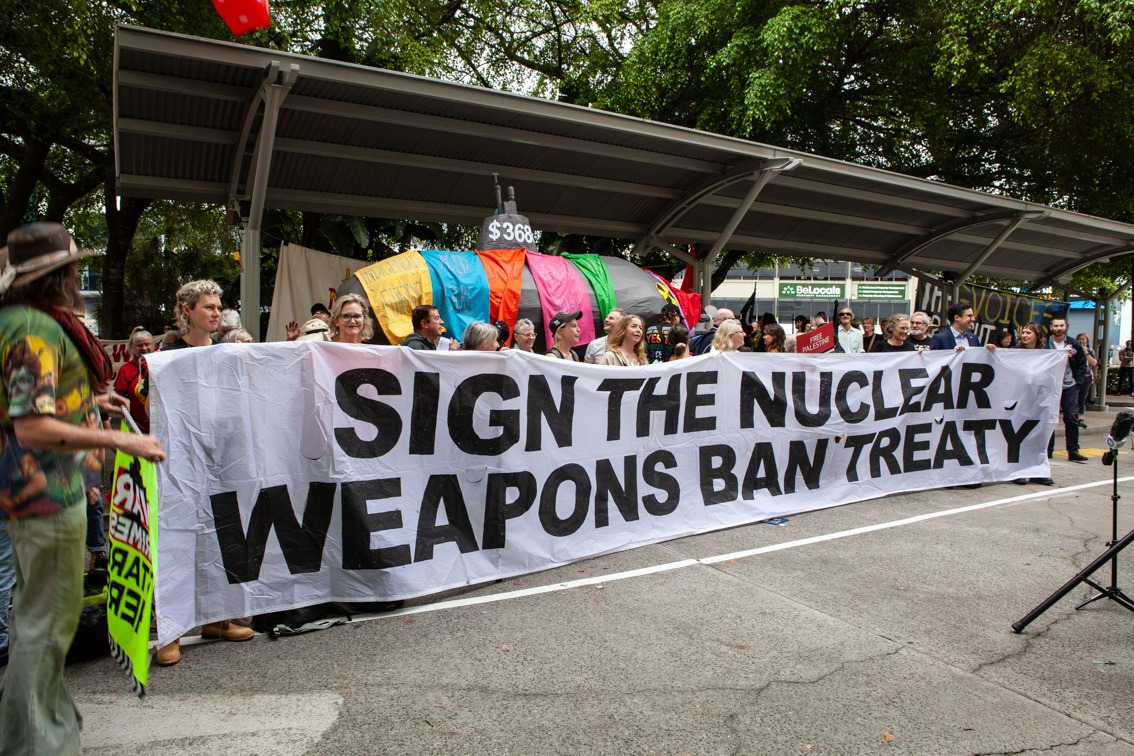
MEDIA RELEASE: First Nations atomic survivors and civil society organisations call on the Australian government to sign the nuclear weapon ban treaty, seventy years after the first Emu Field atomic test.

Today is the 70th anniversary of the first nuclear weapon test on mainland Australia at Emu Field, South Australia, on Anangu Pitjantjatjara Yankunytjatjara (APY) lands.

On October 15th, 1953, the British Government—with the willing support of the Australian government of the day—tested a 10kt atomic bomb, codenamed Totem I. Not only did the operation fail to seek consent from the Anangu people, but the resulting radioactive “black mist” fallout had harmful environmental, health and social outcomes that persist today.

In the wake of the Voice referendum, it’s important to prioritise the voices and calls for justice of First Nations people and other nuclear survivors. 

The International Campaign to Abolish Nuclear Weapons Australia (ICAN) has today  released a civil society statement, co-drafted by Karina Lester (Yankunytjatjara Anangu woman and second generation survivor of the Emu Field nuclear tests) to mark the anniversary and urge the Australian government to sign and ratify the Treaty on the Prohibition of Nuclear Weapons (TPNW). The statement has been signed by more than 130 civil society organisations, including the Australian Red Cross, Public Health Association of Australia, Health Services Union, Oxfam and Catholic Religious Australia. 

The statement outlines the escalating threat of nuclear weapons use, which is “exacerbated by war, regional conflicts and a changing geopolitical climate. The continued possession of nuclear weapons by nine nations poses grave humanitarian, human rights and major climate risks. Use of even a small portion of global nuclear stockpiles would cause nuclear winter, agricultural collapse and catastrophic harm to life on this planet.”

The statement calls on Australia to demonstrate its commitment to nuclear non-proliferation and disarmament by joining the TPNW.

Karina Lester’s late father, Yami Lester, was blinded because of the tests at Emu Field, and Karina carries his story as well as her grandmother’s story about the impacts of the tests on her people.

“Today is a very emotional day for my family. We carry the pain of what happened to my family and community as a result of those tests. Our communities are still suffering the health impacts from radiation poisoning.

“This has been a generational journey for us, and a generational story of talking about the traumas and the suffering and the scars that have been left not only on our traditional lands, on Yankunytjatjara and Pitjantjatjara country, but also in Western Australia as well. Our stories are stories that have been passed on from generation to generation. They’re sad stories, but they’re true stories. This is about truth-telling, and this is our story. 

“This is why I am urging the Australian government to sign and ratify the TPNW, as Prime Minister Anthony Albanese promised to do when in government. They must listen to First Nations voices who never want to see these most destructive, indiscriminate weapons ever be used again”

The statement argues that the TPNW “is the first treaty to set out a clear direction for the total elimination of nuclear weapons and to provide a framework for supporting survivors of nuclear weapons use, including the remediation of impacted environments. It is supported by the vast majority of our Pacific and South-East Asian neighbours.”

It says: “Seventy years on from the first mainland nuclear explosion, let us put an end to any involvement with nuclear weapons, now and forever.”

Additional material: 
BACK TO NEWS

Media Release: Labor re-commits to signing nuclear weapon ban

CAMPAIGN NEWS:

Media Release: Labor re-commits to signing nuclear weapon ban

A promise that now needs to be progressed: Labor re-commits to signing treaty banning nuclear weapons

18th August, 2023

The International Campaign to Abolish Nuclear Weapons (ICAN) welcomes the reaffirmation of Labor’s commitment to sign and ratify the landmark Treaty on the Prohibition Nuclear Weapons (TPNW), but regrets that no timeline has yet been given for acting on this long standing party pledge.

At its national conference in Brisbane, Labor reaffirmed its commitment to join the TPNW, which was first agreed by the party in 2018 at the initiative of Anthony Albanese, who said at the time that it represented “Labor at our best”.

The reformulated policy, approved by conference delegates on Friday: 

  • Reaffirms Labor’s commitment to sign and ratify the TPNW in government, after taking account of three matters.
  • Commits Labor to consider steps on assistance for affected communities and environmental remediation in relation to the British nuclear tests in Australia, and nuclear testing in the Pacific, consistent with Articles 6 and 7 of the TPNW.
  • Welcomes the positive steps that have been taken by the Labor Government to engage with the TPNW, including by attending the First Meeting of States Parties and ending Australia’s opposition to the treaty at the UN First Committee in 2022.

Federal member for Fremantle Josh Wilson MP moved the amendment, saying Labor’s updated policy “demonstrates that Labor values the TPNW and takes it seriously as a new and promising form of international agreement that seeks to shift the otherwise dangerous status quo on nuclear weapons.” 

At an event hosted by ICAN, Wilson confirmed that Australia will attend the Second Meeting of States Parties to the TPNW from 27 Nov – 1 Dec 2023 at the UN in New York.

“We welcome this reaffirmation of Labor’s longstanding commitment, but it’s not enough to keep promising to sign the treaty without acting. We want to see the Prime Minister put pen to paper, without delay. Labor’s commitment on nuclear disarmament and non-proliferation will be hollow if Australia fails to do so,” said ICAN International’s newly appointed Executive Director, Melissa Parke, a former Labor MP for the federal seat of Fremantle.

“Signing the TPNW is especially important given regional concerns about Australia’s acquisition of nuclear attack submarines under the AUKUS partnership with the United States and United Kingdom, which have nuclear arsenals,” said Parke. “The TPNW would prevent current and future Australian governments from engaging in or assisting with nuclear-weapon-related activities in any way.”

“Australia has a proud history of championing nuclear disarmament – Labor has a proud history of championing nuclear disarmament,” Parke said. “It’s time for the Australian government to honour our history, as well as our future, and sign the nuclear weapons ban treaty.”

NEW LABOR PLATFORM TEXT

Statement in Detail

Nuclear Disarmament

1. Acknowledges the growing danger that nuclear weapons pose to us all and the urgent need for progress on nuclear disarmament.

2. Acknowledges the deep and ongoing consequences of nuclear testing in Australia, which have been borne disproportionately by our First Nations peoples, as well as testing in the Pacific.

3. Commits itself to redoubling efforts towards a world without nuclear weapons and strengthening the non-proliferation regime.

4. Congratulates the International Campaign to Abolish Nuclear Weapons (ICAN) on its work in returning to global prominence the cause of nuclear disarmament;

5. Acknowledges the value of the Treaty on the Prohibition of Nuclear Weapons (the Ban Treaty) which came into force on 22 January 2021,and its aspiration to rid the world of nuclear weapons for all time; 

6. Welcomes the positive steps taken by the Albanese Labor Government to engage with the Ban Treaty, including by sending an observer to the first Meeting of States Parties to the TPNW in Vienna, June 2022 and changing Australia’s vote on the annual UNGA resolution on the TPNW in 2022 from ‘oppose’ to ‘abstain’ and encourages attendance at the second Meeting in New York, November 2023.

7. Acknowledges the centrality of the US Alliance to Australia’s national security and strategic policy.

8. Labor in government will sign and ratify the Ban Treaty, after taking account of the need to:

a) Ensure an effective verification and enforcement architecture;

b) Ensure the complementary interaction of the Ban Treaty with the longstanding Nuclear Non-Proliferation Treaty;

c) Work to achieve universal support for the Ban Treaty.

9. Labor will take urgent action to reduce the risk of nuclear war by continuing its proud record of seeking nuclear disarmament and non-proliferation by:

a) Contributing to global progress towards addressing the matters outlined in paragraph 8 by;

b) Advocating to the United States that it actively negotiateswith Russia, China and other nuclear armed states to develop a follow-on treaty to the New START treaty with a view to realising the objective of Article VI of the Treaty on the Non -Proliferation of Nuclear Weapons (NPT), namely, a world free of nuclear weapons; 

c) Seeking to work with partners and allies to build upon the International Commission on Nuclear Non-Proliferation and Disarmament to develop an initiative which proposes a way of working with states possessing nuclear weapons to achieve Article VI of the NPT and encouraging transparency among all states with nuclear weapons in relation to their use doctrine and the composition of their arsenals, while continuing to strengthen non-proliferation goals in the Indo Pacific region; and

d) Considering steps that can be taken with respect to further assistance for affected communities and further environmental remediation in relation to the British atomic tests that occurred on Australian territory, consistent with Article 6 of the Ban Treaty, and considering further collaboration and assistance to Pacific Island communities affected by nuclear testing in the Pacific, consistent with Article 7 of the Ban Treaty.

BACK TO NEWS

Australian Atomic Survivors’ Delegation heads to Parliament House

CAMPAIGN NEWS:

Australian Atomic Survivors’ Delegation heads to Parliament House

MEDIA RELEASE: Atomic Survivors travel thousands of kilometres to call on PM to sign nuclear weapon ban treaty


A group of Australian atomic survivors are travelling to Canberra this week to speak with government decision-makers about their experiences as survivors of the British nuclear testing program in WA and SA. They will outline expectations for future actions from the government to acknowledge and address the harms caused by nuclear weapons testing, calling directly on the Prime Minister to sign the Treaty on the Prohibition of Nuclear Weapons (TPNW).

This year marks the 70th anniversary of the British nuclear testing program at Emu Field in South Australia, and one of the delegates, Karina Lester, a Yankunytjatjara Anangu woman from north-west South Australia, is a second generation nuclear test survivor from these tests. Her late father, Yami Lester, was blinded by the tests at Emu Field, and Karina carries his story as well as her grandmother’s story about the impacts of the tests on her people.

“Our mob were not informed of those tests that were about to take place on our traditional lands,” said Karina. “Consent was never given by Anangu for the Emu Field tests. The Government did not come and ask Anangu if it was okay to test on our traditional lands.

“First Nations peoples of this Country have been speaking up strong about truth telling, this is our truth telling, about the impacts felt by my people, Anangu Pitjantjatjara Yankunytjatjara, the contamination of our traditional lands, the hurt and pain and suffering still felt to this day. All Australians need to know the truth about what happened on our own soil.

“I’m travelling to Canberra because we Aboriginal people need to be around the tables to make the decisions, and the nuclear ban treaty is a good opportunity to be part of the solution.”

Maxine Goodwin is the daughter of an Australian nuclear veteran who became ill as a result of his involvement in the first atomic test in Western Australia. She is joining the delegation because she wants to see the government be held accountable for what happened to veterans and their families. 

“History has demonstrated that governments have been elusive and unaccountable,” said Maxine. “They have been less than accountable when it comes to the history of nuclear testing in Australia. Signing the TPNW is a significant step towards addressing the harm experienced by individuals and communities. From my community’s experience, there has been no accountability for the impacts of the nuclear tests on veterans and their families.”

June Lennon is a Yankunytjatjara, Antikarinya and Pitjantjatjara woman, who was four months old, in October 1953, when the Totem 1 nuclear bomb was detonated at Emu Field. June’s family witnessed the test and have suffered from ill-health ever since. 

“The government didn’t tell the truth about the nuclear testing program,” said June “There were so many lies—they didn’t tell people what they were doing. The people who suffered really need an apology and recognition. We need it so we can remember those people we lost, so their names won’t be forgotten.”

In 1956, Doug Brooks was eighteen when he was stationed at Monte Bello Islands as a serving member of the Royal Australian Navy. He was onboard HMS Alert when, as part of Operation Mosaic, the G2 98 kiloton nuclear bomb was detonated just ten miles away. He and the rest of the crew were exposed to the full blast of the explosion. 

“The 19th of June is the 67th anniversary of my exposure at Monte Bello Islands,” said Doug. “After all these years of fighting with the government, it comes at an appropriate time. I will never stop fighting to get recognition for these people.”

ICAN Australia Director, Gem Romuld, says “this is an incredibly important delegation, some of whom are travelling thousands of kilometres to be in Canberra. 

“Nuclear survivors are experts on the devastating humanitarian impacts of nuclear weapons. Australia’s experience with nuclear weapons testing is a powerful motivation to join the nuclear weapon ban treaty. Joining the treaty will help prevent more people and land from suffering, as well as address historic harms. It’s about the past, the present, and the future.”

The delegation will be in Canberra on the 14th and 15th of June. They will meet with parliamentarians, including the Foreign Minister, and speak at an event hosted by Parliamentary Friends of the Treaty on the Prohibition of Nuclear Weapons. 

On Wed 14th June there will be a picfac at 9:30 am in the Senate Courtyard 28L, followed by a press conference with Co-Chairs of the Parliamentary Friends of the TPNW, at 10 am, in the Mural Hall, Second Floor.

BACK TO NEWS

Media Release: PM must lead on nuclear disarmament at G7 Summit in Hiroshima

CAMPAIGN NEWS:

Media Release: PM must lead on nuclear disarmament at G7 Summit in Hiroshima

As Prime Minister Anthony Albanese prepares to join G7 countries in Hiroshima this weekend as an invitee of the G7 Summit, Nobel Peace Prize recipient, ICAN, calls on Albanese to be a leader on issues of nuclear disarmament, rather than remaining complicit in their existence.

In a message directed at the PM, ICAN Australia Director, Gem Romuld, said that “Atomic bomb survivors in Hiroshima are appealing to all countries to join the UN Treaty on the Prohibition of Nuclear Weapons (TPNW). They don’t want platitudes, they want action. The best way for you, Prime Minister Albanese, to honour them, and ensure no one else ever suffers as they have, would be to join the treaty—as Labor has been promising to do.

All G7 nations either possess, host or support the use of nuclear weapons in their security doctrines. However, several of the invited countries have signed the TPNW, including Indonesia, the Cook Islands and Brazil, and will expect meaningful outcomes on nuclear disarmament from the Hiroshima summit.

Anthony Albanese proposed the resolution that commits Labor to join the TPNW at the 2018 National Labor Conference, and has pledged his personal support for the ban alongside 75% of all federal Labor parliamentarians.

In an appeal via letter to the Prime Minister earlier this month, the ICAN Australia Co-Chairs Dr Marianne Hanson and Dr Margaret Beavis wrote,

“Australia, as a non-nuclear nation and a proud signatory to the Nuclear Non-Proliferation Treaty and the South Pacific Nuclear Free Zone, has a responsibility to lead efforts on the stigmatisation, prohibition and elimination of nuclear weapons, including where the nuclear-armed and nuclear-hosting states fail…

“Under your government, Australia has taken positive steps to engage with the TPNW, for which we commend you. However, we have yet to learn of concrete action to sign and then ratify the treaty. We urge Labor to take the opportunity to advance Australia’s position on this treaty when you visit Hiroshima.”

BACK TO NEWS

Media Release: Time to END policy of Extended Nuclear Deterrence

CAMPAIGN NEWS:

Media Release: Time to END policy of Extended Nuclear Deterrence

MEDIA RELEASE: Time to END policy of Extended Nuclear Deterrence

25th April 2023

In response to the Albanese Government’s release of the 2023 Defence Strategic Review, Nobel Peace Prize recipient, ICAN Australia, says it’s time for Australia to cease the policy of supporting the use of nuclear weapons on our behalf to abandon the myth of Extended Nuclear Deterrence (END) once and for all.

ICAN Australia Director, Gem Romuld, states that “relying on END signals a support for the potential use of nuclear weapons, which would wreak a humanitarian catastrophe on hundreds of thousands—if not millions—of people if detonated. This policy legitimises the use and possession of nuclear weapons and is illegal under the UN Treaty for the Prohibition of Nuclear Weapons (TPNW). It’s time for Australia to move to a nuclear weapon-free defence policy and end our support for END.”

As a state party to the TPNW Australia will need to cease the practice of claiming protection from the US nuclear arsenal, due to Article 1(e) of the treaty, which outlaws encouragement to possess nuclear weapons, among other prohibitions.

The TPNW has strong public support in Australia. An Ipsos poll in March 2022 showed that 76 per cent of Australians want the government to end any support for nuclear weapons and sign and ratify the treaty.

Margaret Beavis, co-chair of ICAN Australia, states that “The defence strategic review speaks of the need to pursue new avenues for nuclear arms control.

“Australia is out of step with our region, in continuing to imagine “nuclear deterrence” makes us safer,” she said.

“Almost all countries from our region recognise the enormous risk nuclear weapons pose, either from intentional use, hacking/disruptive technologies, or just human or technical error. In the last few decades, we have had multiple near misses. We cannot continue to rely on luck.

“Our regional neighbours recognise nuclear weapons as the worst of the weapons of mass destruction.  Almost all have already signed the TPNW.

“Australia has signed all the multilateral treaties banning weapons of mass destruction. Signing the TPWW is indeed “a new avenue for arms control” and would not only reduce the risk of proliferation but also increase pressure on nuclear armed states to re-enter negotiations for verifiable, balanced reductions in stockpiles.”


BACK TO NEWS

Media Release: Nuclear-powered submarines dramatically increase proliferation risks.

CAMPAIGN NEWS:

Media Release: Nuclear-powered submarines dramatically increase proliferation risks.

MEDIA RELEASE: “Nuclear-powered submarines dramatically increase proliferation risks.”

14th March 2023

In response to the AUKUS announcement that Australia plans to acquire nuclear-powered submarines from the US and the UK in a multi-stage plan, Nobel Peace Prize recipient ICAN Australia said: 

 “Acquiring nuclear-powered submarines using highly-enriched uranium (HEU) is both a major proliferation risk and could be seen as a precursor to Australia acquiring nuclear weapons. The clearest signal that Australia could send to our region and the world that this is not our intent, is to sign and ratify the UN Treaty on the Prohibition of Nuclear Weapons (TPNW). 

“Regardless of which nation’s model, Australia’s acquisition of submarines fuelled by HEU undermines our commitment to non-proliferation. It goes against Australia’s past support and actions to reduce use and stocks of HEU, and negates Australia’s support for a proposed Fissile Material Cutoff Treaty. 

“The particular capability of the planned submarines is to support the US in a war in northeast Asia. Whether with China, North Korea or Russia, there is an alarming risk of any such war escalating to use of nuclear weapons.

“Nuclear-powered submarines, and their bases, would become high priority targets for conventional or nuclear attack from adversaries. We don’t need to escalate regional tensions with highly-enriched uranium powered submarines. 

“If Australia acquires nuclear-powered submarines it must unequivocally commit never to develop nuclear weapons, nor host another nation’s nuclear weapons. These are red lines we must not cross. The most effective assurance we can give would be to sign and ratify the UN TPNW.”

Further information: ICAN Australia: AUKUS briefing & Troubled Waters publication.


BACK TO NEWS