Media Release: PM must lead on nuclear disarmament at G7 Summit in Hiroshima
CAMPAIGN NEWS:
Media Release: PM must lead on nuclear disarmament at G7 Summit in Hiroshima
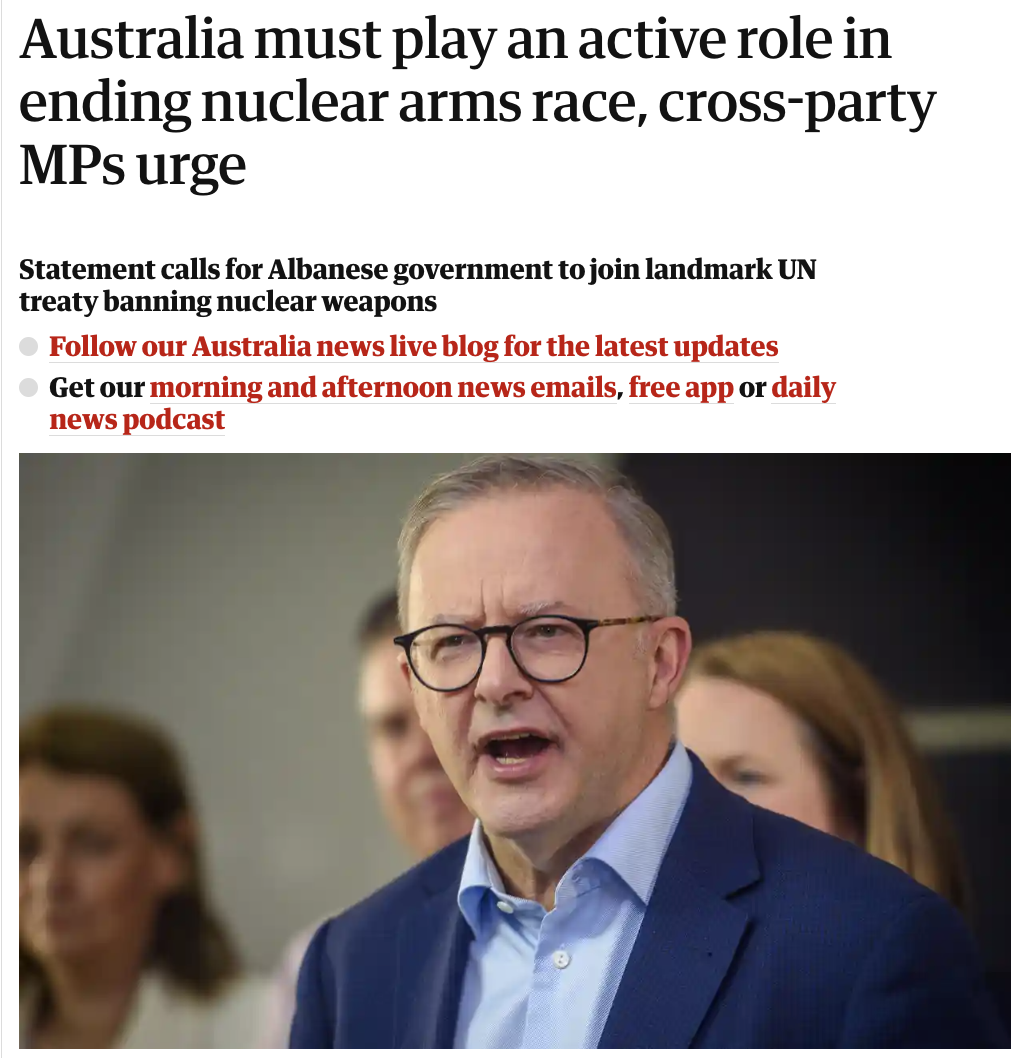
As Prime Minister Anthony Albanese prepares to join G7 countries in Hiroshima this weekend as an invitee of the G7 Summit, Nobel Peace Prize recipient, ICAN, calls on Albanese to be a leader on issues of nuclear disarmament, rather than remaining complicit in their existence.
In a message directed at the PM, ICAN Australia Director, Gem Romuld, said that “Atomic bomb survivors in Hiroshima are appealing to all countries to join the UN Treaty on the Prohibition of Nuclear Weapons (TPNW). They don’t want platitudes, they want action. The best way for you, Prime Minister Albanese, to honour them, and ensure no one else ever suffers as they have, would be to join the treaty—as Labor has been promising to do.
All G7 nations either possess, host or support the use of nuclear weapons in their security doctrines. However, several of the invited countries have signed the TPNW, including Indonesia, the Cook Islands and Brazil, and will expect meaningful outcomes on nuclear disarmament from the Hiroshima summit.
Anthony Albanese proposed the resolution that commits Labor to join the TPNW at the 2018 National Labor Conference, and has pledged his personal support for the ban alongside 75% of all federal Labor parliamentarians.
In an appeal via letter to the Prime Minister earlier this month, the ICAN Australia Co-Chairs Dr Marianne Hanson and Dr Margaret Beavis wrote,
“Australia, as a non-nuclear nation and a proud signatory to the Nuclear Non-Proliferation Treaty and the South Pacific Nuclear Free Zone, has a responsibility to lead efforts on the stigmatisation, prohibition and elimination of nuclear weapons, including where the nuclear-armed and nuclear-hosting states fail…
“Under your government, Australia has taken positive steps to engage with the TPNW, for which we commend you. However, we have yet to learn of concrete action to sign and then ratify the treaty. We urge Labor to take the opportunity to advance Australia’s position on this treaty when you visit Hiroshima.”
BACK TO NEWS
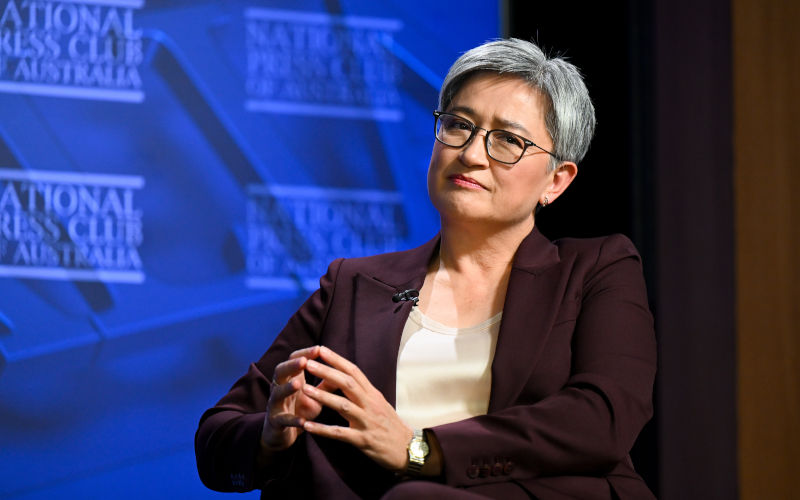
Foreign Minister at the National Press Club
CAMPAIGN NEWS:
Foreign Minister at the National Press Club
KEY POINTS
“I think the TPNW is of substantial normative value.” Foreign Minister Penny Wong.
We agree. The TPNW is intended to further stigmatise nuclear weapons in international law, as an essential step towards their elimination. The normative value of prohibiting an inhumane weapon is proven by the positive impacts the prohibitions of other weapons systems have had in vastly reducing, over time, their production, deployment, threat of use and use.
“In terms of the TPNW, I think the fact that so many states have signed it demonstrates the frustration that there has been insufficient progress in the context of the NPT, and if this can spur more progress in that arena, that is a good thing.” Foreign Minister Penny Wong.
We agree. The Treaty on the Prohibition of Nuclear Weapons was drafted to complement and reinforce the Nuclear Non-Proliferation Treaty. All TPNW states parties are also party to the NPT, and are fulfilling their obligations under the NPT’s Article 6, to pursue effective measures for disarmament. The TPNW is a permanent part of the global legal architecture for nuclear weapons, and its positive effects go beyond the implementation of the treaty itself. Australia must not limit its efforts on nuclear non-proliferation and disarmament to the NPT, but should join the TPNW and end any support for the potential use of nuclear weapons in Australia’s defence posture.
“The US has confirmed that the nuclear-powered submarines visiting Australia on rotation will be conventionally-armed.” Foreign Minister Penny Wong.
This is welcome news. Australia must also insist that any other US or UK vessels or aircraft that are deployed, stationed in or visiting Australia must not carry nuclear weapons or be nuclear-capable, including the US B-52 aircraft proposed to be stationed at RAAF Base Tindal, NT. The South Pacific Nuclear Free Zone, or Rarotonga Treaty, to which Australia is a party, prohibits the stationing of nuclear weapons in Australia.
“Labor has a proud history of championing practical international non-proliferation and disarmament efforts, having ratified the Treaty for the Non-Proliferation of Nuclear Weapons – and will ensure we continue to meet its obligations to the highest and most rigorous standards.” Foreign Minister Penny Wong.
Labor’s history of championing practical international non-proliferation and disarmament efforts must now include Australia’s signature and ratification of the Treaty on the Prohibition of Nuclear Weapons. Failure to do so would cast serious doubt on this history and Labor’s genuine commitment to advancing a world free of nuclear weapons.
“… our job is to lower the heat on any potential conflict, while increasing pressure on others to do the same.” Foreign Minister Penny Wong.
AUKUS and the acquisition of nuclear-powered submarines represents an escalation of tensions in the Asia-Pacific region. Joining the TPNW would lower the heat, and enable Australia to increase pressure on other nations to negotiate time-bound and verifiable agreements to disarm. When it comes to the risk of regional conflict and the potential escalation to the use of nuclear weapons, initiatives that repudiate support for the use or threat of use of nuclear weapons will help prevent a humanitarian catastrophe. Read ICAN’s recent briefing note here.
TRANSCRIPT EXCERPTS
Full transcript and video.
Foreign Minister Penny Wong:
“And some have raised concerns about nuclear non-proliferation.
Labor has a proud history of championing practical international non-proliferation and disarmament efforts, having ratified the Treaty for the Non-Proliferation of Nuclear Weapons – and will ensure we continue to meet its obligations to the highest and most rigorous standards.
Our AUKUS partners understand and recognise Australia’s commitments under international law, including the Treaty of Rarotonga.
Naval nuclear-propulsion is consistent with our obligations under the Treaty of Rarotonga.
The US has confirmed that the nuclear-powered submarines visiting Australia on rotation will be conventionally-armed.”
Guardian Australia foreign affairs correspondent, Daniel Hurst:
You spoke a lot in the speech about Australia sharpening its own articulation of its interest and regional interests. Many countries in our region including Indonesia, Malaysia, Fiji, Samoa, New Zealand, Thailand and the Philippines have signed the Treaty on the Prohibition of Nuclear Weapons [TPNW]. Labor had a platform commitment to sign and ratify it subject to several conditions. Do you expect Australia will be in a condition to sign it in this term of parliament and what undertakings have you given the US and UK on this front?
Foreign Minister Penny Wong:
The position, is not about any private undertakings, the position is what is articulated in the platform resolution which does go to some of the challenging issues associated with the TPNW. I think the TPNW is of substantial normative value.
We share the objective of a world that is free of nuclear weapons. We do believe the best pathway for that, is to ensure that the non-proliferation treaty, the NPT is acted upon and progressed. In terms of the TPNW, I think the fact that so many states have signed it demonstrates the frustration that there has been insufficient progress in the context of the NPT, and if this can spur that more progress in that arena, that is a good thing.
We set out very transparently in the party platform our consideration of that treaty.
BACK TO NEWS
Briefing note: nuclear-powered submarines, B-52 aircraft and nuclear weapons
CAMPAIGN NEWS:
Briefing note: nuclear-powered submarines, B-52 aircraft and nuclear weapons
Key points
- The most effective way for Australia to ensure its nuclear disarmament and non-proliferation credentials is to sign and ratify the UN Treaty on the Prohibition of Nuclear Weapons (TPNW).
- Australia should not put additional obstacles in the way of joining the TPNW.
- Australia’s acquisition of nuclear-powered submarines would undermine the spirit, if not the letter, of the Nuclear Non-Proliferation Treaty.
- The stationing of any nuclear weapons in Australia is prohibited under the South Pacific Nuclear Free Zone (Rarotonga) Treaty.
- Acquiring nuclear-powered submarines would increase tensions within our region and increase the likelihood of Australia being a nuclear target.
- Australia must ensure that any future nuclear-powered submarines, and any B-52 aircraft or other US craft stationed in Australia, will not carry nuclear weapons or be nuclear-capable. We do not believe that a US policy of ‘neither confirm nor deny’ is useful or acceptable.
Precedent
It is unprecedented for a non-nuclear armed nation to acquire nuclear-powered submarines. Australian acquisition of nuclear-powered submarines will motivate and provide justification for others to do the same, indeed it already is.
Nuclear proliferation risks
UK and US submarines use highly enriched uranium (HEU), to 93-97%, which can be directly used in nuclear weapons.
The deal would require Australia to be the first to exploit a loophole in the nuclear Non-Proliferation Treaty (NPT). Former Head of Verification at the International Atomic Energy Agency, Tariq Rauf, says:
Australia’s acquisition of SSNs [nuclear-powered attack submarines] under AUKUS could well open a Pandora’s Box of proliferation with non-nuclear-weapon states such as Argentina, Brazil, Canada, Iran, Japan, Saudi Arabia and South Korea among others also going in for nuclear-powered submarines and keeping nuclear fuel (both low- and highly-enriched uranium) outside the scope of IAEA safeguards. This would weaken the IAEA safeguards (verification) system already facing challenges from new technologies and open up possibilities of diversion of nuclear material for nuclear weapons.
Australia’s acquisition of HEU for use on nuclear-powered submarines would undermine Australia’s own efforts to reduce HEU use and stocks and achieve a fissile material cutoff treaty.
Escalating tensions
Regional neighbours, including Malaysia and Indonesia, have indicated their opposition to Australian nuclear submarines. Acquiring nuclear submarines to be part of US war and nuclear conflict planning, particularly directed against China, is highly provocative and escalates tensions among nuclear-armed, and regional, states. Australia should focus on reducing tensions and risks of armed conflict, seeking cooperation with all nations to address urgent shared global challenges.
Legal concerns
The stationing of any nuclear weapons in Australia is prohibited under the South Pacific Nuclear Free Zone (Rarotonga) Treaty. Australia must never host another state’s nuclear weapons and should end rather than increase its role in assisting possible use or threat of use of nuclear weapons.
Nuclear target
Nuclear-powered submarines would increase the priority of targets in Australia for adversaries, including nuclear-armed ones, of the US, UK and Australia. Such targets could include submarine construction sites and host ports. Attack, as well as accidents, would risk radioactive contamination of Australian host cities. Nuclear submarines and nuclear materials may also become targets for domestic terrorist threats.
Missile concerns
The proposed submarines may be armed with US Tomahawk missiles. There are two problems with this: First, these missiles can carry either conventional or nuclear warheads (dual-use). Even if the missiles on Australian submarines are armed only with conventional warheads, there will always be a level of nuclear ambiguity and risks of misperception, including worst-case planning by adversaries making these submarines a nuclear target. Second, Australia is a member of the Missile Technology Control Regime (MTCR) which aims to limit the development of missiles which have a range beyond 300 kilometres. Tomahawk missiles have a range of 2,400 kilometres and if they are dual-use missiles, would undermine Australia’s commitment to the MTCR.
Australia’s position on the TPNW
Labor made a pre-election commitment to sign and ratify the UN Treaty on the Prohibition of Nuclear Weapons. 107 federal parliamentarians have pledged their commitment to achieving this goal, including the Prime Minister.
Australia attended the first Meeting of States Parties to the TPNW in June 2022 as an observer, and ended its opposition to the treaty by abstaining on a 2022 UN General Assembly resolution supporting it after the previous government voted against it. Steps to sign and ratify the treaty are still pending.
Next steps
Should Australia acquire nuclear-powered submarines, the federal government must ensure that they are non-nuclear weapons capable.
The proposed stationing of B-52 aircraft at RAAF Tindal should exclude nuclear-capable aircraft, given around half the deployed US fleet of B-52s were stripped of their capacity to carry nuclear weapons under the New START treaty.
Australia should reject any presence of nuclear weapons in its territory, including airspace and waters, even if transitory.
Australia’s plans and policies should convincingly support and not undermine nuclear non-proliferation and disarmament. The government must leave no doubt that nuclear-powered submarines and visiting craft of nuclear-armed allies, now or in the future, could be the thin end of the wedge for nuclear weapons hosting, stationing in, or acquisition by, Australia. The most effective way to do this is for the Australian government to sign and ratify the UN Treaty on the Prohibition of Nuclear Weapons. It should add no further obstacles to fulfilling this ALP national policy platform commitment.
Further reading:
- ICAN Australia, Troubled Waters: Nuclear Submarines, AUKUS and the NPT, July, 2022
- International Physicians for the Prevention of Nuclear War, Proposed US/UK nuclear–powered submarines for Australia jeopardise health while escalating an arms race no one can win.
- Tariq Rauf, Australia’s Nuclear-Powered Submarines Will Risk Opening a Pandora’s Box of Proliferation.
- Sébastien Phillipe, The new Australia, UK, and US nuclear submarine announcement: a terrible decision for the nonproliferation regime.
BACK TO NEWS
Second anniversary of TPNW entry into force
CAMPAIGN NEWS:
Second anniversary of TPNW entry into force
Two years ago today the Treaty on the Prohibition of Nuclear Weapons (TPNW) entered into force. On that day it became binding on all states parties, entrenching its place in international law. The nuclear weapon ban is the new gold standard for any nation that is serious about nuclear disarmament and non-proliferation.
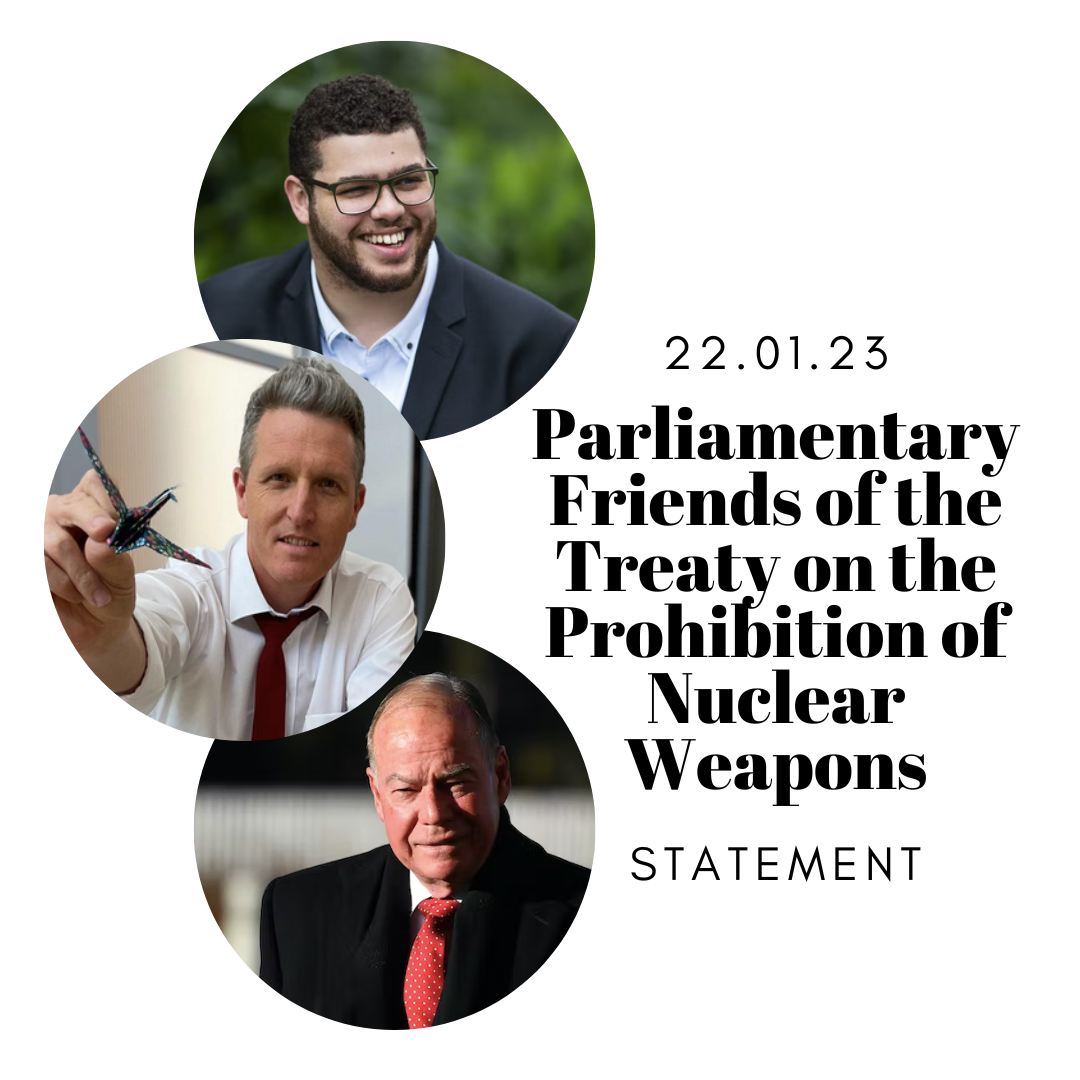
The co-chairs of Parliamentary Friends of the TPNW have released a statement celebrating the anniversary and affirming their commitment to working for Australia’s signature and ratification. The cross-party group has 30 members and is co-chaired by Josh Wilson MP (Labor), Senator Jordon Steele-John (Greens) and Russell Broadbent MP (Liberal).
In their statement, the co-chairs acknowledge the “escalating nuclear threats from nuclear-armed states” and the impact of the Russia–Ukraine war on global security. “At a time when the risk of nuclear conflict has significantly increased, and the existing disarmament and non-proliferation architecture has also been under pressure, the TPNW presents a vital opportunity for new and serious progress in moving towards a world without nuclear weapons.”
Their statement celebrates the already ninety-two countries who have signed the treaty and urges the Australian Government to create a meaningful and lasting legacy by doing the same. “History shows that prohibition treaties on weapons of mass destruction are essential to facilitate progress towards their elimination.”
In The Guardian this morning, Josh Wilson MP, who is chair of the joint standing committee on treaties, said Australia’s peace and security was “massively improved when we help build and enhance the framework of nuclear non-proliferation and disarmament”.
He said the Albanese government had “wasted no time embarking on a serious and steady re-engagement” with both the longstanding nuclear non-proliferation treaty and also the newer ban treaty. To read the full article and statement, click the links below.
Further, to mark this important anniversary, Marianne Hanson and Margaret Beavis of ICAN Australia have published an opinion piece in the Canberra Times, ‘Nuclear dangers are far from over’. They write;
A nuclear-free world requires visionary and bold leadership. It is a global public good. Signing the TPNW, and playing an active role internationally for balanced, phased and verified disarmament will be an excellent start.