Media Release: Parliamentarians’ plea for a world without nuclear weapons

CAMPAIGN NEWS:

Media Release: Parliamentarians’ plea for a world without nuclear weapons

On the second anniversary of the United Nations Treaty on the Prohibition of Nuclear Weapons (TPNW) entering into force, the co-chairs of a cross-party group of parliamentarians, Parliamentary Friends of the TPNW, have released a statement calling on Australia to sign and ratify the treaty. 

The statement—which is co-written by Russell Broadbent MP, Liberal member for Monash, Senator Jordon Steele-John, Greens Senator for Western Australia, and Josh Wilson MP, Labor member for Fremantle, co-chairs of the group—celebrates the already ninety-two countries who have signed the treaty and urges the Australian Government to create a meaningful and lasting legacy by doing the same. “History shows that prohibition treaties on weapons of mass destruction are essential to facilitate progress towards their elimination,” they wrote. “Under the TPNW, nuclear weapons are stigmatised and rejected in their entirety, and a clear pathway is laid out for their eventual elimination.” 

ICAN Australia welcomes the statement and agrees that Australia must play a meaningful role in promoting geo-political stability in our region, concurring with the cross-party co-chairs that moving towards a world without nuclear weapons would promote “a common goal of peace, cooperation, and security ” with our Pacific and ASEAN neighbours.

In their statement, the co-chairs acknowledged the “escalating nuclear threats from nuclear-armed states” and the impact of the Russia–Ukraine war on global security. “At a time when the risk of nuclear conflict has significantly increased, and the existing disarmament and non-proliferation architecture has also been under pressure, the TPNW presents a vital opportunity for new and serious progress in moving towards a world without nuclear weapons.”

ICAN Australia Director Gem Romuld, says that “the second anniversary of the entry into force of the TPNW should serve as a reminder that nuclear weapons pose the single greatest threat to life on earth, and as long as they exist they can be used. Nuclear weapons are never a legitimate means of defence. Australia’s most powerful contribution to ending these abhorrent weapons will be to sign and ratify the TPNW.”Over 100 Australian federal parliamentarians have pledged their support for the treaty, including the Prime Minister, and the Australian Labor Party has committed to sign and ratify it in government since 2018. 

The full Parliamentary Friends of the TPNW statement can be read here.


BACK TO NEWS

B-52 aircraft in Australia should not be nuclear-capable

CAMPAIGN NEWS:

B-52 aircraft in Australia should not be nuclear-capable

In November 2022 the ABC reported on the Australian Government’s planned deployment of up to six US nuclear-capable B-52 aircraft at RAAF Base Tindal in the Northern Territory.

 ICAN Australia is deeply concerned that the aircraft may carry nuclear weapons and contribute to the use or threat of use of nuclear weapons.

 Article 5 of the South Pacific Nuclear Free Zone Treaty, or Rarotonga Treaty, states that ‘Each Party undertakes to prevent in its territory the stationing of any nuclear explosive device.’ As a state party, it is essential that Australia does not allow the deployment of nuclear weapons on the B-52 aircraft that are anticipated to be stationed at RAAF Base Tindal. With dedicated facilities including ammunition depot, maintenance and parking areas, the presence of the B-52s goes beyond mere transit.

The Australian Labor Party’s commitment to sign and ratify the UN Treaty on the Prohibition of Nuclear Weapons (TPNW) represents a widely-supported and important rejection of nuclear weapons and a clear humanitarian response to the horror they represent, at a crucial time of alarming danger of nuclear war and nuclear disarmament in reverse. The TPNW prohibits hosting nuclear weapons as well as assistance with their use or possession. The deployment of nuclear-capable aircraft in Australia would risk inconsistency with both the Rarotonga Treaty and TPNW, and would undermine both Australian government policy and the ALP’s national policy platform. 

 We are aware that in response to commitments made under the New START treaty, of the United States’ fleet of 87 B-52 aircraft (76 of which are in the active inventory), 41 have been stripped of their nuclear capabilities and carry only conventional weaponry[1].

 The Australian government should secure explicit confirmation from the United States that these aircraft would only carry only conventional weaponry. A ‘neither confirm nor deny’ response would not be acceptable; our existing legal obligations require a clear and unambiguous answer from the US on this issue. 

The Albanese Government must ensure that should this deployment be advanced, any B-52s stationed at RAAF Base Tindal should not be nuclear-capable, consistent with Australia’s commitment to nuclear non-proliferation and disarmament and existing treaties.


[1] Hans Kristensen & Matt Korda (2021) United States nuclear weapons, 2021, Bulletin of the Atomic Scientists.


BACK TO NEWS

Media Release: Australia must make its own decision on nuclear weapons treaty

CAMPAIGN NEWS:

Media Release: Australia must make its own decision on nuclear weapons treaty

US Embassy officials in Canberra have warned Australia against signing and ratifying the UN Treaty on the Prohibition of Nuclear Weapons, saying it would be inconsistent with Australia’s policy of nuclear deterrence.

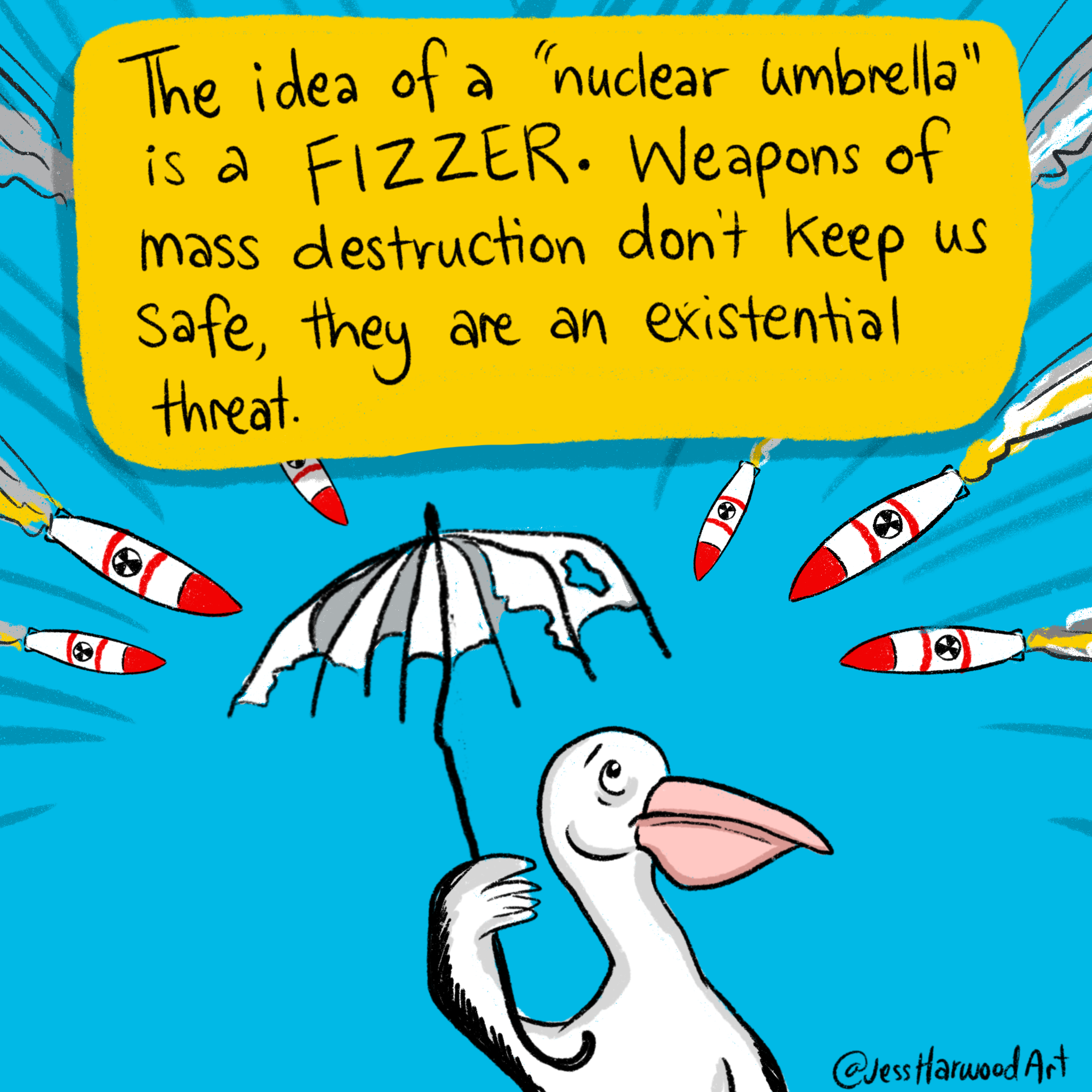
 ICAN Australia Director Gem Romuld said “It’s no surprise that the US don’t want their allies to sign on, because if we claim protection from their so-called ‘nuclear umbrella’ then it helps justify their continued retention and possible use of these illegal and indiscriminate  weapons.”

“The majority of nations recognise that ‘nuclear deterrence’ is a dangerous theory that only perpetuates the nuclear threat and legitimises the forever existence of nuclear weapons, an unacceptable prospect.”

As a non-nuclear weapon state, Australia has ratified the Nuclear Non-Proliferation Treaty, the Rarotonga Treaty (South Pacific Nuclear Weapons Free Zone) and the Comprehensive Nuclear Test Ban Treaty. Australia has signed many multilateral disarmament treaties, including those prohibiting chemical and biological weapons, anti-personnel mines and cluster munitions. The US has refused to sign some of these, and has failed to ratify the nuclear test ban treaty championed by Australia. Pressure is mounting for Australia to sign and ratify the TPNW, which entered into force in January 2021.

The Australian Labor Party has committed to sign and ratify the treaty in government. Consistent with this position, it participated in the first Meeting of States Parties to the TPNW in June as an observer and ended its formal opposition to it by abstaining on a UN First Committee vote last month, in which the previous government voted no.

The TPNW asserts there are no acceptable circumstances to use or threaten to use nuclear weapons, and outlaws any role for nuclear weapons in a state party’s security doctrine. There is strong support among Australians, with 76% of the population supporting Australia signing and ratifying the treaty, and only 6% opposed (Ipsos 2022). 

The TPNW allows states parties to remain in military alliances with nuclear-armed states, provided they do not assist or cooperate on nuclear weapons. Several US allies have successfully signed and ratified the treaty: New Zealand, the Philippines and Thailand. 

“The nuclear weapon ban treaty is a powerful tool to break the current disarmament deadlock. It’s now up to Australia to reject the use or threat of use of nuclear weapons on our behalf. Like New Zealand and the Philippines, we can remain allies without supporting nuclear weapons or assisting in their possible use. A mature relationship and genuine partnership has the capacity to deal with complexity and Australia must not be a nation that facilitates nuclear weapons.”, Romuld said. 

When moving the 2018 motion committing a future Labor government to sign and ratify the TPNW, Anthony Albanese MP said “I don’t argue that this is easy. I don’t argue that it’s simple. But I do argue that it’s just.”


BACK TO NEWS

70th Anniversary of First Nuclear Weapon Detonated in Australia

CAMPAIGN NEWS:

70th Anniversary of First Nuclear Weapon Detonated in Australia

70th Anniversary of First Nuclear Weapon Detonated in Australia

3 October 2022

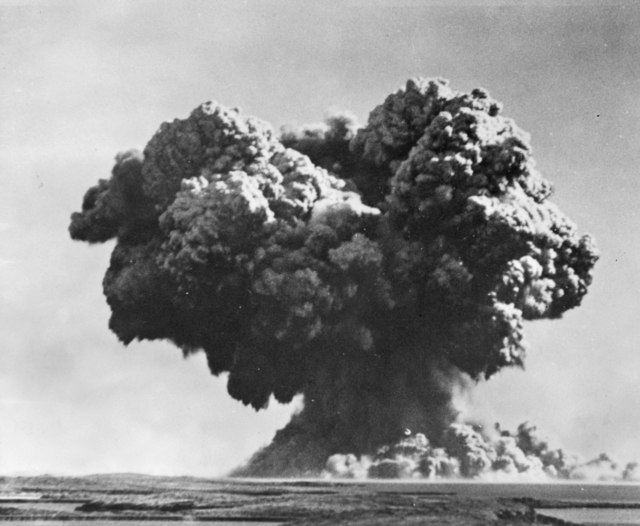
ICAN Australia today marks the 70th anniversary of the first of Britain’s nuclear weapons tests in Australia. This first test on 3 October, 1952 was conducted off the Monte Bello Islands, traditional lands of the Noala peoples.

Developed by the United Kingdom, the test declared Britain as the third country to acquire nuclear weapons capabilities. The test was code named “Operation Hurricane”, and involved the British Naval fleet. It was a plutonium implosion weapon, similar to the design of that used on Nagasaki in 1945. It would be the first of 12 nuclear atmospheric nuclear weapons tests to take place in Australia between 1952 and 1957, with additional development of nuclear weapons capabilities through “minor trials” up until 1963.

The 1985 Royal Commission into British Nuclear Testing in Australia found that fallout reached the mainland around 30 hours after the Hurricane blast, and spread across the northwest of Australia.

Between 1953 and 1957, further testing took place at Emu Field and Maralinga in South Australia without the consent of the local Anangu Peoples. Two further atomic tests took place again on Monte Bello islands in 1956. These tests saw fallout over much of the Australian mainland and further into the Pacific.

In her remarks at the United Nations in 2017, Kokatha elder and ICAN Ambassador Aunty Sue Coleman-Haseldine bore witness to the legacy of nuclear testing on First Nations communities. “Aboriginal people were still living close to the test sites and were told nothing about radiation” she told the negotiating conference for the Treaty on the Prohibition of Nuclear Weapons, “High rates of cancer and chronic illness haunt my family and our wider community.”

Australia, as a state that has been subjected to nuclear weapons testing by foreign powers, is urged to sign and ratify the TPNW, and cooperate with other States Parties on addressing the historic and on-going harms of the nuclear weapons tests here” said Dimity Hawkins AM, ICAN co-founder.

Today is a deeply significant anniversary. We encourage you to take time to consider the victims and survivors of nuclear weapons in Australia, and the vast areas of country that were used as nuclear sacrifice zones. We hope the UN Treaty on the Prohibition of Nuclear Weapons will be a powerful tool to seek long overdue justice for communities still impacted by this devastating chapter of history.

A statement from people affected by nuclear testing in Australia was released in June 2022, which you can read below.

Detonation at Trimouille Island, October 3 1952 (Credit: Naval Historical Collection)

BACK TO NEWS

Ten independents call for progress on nuclear ban treaty

CAMPAIGN NEWS:

Ten independents call for progress on nuclear ban treaty

Ten independents call for Australia to step up on nuclear disarmament

23 September 2022

As world leaders gather in New York this week for the annual opening of the United Nations General Assembly, ten independent federal parliamentarians have issued a joint statement calling for Australia to engage constructively on nuclear disarmament and the Treaty on the Prohibition of Nuclear Weapons (TPNW).

In the context of Russia’s open threats to use nuclear weapons and the failure of all nine nuclear-armed nations to progress disarmament, they note that the groundbreaking agreement, the TPNW, comes at a critical time. They state the “danger of nuclear war is widely assessed to be at least as great as during the 1962 Cuban missile crisis, and perhaps ever.”

Following a signature and ratification ceremony yesterday at the UN, the TPNW now has 91 signatories and 68 states parties, and seeks to deligitimise nuclear weapons and break the deadlock on progress on disarmament.

The independents welcome Labor’s pre-election commitment to sign and ratify the TPNW in government and urge the new government to “make use of every opportunity to advance Australia’s position in support of the Treaty on the Prohibition of Nuclear Weapons.”

Zoe Daniel MP, independent member for Goldstein, and letter signatory said;

If anything demonstrates the urgency of Australia supporting the Treaty on the Prohibition of Nuclear Weapons, as Labor has previously promised, it is the threat of Vladimir Putin deploying nuclear weapons; it shows that the threat of nuclear conflict is as great as it has ever been and that it is simplistic to believe that the threat of the devastation they would unleash is a sufficient deterrent against their use.

Senator David Pocok, independent Senator for the ACT, and letter signatory said;

As geopolitical tensions escalate it is more urgent than ever to keep pushing for nuclear disarmament. I urge the Australian Government to sign and ratify the UN Treaty on the Prohibition of Nuclear Weapons at the earliest opportunity.

ICAN co-founder, Associate Professor Tilman Ruff, said;

Under governments both Labor and Coalition, Australia has done the right thing and joined the treaties banning biological and chemical weapons, landmines and cluster munitions. It is time for us to join the treaty that bans the most destructive weapons of all.

Signatories:

  • Kate Chaney MP, independent member for Curtin, WA
  • Zoe Daniel MP, independent member for Goldstein, VIC
  • Helen Haines MP, independent member for Indi, VIC
  • Senator David Pocock, independent Senator for the ACT
  • Dr Monique Ryan MP, independent member for Kooyong, VIC
  • Dr Sophie Scamps MP, independent member for Mackellar, NSW
  • Allegra Spender MP, independent member for Wentworth, NSW
  • Zali Steggall MP, independent member for Warringah, NSW
  • Kylea Tink MP, independent member for North Sydney, NSW
  • Andrew Wilkie MP, independent member for Clark, TAS

BACK TO NEWS