Vale Anne Kantor AO
CAMPAIGN NEWS:
Vale Anne Kantor AO
Anne Kantor AO
20 Sep 1935 – 14 Sep 2022
ICAN Australia honours the huge heart, compassion, generosity and humility of Anne Kantor’s life and work.
Anne and her extended family have been and continue to be friends, fellow travellers, wise counsellors and vital supporters of ICAN since its very beginnings in Melbourne in 2006.
Their vision, generosity and belief in our work was instrumental to us being able to launch a global campaign coalition that became the main civil society partner for the governments that negotiated the historic Treaty on the Prohibition of Nuclear Weapons in 2017, the first international treaty to ban these worst of all weapons of mass destruction. It was for our contribution to this treaty that ICAN became the first Australian-born Nobel Peace Prize laureate.
We are glad that till the end she could be at home with Eve and Mark, enveloped by love and family. With gratitude, admiration and determination we honour Anne’s magnificent legacy and express our deep condolences to Anne’s family and loved ones.
ICAN Australia will miss and remember Anne. We will honour her memory and life in the best way we can, by continuing our efforts to rid the world of nuclear weapons.
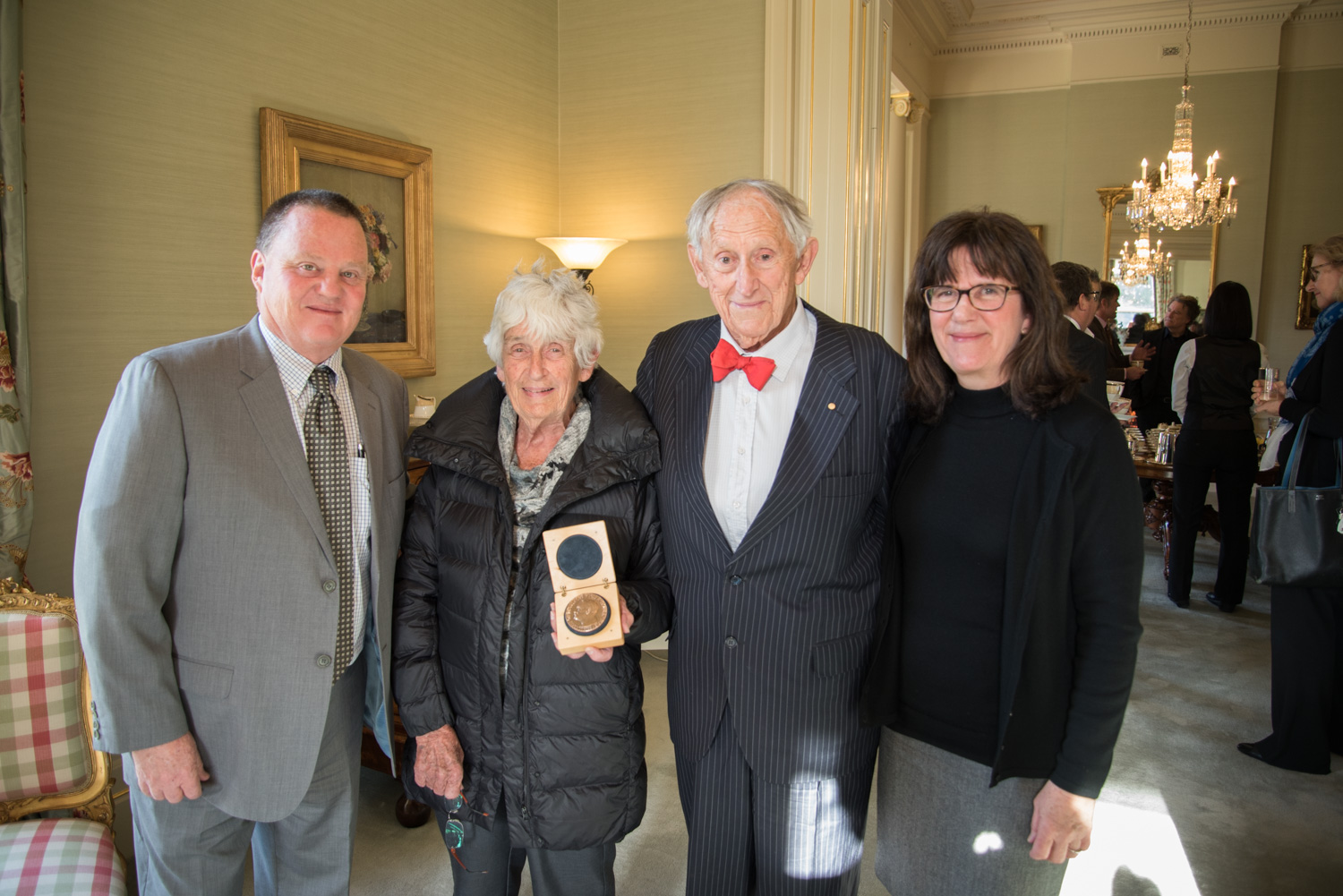
Image: Mark Wootton, Anne (holding ICAN’s Nobel Peace Prize medal), Milan and Eve Kantor at Government House Melbourne, 19 July 2018. Credit: Jessie Boylan
BACK TO NEWS
Troubled Waters: nuclear submarines
CAMPAIGN NEWS:
Troubled Waters: nuclear submarines
In September 2021 the Australian, UK and US heads of state announced a new partnership “AUKUS” and their intention to assist nuclear-powered submarines for Australia. The Australian Government is currently undergoing an 18-month scoping period on this proposal.
ICAN Australia has launched a new report ahead of the tenth Review Conference of the Nuclear Non-Proliferation Treaty (NPT) in August 2022, Troubled Waters: nuclear submarines, AUKUS and the NPT.
Troubled Waters critiques the Australian government’s proposal to acquire nuclear-propelled submarines and proposes closure of the loophole in safeguards under the nuclear Non-Proliferation Treaty (NPT) that would be exploited for the plan to go ahead.
Former Head of Verification and Security Policy Coordination at the International Atomic Energy Agency, Tariq Rauf, argues that the planned submarine deal would pose a threat to nuclear non-proliferation and that states parties to the 1970 NPT should consider amending the treaty’s operation to prevent all non-nuclear-armed states from gaining access to nuclear propulsion technology.
Of key concern is the threat Australian nuclear submarines pose to the NPT, the broader safeguards regime and peace in our region. Further, Australian nuclear submarines would increase nuclear dangers and are an unnecessary, precedent-setting and retrograde step.
Troubled Waters contains writing by Australian and international safeguards, non-proliferation and legal experts including:
- Tariq Rauf, The challenge of nuclear-powered submarines to IAEA safeguards.
- Trevor Findlay, The AUKUS submarine project and the nuclear non-proliferation regime.
- Richard Tanter, Nuclear-powered submarines for Australia – stepping back into the Anglosphere and into a new Asian arms race.
- Monique Cormier, Implications for the international legal regime.
- Talei Luscia Mangioni, Pacific perspectives on proposed AUKUS nuclear-propelled submarines.
- Muhadi Sugiono, Indonesian concerns about the proposed AUKUS nuclear-propelled submarine deal.
Further, the new Australian government has the opportunity and mandate to provide enduring certainty of the government’s commitment to nuclear non-proliferation and disarmament by signing and ratifying the UN Treaty on the Prohibition of Nuclear Weapons.
Troubled Waters was first published in January and revised in July 2022.
BACK TO NEWS
Overview: Vienna Declaration and Action Plan
CAMPAIGN NEWS:
Overview: Vienna Declaration and Action Plan
Last week saw the momentous first Meeting of State Parties (1MSP) in Vienna for the Treaty on the Prohibition of Nuclear Weapons (TPNW). At this meeting, representatives and delegates adopted two major documents, setting out a framework for implementing the TPNW and working towards the total elimination of nuclear weapons. The first document – the Vienna Declaration – describes the commitment of States Parties to the articles and values of the TPNW, while the second document – the Vienna Action Plan – details the concrete steps that countries must take to implement the Treaty.
Of course, not everyone has the time or patience to read through complicated international agreements. So here is an overview of the important points from these historic documents, and how they relate to the TPNW.
The Vienna Declaration represents a political statement by the States Parties to the TPNW outlining their commitment to the treaty and its values, affirming their “determination to realize the complete elimination of nuclear weapons,” and to chart a “path forward for the full and effective implementation of the Treaty.”
The Declaration also set forth the moral and ethical imperatives that underpin the TPNW. It states that “the catastrophic humanitarian consequences of nuclear weapons” are “incompatible with respect for the right to life.” These include the unimaginable levels of death and destruction, as well as the “profound” long-term environmental and health effects that so many are living with today. The Declaration also notes the risk of a nuclear detonation, whether by accident or by design, means that “we cannot afford to wait.”
Furthermore, the participants of the 1MSP expressed their deep concern and dismay at threats to use nuclear weapons, as well as their ongoing role in countries’ security strategies – with there now being nearly 13,000 nuclear weapons stationed around the globe. They declared that far from ensuring peace and security, nuclear weapons are “linked to coercion, intimidation and the heightening of tensions.” It is for this reason they called for an end to current moves by nuclear states to modernise and expand their nuclear arsenals.
Participants conveyed a commitment to international cooperation between governments, the United Nations, and international society. The issues of Universality and Complementarity – two important aspects of the TPNW – are also addressed in the Declaration, committing States Parties to growing membership of the Treaty, and cooperating with all countries in forums such as Non-Proliferation Treaty Review Conferences.
The Declaration concludes that although the Treaty signatories “have no illusions about the challenges and obstacles” that lie ahead, they are committed to moving ahead “with optimism and resolve.”
Universalisation
Universalisation is represented by Article 12 of the TPNW, which states that “Each State Party shall encourage States not party to this Treaty to sign, ratify, accept, approve or accede to the Treaty, with the goal of universal adherence of all States to the Treaty“. Important Action Points here include commitments to conduct ministerial or diplomatic missions to non-Party countries to encourage them to join (Action 3), and to appoint representatives within governments responsible for promoting the TPNW (Action 6). Other strategies for growing TPNW membership include raising awareness of the Treaty at international conferences and events, or at regional meetings (Action 7), as well as engaging with nuclear-armed countries, and countries that rely on nuclear weapons for deterrence to promote the treaty and its values (Action 12)
Towards the Elimination of Nuclear Weapons
Article 4 of the TPNW calls for the establishment of a Competent International Authority, which would support the goal of eliminating nuclear weapons by overseeing and verifying the dismantling and destruction of nuclear weapons and related facilities. As this will be one of the most significant undertakings of the TPNW, the Action Plan calls for additional discussion and dialogue during the intersessional period before the next Meeting of States Parties (Action 15). This will help determine the structure and functioning of such an Authority.
Importantly, the 1MSP established a 10-year deadline by which nuclear-armed states must eliminate their nuclear weapons stockpiles when they join the TPNW. Moreover, upon joining the TPNW countries will have 90 days to remove nuclear weapons owned by other countries from their soil.
Victim Assistance, Environmental Remediation, and International Assistance
Two of the most innovative and significant aspects of the TPNW are Articles 6 and 7. Article 6 establishes positive obligations for States Parties to ensure sufficient and equitable assistance to victims of the use and testing of nuclear weapons, as well as to take necessary measures for environmental remediation of contaminated areas. Article 7 requires states to provide affected states with financial and technical assistance to aid them in fulfilling their obligations.
The Action Plan sets out a number of steps governments must take to implement Articles 6 and 7. Countries are to create domestic government processes for victim assistance and environmental remediation, including adapting or adopting national laws, and to appoint a representative to oversee this work (Actions 21 and 22).
There is also a commitment to establish mechanisms to provide technical and financial assistance to affected states (Action 23). An example of this could be an international trust fund to support affected states (Action 29).
To help implement these commitments, affected states agreed to assess the health and environmental effects of nuclear weapons use and testing to determine the needs of victims and the extent of contamination (Actions 33 and 34).
Complementarity
Ensuring that the TPNW complements and enhances existing nuclear weapons agreements, such as the Non-Proliferation Treaty (NPT) and regional Nuclear-Weapons Free Zones, was an important issue addressed at the 1MSP. The Action Plan states that TPNW “builds upon, contributes to and complements a rich and diverse disarmament and non-proliferation architecture”
To this end, TPNW members are encouraged to emphasise and promote the complementarity of the TPNW in other disarmament forums, such as NPT Review Conferences (Action 35), and to cooperate with international organisations such as the International Atomic Energy Agency to further enhance the complementarity of the TPNW (Action 37).
Inclusivity
The Action Plan includes a number of points on enhancing and implementing inclusivity standards included in the TPNW. Countries are required to incorporate gender considerations in the implementation of the Treaty (Action 39). Further to this, the Action Plan recommends that gender considerations be taken into account in all TPNW-related work (Action 47), to establish a Gender Focal Point to coordinate this work (Action 48), and to establish guidelines for age- and gender-specific Victim Assistance (Action 49).
TPNW members are also called to ensure the participation of all affected communities, and in particular that of Indigenous peoples (Action 41).
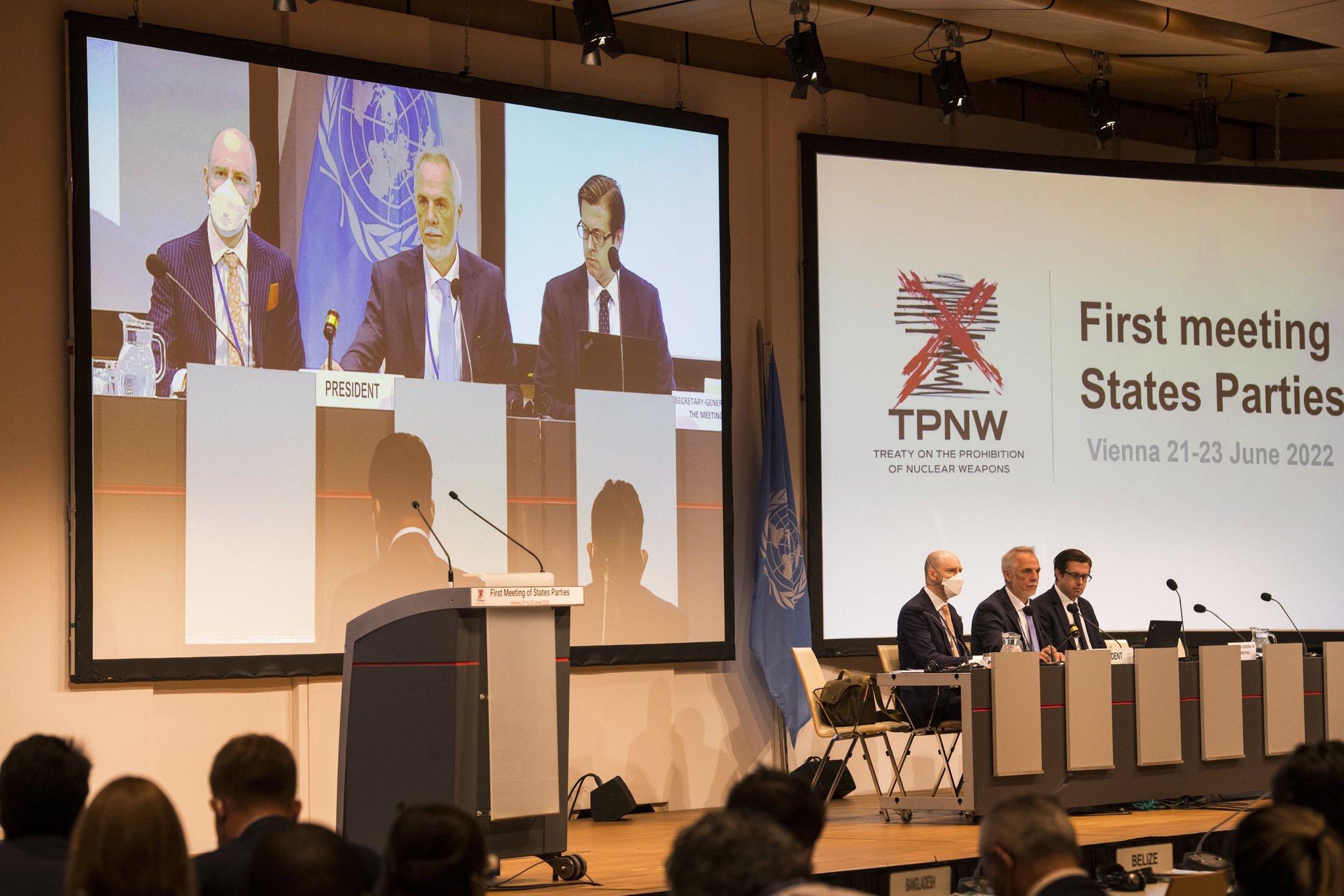
Image: Ambassador Alexander Kmentt (middle) presides over the First Meeting of States Parties to the TPNW on 21-23 June 2022.
BACK TO NEWS
Sachertorte #6: Meeting of States Parties to the TPNW, Day 3
CAMPAIGN NEWS:
Sachertorte #6: Meeting of States Parties to the TPNW, Day 3
Sachertorte: a famous Viennese chocolate cake. Easier to eat than to pronounce correctly. Used here to provide a slice of the action for the Treaty on the Prohibition of Nuclear Weapons in Vienna, Austria.
Thursday 23 June
First Meeting of States Parties to the Treaty on the Prohibition of Nuclear Weapons, Day 3
Report by Talei Luscia Mangioni, ICAN Australia board member, and Dr Tilman Ruff, ICAN Co-Founder.
The final day of the 1MSP concluded with a very strong commitment on implementation of the TPNW with the adoption of the Vienna Declaration and Action plan, an ICAN briefing paper of which can be found here. Both were commended as a very strong political declaration condemning nuclear weapons as well as a very detailed and comprehensive action plan with a strong emphasis on universalisation, positive obligations of victims assistance and environmental remediation, establishment of a scientific advisory group, the deadline of ten years to destroy nuclear stockpiles, and 90 days to remove nuclear weapons of another country if hosted on their territory. It was also decided that Mexico would chair 2MSP scheduled for November 2023 in New York City, given its historical and ongoing role in advancing disarmament and non-proliferation especially with regards to the TPNW.
A detailed account of national positions and discussion can be found in the excellent Reaching Critical Will Nuclear Ban Daily reports; in this account I will focus on the substantive outcomes and offer some reflections of a more general nature about the process and conduct of the meeting and their implications for our ongoing work.
Particularly as the TPNW does not have a dedicated secretariat in the way that for example the Chemical Weapons Convention and Comprehensive Nuclear Test Ban Treaty do, it is widely recognised by supporters of the treaty that intersessional work that goes on between formal meetings is vital to progress and implement the treaty. The overall structure agreed involves a coordinating committee comprising the outgoing and incoming presidents of the treaty meetings as well as the co-chairs of the informal working groups which were agreed, supported by the UNODA as secretariat. Importantly, both the International Committee of the Red Cross (ICRC) and ICAN are invited to participate in meetings of this committee, which will meet at least quarterly.
Three informal working groups were established, addressing:
1. Universalisation – co-chaired by South Africa and Malaysia. This reflects Article 12 of the treaty requiring states parties to encourage states not yet parties to join the treaty. The approach to universalisation efforts is broad including through increasing signatures and ratifications, as well as promoting the norms, values and underlying arguments of the treaty, including about the inherent risks and catastrophic humanitarian consequences of nuclear weapons, and the treaty’s effective contribution towards disarmament and international peace and security. A range of specific actions were delineated.
2. Processes towards the elimination of nuclear weapons – co-chaired by Mexico and New Zealand. This group will address Article 4 of the treaty. States agreed on timelines which the treaty specifies required decision at this MSP. The maximum duration for the elimination of nuclear weapons from a nuclear-armed state which joins the TPNW was agreed at 10 years, with extension under exceptional circumstances for up to 5 further years. It was further agreed that for nuclear weapons hosting states which join the TPNW, nuclear weapons must be removed from their territory within 90 days. An important area of ongoing work for this group will be to explore and develop further the role, functioning and nature of the competent international authority or authorities required under the treaty to verify the time-bound. irreversible dismantling of nuclear weapons and nuclear weapons programs and facilities required under the treaty.
3. Victim assistance, environmental remediation and international cooperation and assistance – co-chaired by Kazakhstan and Kiribati. This group will focus on the treaty’s so-called ‘positive obligations’ enshrined in Articles 6 and 7. This ongoing work has significant potential to engage states which have not yet joined the treaty. It was notable that Germany, a nuclear hosting state which currently rejects the TPNW, expressed interest in this work. One possibility which the group will explore is the establishment of an international trust fund to support international cooperation around victim assistance and environmental remediation related to nuclear weapons use and testing.
These informal working groups will be open to the participation of all states parties, again with ICRC and ICAN and the UNODA secretariat and relevant international organisations as observers. For each working group, states parties are to appoint a national contact point within between 60 and 90 days.
Three further supportive programs of work were agreed:
Scientific Advisory Group
Beginning the 5th plenary meeting for the 1MSP, Ambassador Alexander Kmentt opened discussions on institutionalizing scientific and technical advice for effective implementation of the Treaty. It will have up to 15 members with diverse expertise relevant to the implementation of the treaty. States have 90 days to nominate members, and a few nominations have already been made.
Kmentt highlighted the rationale behind establishing a scientific and technical advisory group with access to up to date scientific and technical advice, especially on issues such as victim’s assistance, environmental remediation and appropriate humanitarian response. Malaysia, South Africa, Mexico and Cuba remarked on the issues such as membership, rules, roles and reporting mechanisms of this group.
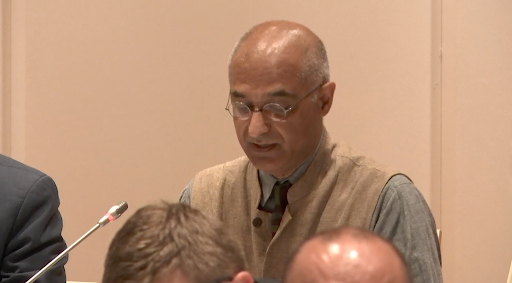
Image: Zia Mian, Princeton University
In addition, some comments from civil society were made, including Princeton University, Zia Mian who gave a short history on scientists’ complicity in nuclear weapons and resistance to nuclear weapons use through disarmament and raised the scientists’ possible central and progressive role in this group. IPPNW stated the importance of evidence-based policy making, and highlighted that “we believe it is critical to create an advisory panel of scientists and on the humanitarian consequences and risks associated with it and the requisite humanitarian response.”
Overall, states agreed to create a Scientific Advisory Group which will: “Advise states parties and report regularly on the status and developments regarding nuclear weapons, nuclear weapon risks, the humanitarian consequences of nuclear weapons, nuclear disarmament, and related issues. Also, comprise of up to 15 members and take into account the need for a comprehensive spread of relevant fields of scientific and technological expertise, gender balance, and equitable geographical distribution.”
Intersessional Structure
The issue of formulating an intersessional structure including such as working groups on issues like positive obligations was then discussed. Kmentt highlighted the need to keep a level of flexibility given limited financial and human resources and create focal points on gender and complementarity. Amongst South Africa, Cuba, ICAN, Mexico, Jamaica, New Zealand and Ireland there was discussions about the intersessional structure, including on establishing a coordinating committee, the future location of all meetings to take place in New York to allow participation of “developing” states-parties and equitable participation and continued collaboration between states-parties.
Overall, states agreed to: “establish informal working groups to advance these actions and a committee to coordinate them, including civil society and to meet at least once every quarter. – Informal working groups include: – One on universalization, co- chaired by South Africa and Malaysia; – One on victim assistance, environmental remediation; international cooperation and assistance, co-chaired by Kazakhstan and Kiribati; – And one on the implementation of Article 4, in particular work related to the future designation of (a) competent international authority(ies), co-chaired by Mexico and New Zealand.”
Complementarity with other Treaties, especially NPT
One of the most dishonest but persistent and strident criticisms of the TPNW from states supportive of nuclear weapons has been that it somehow contradicts or undermines other treaties related to nuclear weapons, particularly the nuclear Non-proliferation Treaty (NPT). This criticism was thoroughly and comprehensively repudiated by states parties during the meeting, all of whom strongly support the NPT and are members in good standing.
A discussion of a working paper led by Ireland and Thailand also ensured the complementarity of the TPNW with other disarmament and non-proliferation Treaties. This was done with regard to how the TPNW has been wrongly denigrated by nuclear weapon states and their allies as being oppositional to the NPT. Ireland introduced the working paper with provisions that TPNW is complementary to other disarmament agreements. The primary decision was to assign an informal facilitator/s to look at tangible cooperation between TPNW and NPT complementarity and with other treaties between 1MSP and 2MSP. And also several actions to encourage states parties to advocate complementarity with disarmament and non-proliferation and enhanced cooperation with other international bodies like CTBTO and IAEA on nuclear safeguards and verification. Thailand powerfully stated that “we are committed to doing more and we will continue to do so until the misinformation and accusation against the Treaty has been eradicated and all states are on the right side of history”. States including Philippines, Malaysia, South Africa, Cuba, Mexico, Kazakhstan, Peru, ICAN and ICRC affirmed support of the working paper, with many commenting on the mutual compatibility between NPT (as cornerstone of disarmament) and TPNW and other Treaties and SDGs. Kmentt formally appointed Ireland and Thailand to be informal facilitators on this issue.
This important political work should greatly assist and encourage states not yet parties to engage with the TPNW and broaden the contribution of the TPNW in advancing disarmament.
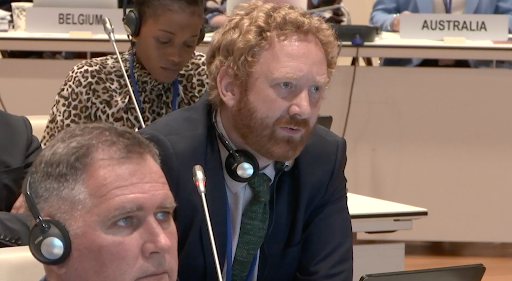
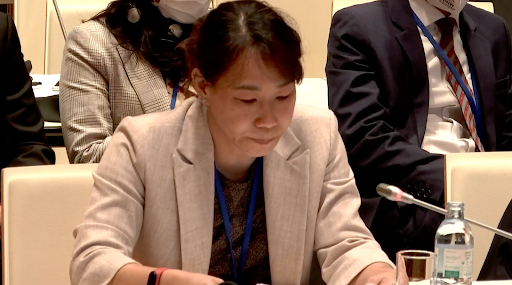
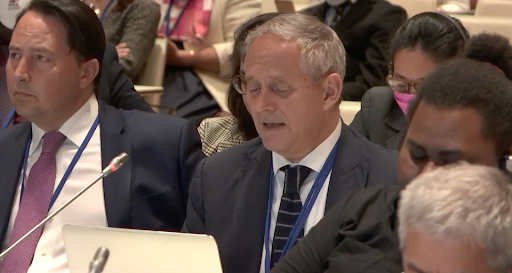
Image: Ireland’s delegation speaking.
Image: Thailand’s delegation speaking.
Overall, states agreed to: “the TPNW builds upon, contributes to and complements a rich and diverse disarmament and non-proliferation architecture and agreed on some steps to highlight this including: – Appointing an informal coordinator to articulate areas for cooperation between the TPNW and Nuclear Non-Proliferation Treaty (NPT) (Action 36) – Cooperate with other international bodies, such as the IAEA and the CTBTO, in order to enhance cooperation (Action 37).”
Gender provisions
The meeting appointed Chile as gender focal point to advance intersessional work to support the implementation of the gender provisions of the treaty.
Preparations for 2MSP 2023
States parties appointed the state-party of Mexico as convenor of 2MSP at New York. Mexico stated its
commitment to continuing inclusive and substantive consultations prior to the meeting, we believe it is the way to make progress with the ambitious mandate that we have adopted in regards to adopting decisions. This current meeting and the humanitarian aspect which was very successful shows more than ever the importance of eliminating nuclear weapons in a world in which nuclear weapons are becoming eminent.”
The representative of Mexico also affirmed a commitment to working groups and continuing the collaborative spirit of the Treaty going forward, especially with Austria who convened the 1MSP and Kazakhstan who will convene the 3MSP. Ambassador H.E. Juan Ramón de la Fuente was then elected President of 2MSP. The venue of the headquarters of the United Nations of New York and dates of 27 November – 1 December 2023 were confirmed. Kazakhstan thanked Austria for convening 1MSP and thanked Mexico, and proposed to work progressively with both for the future.
Image: Mexico’s delegation speaking.
MSP1 process
These processes with delineated actions (50 of them), many with specified timelines, will help to advance the implementation of the treaty efficiently, with a cooperative division of labour, and are realistic in view of the limited funds and capacities of many states parties. These processes also continue the unique and precious openness and inclusivity that have characterised the evolution of the Humanitarian Initiative culminating in the TPNW, with productive and positive partnership between states, international organisations, the UN, diverse civil society organisations, academics and experts. The MSP continued the TPNW’s unique role in the nuclear field in bringing global democracy and humanity to nuclear weapons matters. Diverse civil society organisations had regular and meaningful opportunities to contribute to the discussion and debate during the MSP.
A number of aspects of the process of this MSP and its preparation stand out. The processes were efficient, constructive, cooperative and involving well-planned and inclusive consultations enabling unusually speedy consensus decision-making around final adjustments and adoption. The president of MSP1, Austrian Ambassador Alexander Kmentt, ensured that this valuable political capital of high ambition consensus decision-making remained unbroken through the meeting. As one who has observed other disarmament fora, this is refreshing compared with the degraded lowest common denominator consensus processes one observes with monotonous regularity in NPT and Conference on Disarmament meetings.
Adoption of the Final Document, Declaration and Action Plan
The conference concluded after the adoption of the “Vienna Declaration on the TPNW: Our Commitment to a World Free of Nuclear Weapons”. There was a brief proposal from South Africa that the title should be changed to remove the geographic location of “Vienna ” from the beginning of the title of the declaration to highlight that it was the result of the 1MSP rather than one specific state. Mexico, Ireland, Indonesia, Costa Rica and Kazakhstan appealed to South Africa to leave “Vienna” in the title since similar international declarations do the same and to highlight Austria’s ongoing support in the TPNW. This was followed by the adoption of the very detailed Draft Vienna Action Plan.
The political declaration promulgated from MSP1 is a compelling document. As noted by Ambassador Kmentt, it is very likely the clearest and strongest rejection of nuclear weapons ever issued by a multilateral forum. It describes nuclear weapons as heightening tensions and being used to coerce and intimidate:
This highlights now more than ever the fallacy of nuclear deterrence doctrines, which are based and rely on the threat of the actual use of nuclear weapons and, hence, the risks of the destruction of countless lives, of societies, of nations, and of inflicting global catastrophic consequences.
The Declaration expresses deep concern that:
despite the terrible risks, and despite their legal obligations and political commitments to disarm, none of the nuclear-armed states and their allies under the nuclear umbrella are taking any serious steps to reduce their reliance on nuclear weapons.
Hopefully Australia signing the treaty in the near future will change that!
The declaration concludes:
We will take every path that is open to us, and work persistently to open those that are still closed. We will not rest until the last state has joined the Treaty, the last warhead has been dismantled and destroyed and nuclear weapons have been totally eliminated from the Earth.
Ambassador Alexander Kmentt then closed the conference in a moving speech, stating:
In the situation where multilateralism is very strained… where every indicator of nuclear weapons is pointing in the wrong direction, we point very clearly in the right direction. We have shown our united determination to forge ahead to make real progress on nuclear disarmament and non-proliferation, we have adopted an impressive and ambitious action plan, we have set up an innovative, flexible and inclusive intersessional structure that ensures all states-parties can contribute and achieve maximum results without over-burdening anyone. We have agreed a powerful and clear political declaration, that we do not accept the status quo of the nuclear nuclear status quo of the Sword of Damocles above us. So the path is prepared and now of course the real work starts. So let us continue to work in this spirit and show the world what is possible.
This was met with a large and celebratory standing ovation by all of those in the room. After a long week, the 1MSP was brought to a close with many actions for us in the disarmament and non-proliferation community to look forward to over the next year.
During 1MSP, eight countries announced they are working to ratify the TPNW: Brazil, Democratic Republic of the Congo, Dominican Republic, Ghana, Indonesia, Mozambique, Nepal and Niger.
By the next MSP late next year, we have every right to expect our new Australian government to have signed this landmark instrument which is the one positive light in the face of every measure of nuclear weapons risk currently worsening. We all can play a role in ensuring our new government follows up its welcome first step of joining MSP1 by delivering on its important commitment to join the TPNW.

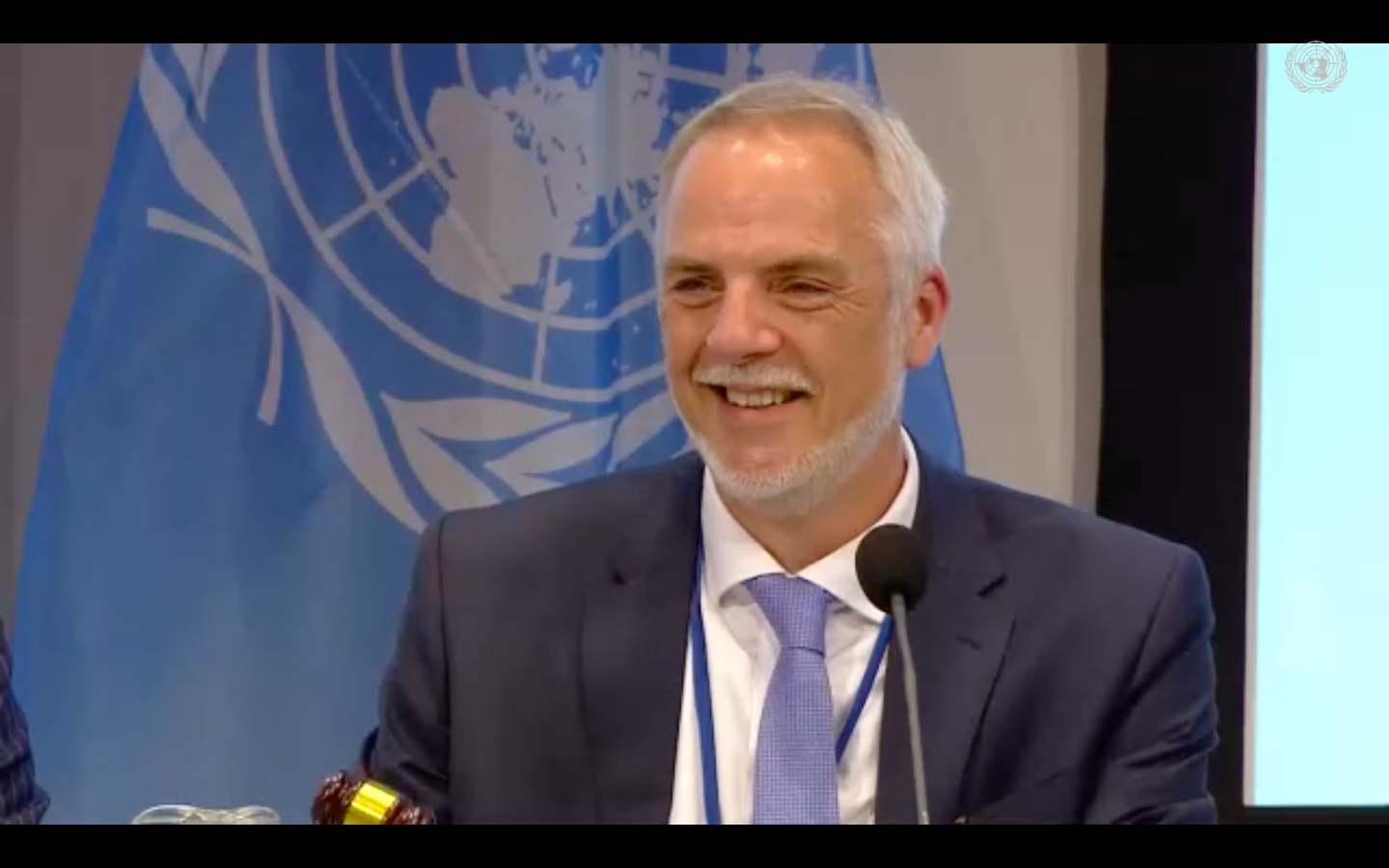
Image: President of the conference Alexander Kmentt closes the first Meeting of States Parties to the TPNW on 23 June 2022.